A subplot is a secondary storyline that runs parallel to the main story and weaves into it: it has its own small arc — beginning, middle, and end — but it's subordinate to the central plot and exists to serve it. A subplot that adds does at least one concrete job — it deepens the theme, complicates the plot, develops a character, or raises the stakes — and it passes a blunt test: if you delete it and nothing changes in the main story, it doesn't belong. In this guide you'll see exactly what a subplot is, what types there are by function, how many you should have, a step-by-step method for writing them, and — the hardest part — how to braid them into the main plot without losing focus.
Most guides explain well what a subplot is and stop there. The trouble comes later, on page 200, with four open threads and no idea which one to advance, which one you haven't touched in three chapters, and which one has spun out of control until it swallowed the main plot. This article is about exactly that: execution. About how to design a subplot so it works, how to weave it into the central story, and how to not lose track of several at once. If you're starting from scratch and still don't have the backbone of your story clear, begin with our general guide on how to write a novel and come back here for the subplot layer.
- What it is: a secondary line with its own arc that leans on the main plot and enriches it. The main plot rules; the subplot serves.
- The deletion test: if you cut a subplot and nothing changes in plot A, it isn't integrated and it doesn't belong.
- It earns its place: every subplot must do at least one job — deepen theme, complicate the plot, develop a character, or raise the stakes.
- How many: two or three usually suffice; up to seven or eight in ensemble novels, epic fantasy, or historical fiction.
- How to stitch them: with braiding — you alternate threads, hand off at moments of tension, and tighten the braid until they converge near the climax.
What a subplot is (and how it differs from the main plot)
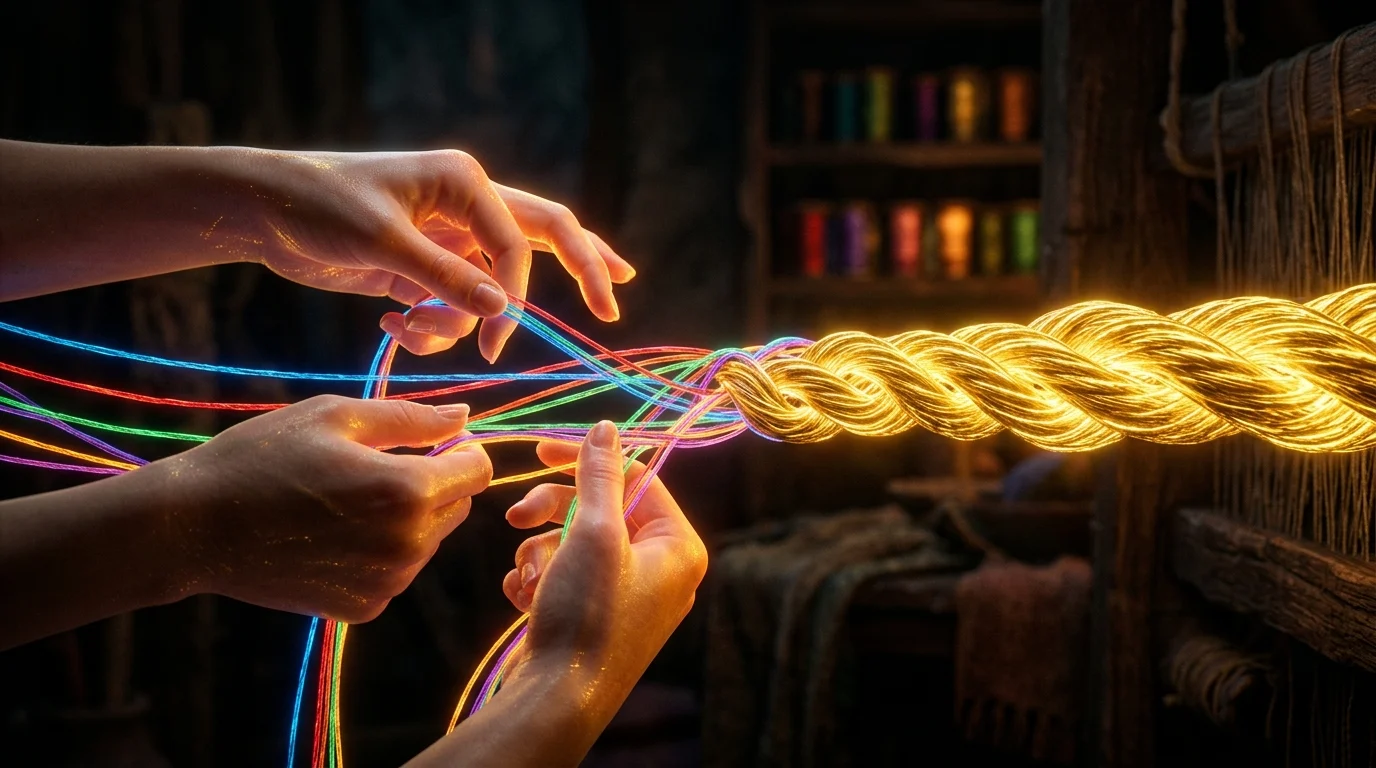
Think of your novel as a rope. The main plot is the thickest strand: the central conflict that starts in act one, escalates across the book, and resolves at the climax. It's the promise you make to the reader and the one you're bound to keep at the end. The subplots are the finer strands that coil around that thick one: secondary storylines, shorter and lighter, that run parallel and weave into the main plot.
The key difference isn't content, it's hierarchy. A subplot has its own mini-structure — a beginning, a middle, and an end — but it's subordinate: it exists to serve the central story, not to compete with it. When a subplot grows so large it eclipses the main one, one of two things has happened: either you've changed stories without noticing, or you have two novels fighting for the same space. That's why the healthy relationship is always the same: the main plot rules, the subplot serves. And the test for whether a subplot is properly tied in is brutally honest: if you can delete it and absolutely nothing changes in the main plot, then it isn't integrated and it doesn't belong.
A subplot isn't a smaller story parked alongside the main one. It's a mirror, a counterweight, or a lever that makes the main story mean more.
What subplots are for: the functions of a subplot
Here's the mindset shift that puts everything in order: stop asking "what other story can I tell?" and start asking "what job does my novel need that this line could do?" A subplot that earns its place fulfills at least one of these four functions:
- It deepens the theme. In line with what Robert McKee argues in Story, a subplot can echo the central theme as a variation — reinforcing it — or contradict it as an irony. Either way it enriches the meaning instead of diluting it: the theme stops being an abstract idea and gets examined from two sides.
- It complicates the main plot. The best subplot doesn't run off on its own: it crosses the A-plot and puts it in a bind. It adds an obstacle, a divided loyalty, or an unexpected consequence that forces the protagonist to decide.
- It develops a character. As John Truby describes in The Anatomy of Story, a subplot defines the protagonist by comparison: a secondary character faces a problem similar to the hero's but solves it differently, and that difference illuminates their traits and dilemmas better than any description.
- It raises the stakes. A subplot can lift the emotional or material cost of the story: it puts something the protagonist wants at risk, widens the world, or gives the reader one more reason to fear for the outcome.
As a background benefit, subplots give texture and rhythm: they let you switch registers and give the reader a breather without pulling them out of the story. But careful: that breather only works if the subplot also does one of the four jobs above. Rest on its own is filler.
Types of subplots by function
You'll find plenty of subplot lists sorted by topic (romance, revenge, mystery…), but that classification doesn't tell you how to use them. It's more useful to sort them by what they do inside the novel. A single line can fulfill several of these functions at once.
| Type | What it does in the novel | Verified example |
|---|---|---|
| Romantic | Adds emotion and humanizes; raises the personal cost | The slow burn between Ron and Hermione in Harry Potter |
| Mirror (thematic) | Reflects the central theme by variation or opposition | Levin and Kitty versus Anna and Vronsky in Anna Karenina |
| Contrast (foil) | Illuminates the protagonist by comparison with another path | St. John Rivers's loveless proposal in Jane Eyre |
| Complication | Twists the main plot and puts it in a bind | Lydia's elopement with Wickham in Pride and Prejudice |
| Secondary character | Adds moral weight and pushes the protagonist to act | Sonya's sacrifice in Crime and Punishment |
| Convergent | Starts separately and collides with the A-plot at the end | Tom's affair with Myrtle in The Great Gatsby |
How many subplots a novel should have
There's no magic number, but there is a useful rule of the craft: most novels do fine with two or three clear subplots besides the main one. It's a comfortable range to follow — for you while you write and for the reader while they read you. Beyond that, every new thread multiplies the risk of losing focus.
The ceiling rises in certain genres. In ensemble novels, in epic fantasy, or in historical fiction, the reader expects a tapestry of parallel lines and you can sustain seven or eight threads. But the real rule is never quantity, it's this: every subplot has to earn its place. Ten well-tied subplots work; two that do nothing get in the way. Before adding a new line, run it through the deletion test and ask which of the four jobs it's doing. If you can't answer, it isn't a subplot yet: it's a loose idea.
How to write a subplot step by step
Designing a subplot isn't improvising a second story; it's making five concrete decisions. Here's the method you can apply to each thread before writing a single scene:
- Define what job it does, in one sentence. "This subplot complicates the main plot by forcing the protagonist to choose between X and Y." If you can't write that sentence, don't go on: the line isn't justified yet.
- Give it its own mini-structure. Every subplot needs its beginning (where and why it starts), its middle (how it complicates), and its end (how it closes). It doesn't have to take up much space, but it does need the shape of an arc, not a loose drip.
- Anchor it to a character. Subplots live in people, not concepts. Decide who embodies it and what that person wants. A good shortcut is to cross it with a secondary character with a life of their own, not a casting function.
- Mark the connection point with the A-plot. Every subplot needs at least one point where it genuinely touches the central line: a shared character, a consequence that splashes onto the main plot, a decision that changes its course. Without that crossing, you have a parallel story, not a subplot.
- Decide where it converges. Subplots usually resolve before or during the climax, so they add momentum to the peak instead of letting the air out after it. It's not an unbreakable law — closing a thread in the resolution or the epilogue can be a legitimate choice — but as a default it works very well.
Fill this in for each thread before weaving it into the manuscript:
- What it contributes: the concrete job, in one sentence (theme / complication / character / stakes).
- Character who embodies it: who and what they want.
- Arc: beginning → middle → end.
- Connection point(s) with the A-plot: at least one, real.
- Where it converges or closes: approximate chapter, near the climax.
- Deletion test: if I remove it, what breaks in the main plot?
How to weave subplots without losing focus
Designing the threads is half the work. The other half — the one that sinks more manuscripts — is stitching them together. The technique is called braiding, and the image is literal: you braid a rope by alternating the strands, handing off from one to the next. When the main plot reaches a moment of tension, you cut and hand the turn to a subplot; the reader is left hanging on the first while the second advances. That relay is what keeps the pages turning.
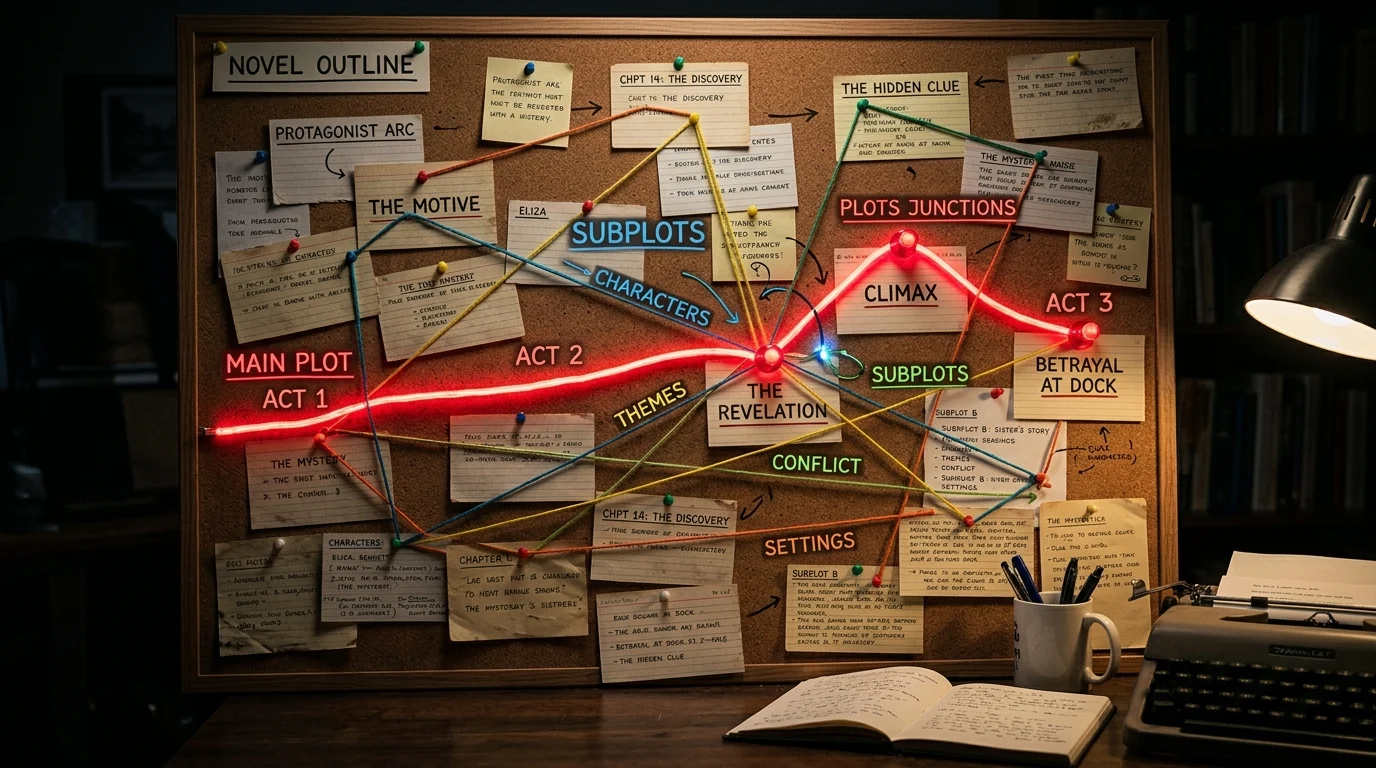
The key is the braid's progression: at first the threads run separately and, as the novel advances, you bring them closer until they converge near the climax. A subplot that seemed to go its own way in act one should, by act three, be colliding head-on with the main plot. To manage it, it helps to think in terms of a subplot map: a central line with the parallel threads drawn over it and the points where each one crosses the A-plot marked. That visual board tells you at a glance which thread you've been neglecting and where you need to make them meet. A good place to lay it out is your outline, and the split of peaks and valleys fits naturally into a three-act skeleton.
The opposite danger also exists: the thread you forget. A subplot you open with force in chapter 3 and don't touch again until chapter 25 leaves the reader feeling let down, and those loose ends are one of the most common causes of plot holes in long novels. Practical rule: if a subplot matters, don't let it vanish for more than three or four chapters without at least a nod that reminds the reader it's still alive.
Losing track of a thread?
When you've got several subplots open, ask Aura about a specific plotline, character, or thread and it pulls the relevant passages from your own manuscript so you can pick up right where you left off.
Write in ScriptumExamples of subplots in famous novels
The best way to internalize all this is to see how the greats pulled it off. Notice one thing common to every example: in none of them does the subplot go its own way; it always touches the main plot and, almost always, pushes it toward its resolution.
| Novel | Subplot | What it gives the main plot |
|---|---|---|
| Pride and Prejudice (Austen) | Lydia's elopement with Wickham | Darcy's secret intervention to fix the scandal proves his true character to Elizabeth and unlocks the central romance. |
| Les Misérables (Hugo) | Marius and Cosette's romance | It drags Valjean to the barricade and to his final test of sacrificial love; Éponine dies taking a shot meant for Marius. |
| To Kill a Mockingbird (Lee) | The mystery of Boo Radley | It works as a thematic mirror of Tom Robinson's trial — both innocent "mockingbirds" — and pays off at the climax when Boo saves the children. |
| The Great Gatsby (Fitzgerald) | Tom's affair with Myrtle | Myrtle's death drives her husband to kill Gatsby: the subplot converges with the A-plot and precipitates the ending. |
| Middlemarch (Eliot) | Lydgate and Rosamond's marriage | Lydgate's crushed idealism echoes Dorothea's; in this ensemble novel the parallel lines comment on one another. |
| The Lord of the Rings (Tolkien) | Aragorn and Arwen's romance | It gives Aragorn an intimate reason to claim the throne, even though it barely appears in the main narrative: it's developed mostly in the appendices. |
The pattern repeats in Anna Karenina: the fertile love of Levin and Kitty contrasts by opposition with the destructive passion of Anna and Vronsky. Tolstoy isn't telling two romances; he's examining a single thesis about love from its two extremes. That's a mirror subplot firing on all cylinders.
How to organize your subplots in Scriptum
Carrying several subplots in your head while writing a long novel is exhausting: who knows what, which thread you've left untouched, in which chapter this line crossed the main one. This is where a tool takes the mental load off you — but it's worth being honest about what it does and what it doesn't.
In Scriptum, the Story Bible holds the consistency sheets for your characters and your world, the scaffolding your subplots stand on: if a thread depends on the relationship between two characters or on a rule of your universe, there it is, pinned down so you don't contradict yourself two hundred pages later. And Aura, Scriptum's AI, has a selective memory of your manuscript: when you ask it about a plotline, a character, or a specific thread, it pulls the relevant passages from your own text. It doesn't do it on its own or "watch" your subplots for you — you're the one asking — but when you return to a line you abandoned ten chapters ago, asking it to remind you of everything about that subplot gives you the context back in seconds instead of forcing you to reread half the book. To place the tool in your workflow, this guide to software for writing novels helps you compare it.

Common mistakes when writing subplots
- The subplot that touches nothing. The cardinal error: an entertaining line that runs parallel but never crosses the main plot. However good it is, if it passes the deletion test, it's a digression dressed up as a subplot.
- The one that eats the novel. A thread that grows until it eclipses the main one disorients the reader: you promised one story and you're telling another. If it excites you more than the central one, maybe it's your real novel; decide, but don't let both win at once.
- The forgotten thread. Opening a subplot with force and not returning to it for twenty chapters leaves a loose end the reader notices. Every living line needs to reappear regularly.
- Too many threads. Five or six subplots without justification don't add richness, they add noise. Cut the ones that do none of the four jobs.
- Closing them all after the climax. Resolving them in a long epilogue, one after another, deflates the ending. Make most of them converge toward the climax and add to it.
- Confusing subplot with filler. A quiet scene isn't a subplot just because it's secondary. If that breather doesn't deepen theme, complicate plot, develop character, or raise stakes, it's padding.
Frequently asked questions
What is a subplot in a novel?
A subplot is a secondary storyline that runs parallel to the main story and weaves into it. It has its own small arc — a beginning, a middle, and an end — but it's subordinate to the central plot: it exists to serve it, not to compete with it. A good subplot deepens a theme, complicates the main plot, develops a character, or raises the stakes. The definitive test is simple: if you can delete it and nothing changes in the main plot, then it isn't integrated and it doesn't belong.
How many subplots should a novel have?
There's no magic number, but as a rule of the craft, most novels do fine with two or three clear subplots besides the main plot. It's a comfortable range to follow for both you and the reader. You can reach seven or eight in ensemble novels, epic fantasy, or historical fiction, where the reader expects a tapestry of parallel lines. The real rule isn't how many, but that each one earns its place: if a subplot does no concrete job in the story, it subtracts instead of adding, however many or few you have.
What is the difference between the main plot and a subplot?
The main plot is the backbone of the novel: the central conflict that starts in act one, escalates across the book, and resolves at the climax. It's the promise you make to the reader. The subplot is a secondary line, shorter and lighter, that leans on the main plot and enriches it. The main plot rules; the subplot serves. If a subplot grows so large it eclipses the main one, either you've changed stories without meaning to, or you have two novels fighting for the same space.
How do you weave a subplot into the main plot?
You weave it with the braiding technique: you alternate the threads as if braiding a rope, handing off from one to the next at moments of tension to keep the reader hooked. Every subplot needs at least one real connection point with the A-plot — a shared character, a consequence that touches it, a decision that changes its course — and, as you advance, the braid tightens until the lines converge near the climax. In Pride and Prejudice, for example, Lydia's elopement with Wickham (a subplot) leads to Darcy's secret intervention, which is exactly what unlocks the central romance.
What are subplots for?
A subplot that earns its place does at least one of these four jobs: it deepens the central theme (mirroring or contradicting it), complicates the main plot by putting it in a bind, develops a character by showing them from another angle, or raises the stakes. Subplots also give texture and rhythm: they let you switch registers and offer the reader an emotional breather between the peaks of the main plot. The key idea is that a subplot isn't filler; it's a mirror or a counterweight that makes the central story mean more.
What types of subplots are there?
The most useful approach is to classify them by function, not by topic. The main ones are: the romantic subplot (adds emotion and humanizes the characters), the mirror or thematic subplot (reflects the central theme by variation or opposition), the contrast or foil subplot (illuminates the protagonist by comparison with another), the complication subplot (twists the main plot and puts it in a bind), the secondary-character subplot (adds moral weight and pushes the protagonist), and the convergent subplot (starts separately and collides with the main plot at the resolution). A single line can fulfill several functions at once.
Conclusion: every thread has to pull
Subplots aren't ornaments or detours: they're the fabric that turns a story into a novel. Used well, they make the theme resonate, give characters volume, and make the main plot weigh more than it would alone. Used badly, they scatter the reader and blur the book's promise. The whole difference fits in a single question you should put to every thread: what job are you doing for the main story? If there's no answer, there's no subplot.
Design each line with its arc, anchor it to a character, stitch it to the central plot at least at one point, and make them all converge toward the climax. And when you've got several threads open and need to recover the context of one without rereading half the manuscript, lean on the Story Bible to keep your consistency and ask Aura about the thread that's slipping away. That's exactly what Scriptum does.