NaNoWriMo (National Novel Writing Month) is the annual challenge to write 50,000 words in November. That's 1,667 words a day, thirty days with no excuses, and a raw draft at the end. This guide gives you the week-by-week plan, the maths you need, the routines that work, and how to use AI as a co-pilot without cheating. If you've always said "one day I'll write a novel," November is the month that day finally arrives.
Every year, more than half a million writers around the world sit down on 1 November in front of a blank page with the same goal: reach the 30th with 50,000 words of novel written. Some make it, others don't. The difference is rarely talent — it's almost always preparation and strategy. This guide exists so you end up on the side that finishes.
What NaNoWriMo is (and why it works)
National Novel Writing Month was born in 1999 from a simple idea: most people who say they want to write a novel never do it because they're waiting for the perfect moment, the perfect inspiration, or the perfect year. NaNoWriMo eliminates that wait and replaces it with a date on the calendar and a concrete number: 50,000 words in thirty days.
The reason it works isn't magic — it's psychological. First, the challenge has a global community moving alongside you: knowing that hundreds of thousands of people are writing at the same time as you is a powerful motivational engine. Second, the time pressure kills the perfectionist: with 1,667 words a day to hit, there's no room to re-read and rewrite every paragraph into exhaustion. The forced pace quiets the inner voice telling you that what you're writing is rubbish. And third, the challenge proves something no theory book can teach you: that you can do it. That you have the story inside you, and it comes out when you sit down and write.
The result at the end of November isn't a publishable novel. It's something more valuable at that moment: proof that you're capable of finishing a first draft. And for most aspiring writers, that changes everything.
The maths of the challenge: 1,667 words a day
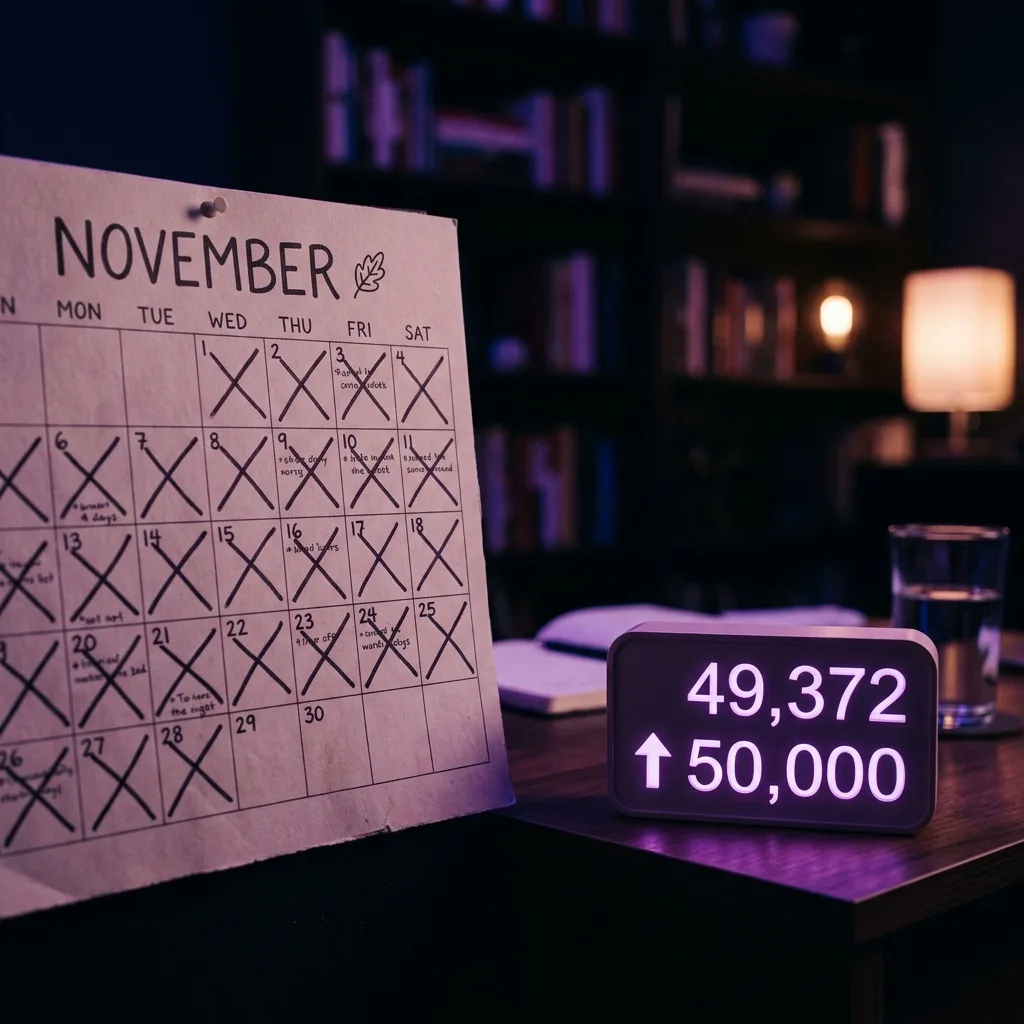
50,000 words ÷ 30 days = 1,667 words a day. At a relaxed writing pace (around 500 words every 30 minutes with no interruptions), that's between one and one and a half hours of writing each day. It's not a sprint; it's a long-distance race at a steady pace.
But life isn't linear, and the NaNoWriMo maths don't have to be either. What matters is your running total at the end of the day, not that each session is identical. Here's how to think about the challenge depending on your style:
- Weekday writer. Write 2,000 words Monday to Friday and keep your weekends free. You'll hit 50,000 with room to spare.
- Weekend writer. If you can only write on Saturdays and Sundays, you need 3,125 words per session. Doable, but demanding.
- Sprint writer. You prefer short, intense bursts. Four 25-minute sprints a day (Pomodoro technique) with 400–500 words each gets you to 1,667 without a problem.
The biggest mathematical mistake in NaNoWriMo is not making up for missed days. Skip one day and write nothing, and you need 3,334 words the next. Miss three days in a row during Week 2 (where most participants drop out), and the debt becomes demoralising. The practical advice: try to build a 500-word cushion on good days so you can absorb the bad ones without panic.
Get ready before November: premise, characters, and structure
NaNoWriMo starts on 1 November, but winners start preparing in October. This isn't about writing the book before the book; it's about not arriving on day one without knowing who your protagonist is or what your story is about.
There are three pillars you should have sorted before the clock starts:
- The premise. A single sentence that says what your novel is about: who wants what, what's stopping them, and what's at stake. If you can't sum it up in one sentence, you don't have a story yet — you have a situation.
- The main characters. Protagonist and antagonist as a minimum. You don't need a twenty-page character sheet: it's enough to know what each one wants, what their biggest fear is, and what contradiction makes them human. If you want to go deeper, the guide on how to create unforgettable characters gives you a complete methodology.
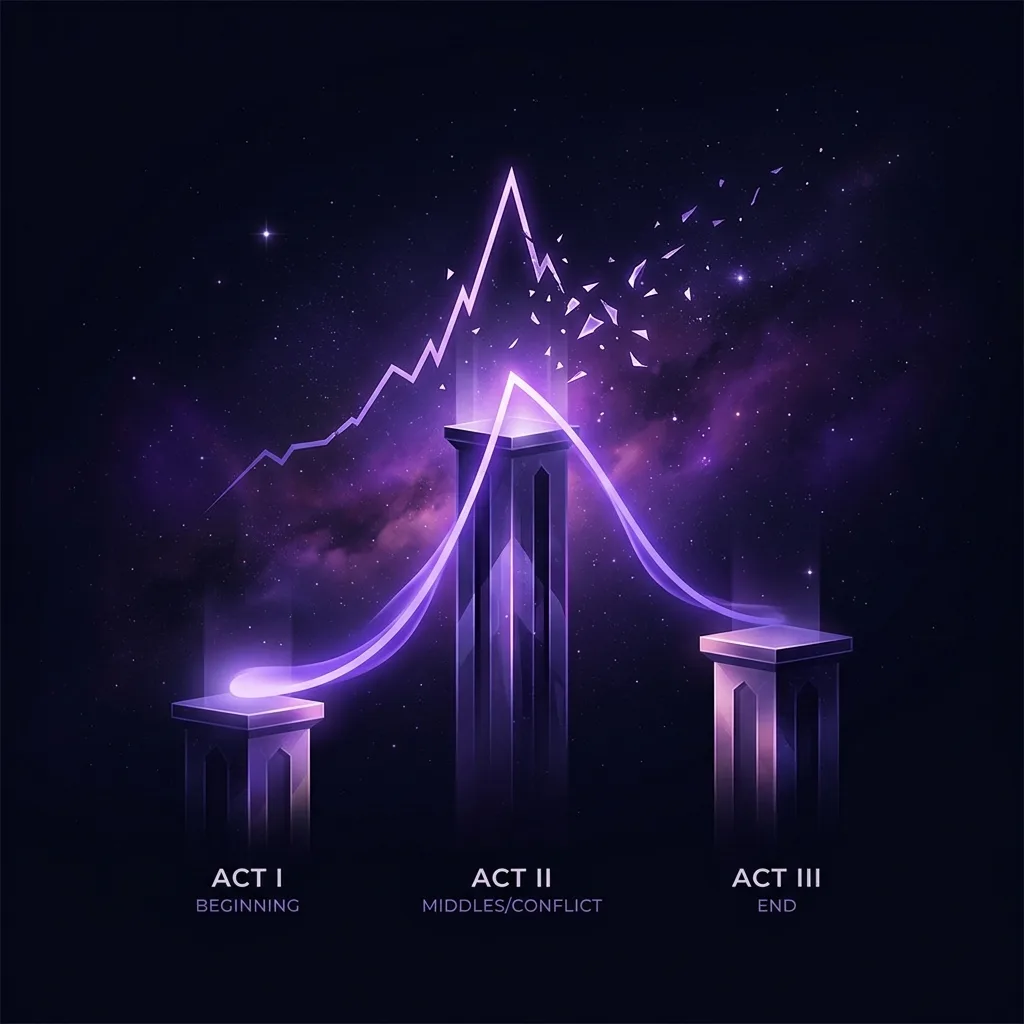
- The structure. Knowing the three main turning points of your story (the inciting incident, the point of no return, and the climax) gives you a map to follow when you get lost. The three-act structure is the most universal framework and the one that works best for a NaNoWriMo first draft.
If your novel has its own world — fantasy, science fiction, historical — spend some time before November laying the foundations of that world too. You don't have to build the full encyclopaedia, but you do need the elements you'll call on in the first few weeks. For that, the guide on how to build a coherent story bible gives you exactly the right framework.
The week-by-week plan (the four weeks of November)
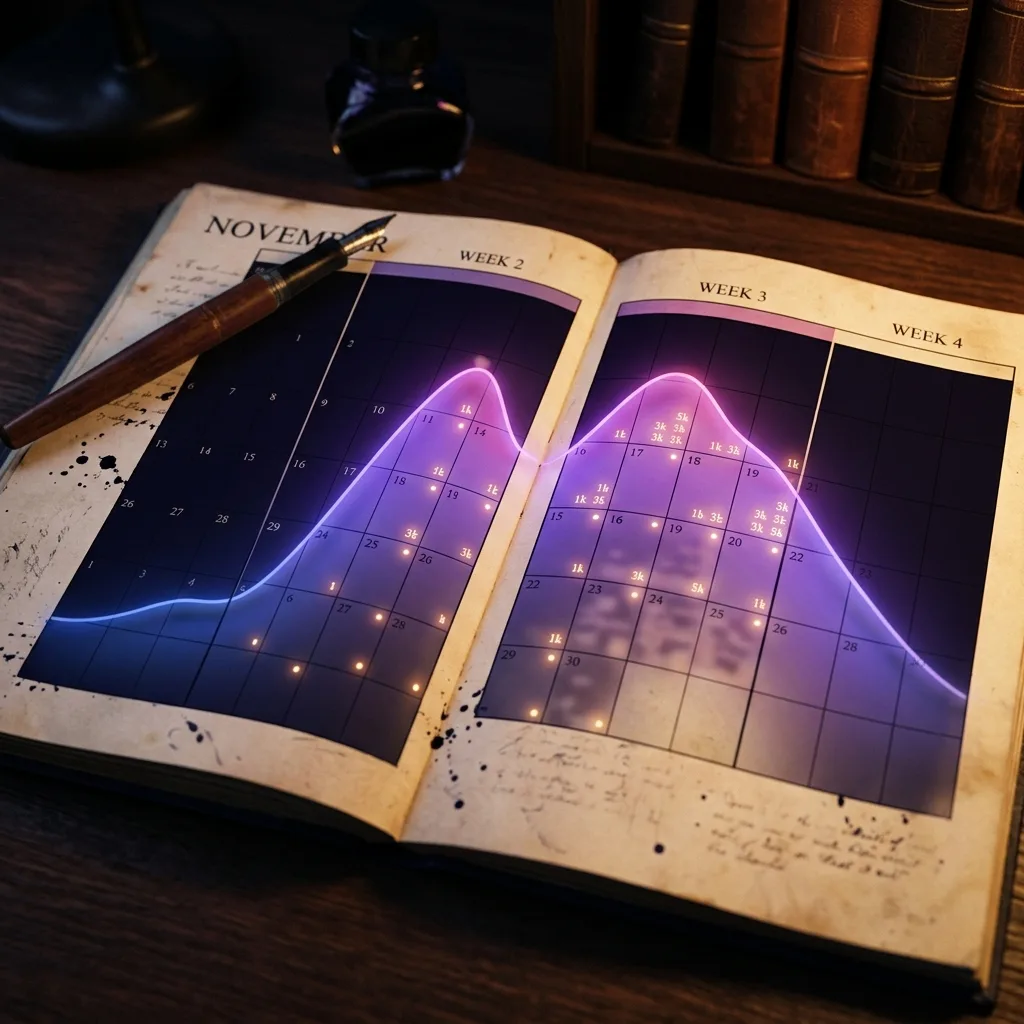
NaNoWriMo isn't a flat month. It has its own rhythms that repeat year after year for almost every participant. Knowing them in advance is the difference between crossing the finish line and dropping out halfway.
Week 1 (days 1–7): the opening euphoria
The first week is the easiest. You have energy, the story feels fresh, and the excitement of starting carries you. Many participants write above their daily quota in these early days. Use it: if you can reach day 7 with 14,000–15,000 words rather than 11,669, you'll have built a cushion that's worth its weight in gold come Week 2. The goal this week isn't just to rack up words — it's to establish the daily writing habit.
Week 2 (days 8–14): the valley of despair
Week 2 is where NaNoWriMo is won or lost. The initial euphoria has worn off, the story no longer writes itself, and you're starting to see all the problems in the draft: weak dialogue, a plot that won't move, characters you don't know where to take. This is exactly the point where most participants quit. What you need to know is that this happens to everyone, including writers with published novels. It isn't a sign that your story is bad — it's the normal crisis of the midpoint. The only solution is to keep writing, even if it's bad. Remember: you can fix a bad draft, but you can't fix a blank page.
Week 3 (days 15–21): the second wind
If you survive Week 2, something shifts. You've got more than 25,000 words behind you, the end is starting to come into view, and a second wind arrives. The story has taken on a life of its own and sometimes the characters do things you didn't plan — things that turn out better than what you'd originally intended. This week the goal is to hold your pace and not look back: no re-reading the early chapters, no editing. Forward only.
Week 4 (days 22–30): the final sprint
Counting down is a powerful motivator. In the last week, most active participants pick up speed again. The final days are often the most productive of the month. If you're on track, write toward the ending calmly. If you're behind, this is the moment for aggressive sprints: 1,000-word sessions in 45 minutes with every ounce of concentration you have. The finish line is close.
How to keep pace without stalling

Your daily routine is the real engine of NaNoWriMo. Not inspiration, not mood, not waiting for the muse to show up. A solid writing routine is what separates those who finish from those who don't.
These are the principles that make the biggest difference:
- Same place, same time. The brain learns through repetition. If you write every day at 7 a.m. at your usual desk with your usual coffee, your brain learns that moment is "writing mode" and the transition becomes automatic.
- Eliminate friction to the maximum. Document open the night before, phone in another room, notifications off. Every obstacle between you and the first word is a potential excuse.
- Kill the perfectionist. The biggest enemy of NaNoWriMo isn't a lack of time — it's compulsive revision. Always write forward. If a scene comes out badly, type "[FIX THIS]" and move on. December exists for corrections.
- Leave the thread dangling. Hemingway said he stopped writing when he still knew what came next. It's the best antidote to the blank page the following day: end each session in the middle of a scene, not at the end of a chapter.
- Don't re-read what you've written. Going back over previous chapters is perfectionism's favourite trick, disguised as productivity. Once it's written, you don't go back. Forward only.
If the block still shows up despite all this, the article on common writing mistakes beginners make has a specific section on why we stall and how to get moving again without losing the thread.
Inspiration exists, but it has to find you working. In NaNoWriMo, the work is showing up to the words every day — even the days when the words don't want to come on their own.
Write faster with AI: Scriptum in your NaNoWriMo
Using artificial intelligence in NaNoWriMo is a topic that stirs debate, and rightly so. If you use AI to generate text that you then count as your own, you're cheating yourself. The challenge is yours. But there's a way to use AI that isn't just legitimate — it can be the difference between finishing and giving up.
The most common problem in NaNoWriMo isn't running dry on initial inspiration; it's losing coherence from week two onwards. You're 20,000 words in, your characters have evolved, the plot has taken turns you hadn't anticipated, and you can no longer quite remember what eye colour you gave the secondary character in chapter four, or the name of the town where the flashback scene took place. Re-reading the full draft to check costs you time you don't have. And those kinds of inconsistencies, if they pile up, break the flow and the rhythm.
This is where Scriptum Memory comes in. As you write, Scriptum builds an active record of your novel: who your characters are, what their relationships are, what events have happened and in what order, what elements of the world you've established. When you're in chapter 18 and need to know whether your protagonist already knew that character in the market scene, you don't have to re-read anything — Scriptum tells you instantly. That isn't writing for you; it's removing a massive source of friction that, in November with a word counter bearing down on you, can be fatal.
If you want to understand how AI can act as a co-pilot without taking away your voice, the article on ChatGPT for writing novels and why it falls short explains exactly what a specialised AI writing tool can do that a generic chat tool cannot. You'll also find in AI prompts for writing fiction a practical guide to framing requests to the AI so you can unblock scenes without the result sounding like it was written by a machine.
In short: AI in NaNoWriMo isn't a shortcut — it's a co-pilot. You bring the story, the characters, and the creative decisions. The tool helps you not lose the thread and keep going when you get stuck. It really is that simple.
December: what to do with the draft
You reach 30 November. You've hit 50,000 words (or you're close). The nanowrimo.org counter congratulates you. And then the question no one prepares you to answer appears: now what?
The first thing to do in December is not touch the draft. At least one or two weeks. Temporal distance is the most powerful tool in revision: after a month of writing in frenzied mode, your brain needs time to forget what you meant to say and see only what you actually said. Without that distance, you revise with the eyes that wrote it, not with a reader's eyes.
When you return to the draft with fresh perspective, revision has distinct phases. Don't start by fixing commas — start by reviewing the structure. Does the story make sense? Do the character arcs close? Are there scenes that add nothing? Only when the architecture is sound do you drop down to the level of prose. The complete guide on how to self-edit your novel gives you the step-by-step method for transforming that raw draft into something publishable.
And if the novel didn't reach 50,000 words or ended up incomplete, that isn't a failure either. If you have 30,000 more words than you had on 31 October, the challenge did its job. NaNoWriMo isn't a pass-or-fail exam — it's an accelerator that gets you out of inertia.
Conclusion: 30 days that change how you write
NaNoWriMo doesn't make you a writer. You already are one if you write. What the challenge gives you is thirty days with no excuses, a community moving alongside you, and irrefutable proof that you can finish what you start.
What you learn in November isn't just writing technique — though that too: you learn that you can sit down at the page even when you don't feel like it, that a bad draft is better than no draft, that consistency generates more pages than talent, and that the story you've been thinking about writing for years has a better chance of existing than you thought.
That's priceless. And that lesson doesn't disappear in December. It stays with you in every novel you write after.
If you want to arrive in November with the best tools available, Scriptum is built for exactly this: writing long novels with coherence, with AI as your co-pilot, and without losing your voice in the process. All included for €7.99/month.
Frequently asked questions
How many words do you have to write for NaNoWriMo?
The official NaNoWriMo goal is 50,000 words in the 30 days of November — that works out to 1,667 words a day, roughly two and a half pages at a normal pace. The novel doesn't have to be finished at 50,000 words; many first novels need more, but that threshold is what the challenge sets as the target and what earns you the title of "winner".
Can you really write a novel in a month?
A first draft, yes. Thousands of writers do it every November. What you can't produce in a month is a finished, publishable novel: the raw draft needs months of revision and editing before it can become a book. But what the challenge does achieve is making the book exist — moving it from the idea in your head to the manuscript on the desk, which is the hardest step for most writers.
Do you need to plan ahead, or can you improvise (plotter vs pantser)?
Both approaches work. Plotters tend to feel more at ease because they have a roadmap for Week 2. Pantsers start with more energy but can get stuck in the middle. The most recommended middle ground is to be a "plantser": work out the premise, main characters, and the three key turning points without mapping out scene by scene, and let the story breathe inside that skeleton.
When does NaNoWriMo take place?
The official NaNoWriMo takes place every year throughout November, from the 1st to the 30th. The organisation (nanowrimo.org) opens registration in October. There are also two spin-off events called Camp NaNoWriMo, held in April and July, with customisable goals and a more flexible format.
Is a NaNoWriMo draft good enough to publish?
Not directly. A NaNoWriMo draft is, by design, fast and unpolished — repeated scenes, weak dialogue, unresolved plot threads, and that's exactly what a first draft should be. After the challenge comes revision and self-editing, which transforms that draft into something publishable. Many published novels started as NaNoWriMo drafts, but none of them skipped several rounds of editing.
Can I use AI during NaNoWriMo?
Yes, but thoughtfully. Using AI to generate text you then count as your own goes against the spirit of the challenge. What makes sense is using it as a co-pilot: to unblock a scene when you're stuck, to generate ideas you then develop, or to keep track of story and character consistency without having to re-read the whole draft. Tools like Scriptum are designed to boost your writing without replacing it.