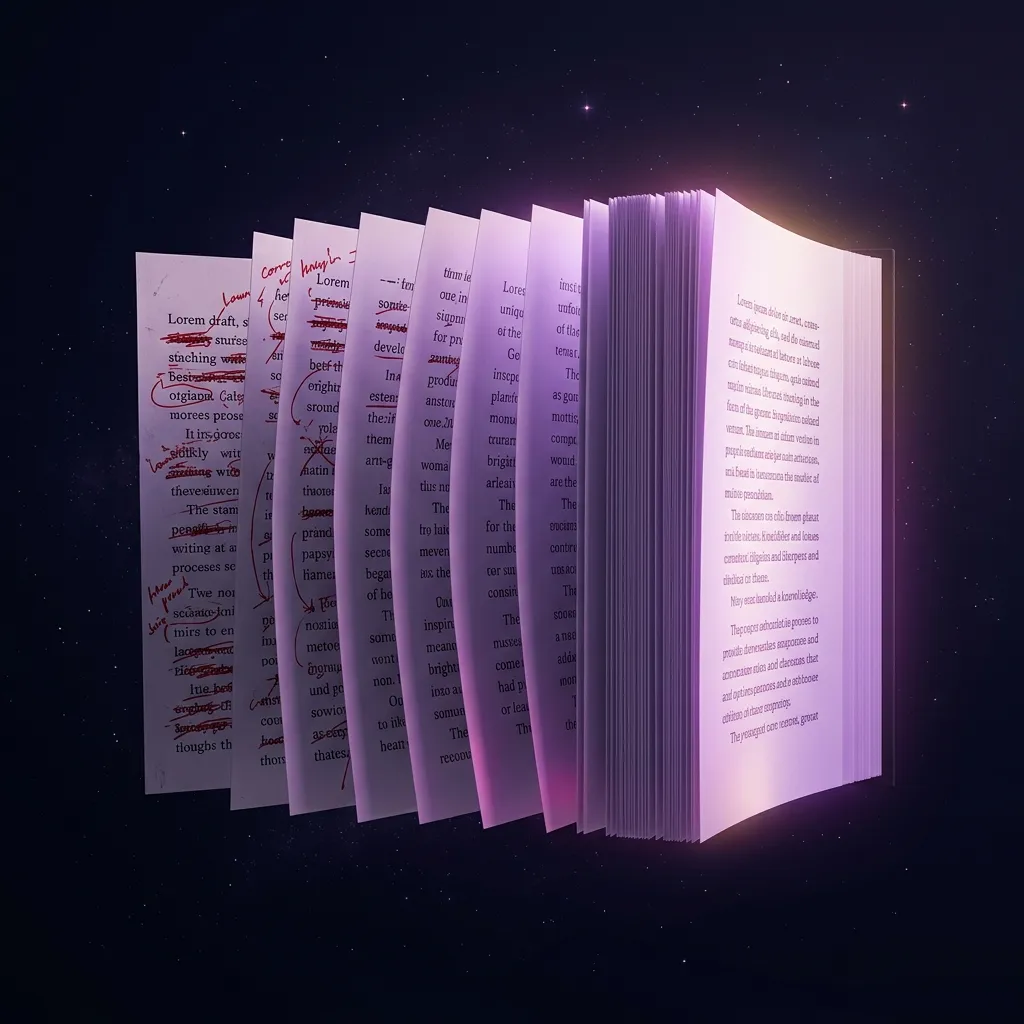
Editing a novel isn't a single pass: it's several, and they work in levels. First the structural edit (plot, pacing, arcs), then the line edit (sentence by sentence), and finally the copyedit (spelling and punctuation). Before you start, let the manuscript rest so you can gain distance. Self-editing doesn't replace a professional editor, but it leaves the text vastly better — and it's the step no writer can skip.
You've typed THE END on your manuscript. Congratulations, genuinely: most people who start a novel never reach that point. But here's what almost nobody tells you: the finished draft is not the novel. It's the raw material of the novel. What separates that pile of pages from a book someone actually wants to read is editing. And editing isn't "giving it a quick once-over": it's an ordered process, done in levels, in cold blood, with method. If finishing the draft is half the work, self-editing it is the other half. This guide explains how to edit a novel step by step, without shortcuts.
Finish the first draft… then let it rest
The first rule of editing is counterintuitive: don't edit while the ink is still warm. The day you finish the draft you're too close to the text. You know every decision, every intention, every nuance you wanted to convey, and your brain fills in the gaps automatically. You read what you meant to write, not what you actually wrote.
That's called a lack of critical distance, and it's the self-editor's biggest enemy. If you dive into editing the same day you finish, you'll be unable to see the plot holes, the repetitions, or the sentences that don't work. You're too in love with your own work — and that's human.
The solution is simple and demands patience: save the manuscript and don't open it for at least four weeks. The longer, the better. Before you start editing it also helps to make sure the draft is truly done; if you're still struggling to cross the finish line, first learn how to finish your novel and only then think about editing it. During the rest period, start another project, read other authors, or simply disconnect. The goal is to come back to the text the way a reader who didn't write it would: able to see what's wrong.
The three levels of editing
The most common mistake when self-editing is trying to fix everything at once: correcting a comma, rewriting a scene of dialogue, and questioning an entire chapter all in the same read. That's no way to move forward. Professional editing works in levels, from large to small, and for a reason of pure logic: there's no point polishing the punctuation in a scene you're going to cut entirely when you fix the structure.
There are three levels, and they're done in this order:
1. Structural edit (developmental edit)
This is the edit of the foundations — the first one you do. Here you're not looking at sentences: you're looking at the whole novel as architecture. You ask the big questions:
- Does the plot hold up? Are there holes, loose ends, events that go unexplained or that resolve too easily?
- Does the pacing work? Is there a sagging middle that collapses? Chapters that could be cut? An action scene that arrives too late, or a stretch that suddenly rushes?
- Do the character arcs close? Does the protagonist change? Are their decisions consistent with what we know about them?
- Do the subplots earn their place? Or is there one you could cut without the story suffering?
The structural edit is the hardest because it can force you to rewrite entire chapters, move scenes around, or cut a secondary character. But it's also the most valuable: fixing the structure improves the novel more than a thousand well-placed commas. If you discover the foundation is cracked, working through the three-act structure with its plot points is usually the fastest way to see where everything falls apart.
2. Line edit
Once the structure is solid, you come down to the sentence level. The line edit works paragraph by paragraph, sentence by sentence, so the prose is clear, fluid, and has your voice. This is where the text goes from "it works" to "it reads well." What you're looking for:
- Clarity. Does it land on the first read? Convoluted sentences, endless subordinate clauses, and ambiguities get caught here.
- Repetitions. The same word three times in a paragraph, the same sentence structure over and over, the same gesture in every scene of dialogue ("smiled," "nodded," "sighed").
- Filler words and padding. Adverbs ending in -ly everywhere, "that," "but," "then," "suddenly," "began to" — words that add nothing and dilute the force.
- Show, don't tell. Sentences that summarize an emotion ("she was sad") instead of showing it through action and detail. This is where you apply the show, don't tell principle so the reader feels rather than being informed.
- Weak verbs and passive voice. "Made a movement" versus "moved"; "was seen by" versus "they saw him." The precise verb always wins.
This is the longest and most painstaking level, but also the most satisfying: you watch your prose gain muscle line by line.
3. Copyedit
The final level, and only once the other two are done. The copyedit deals with the rules: spelling, punctuation, and typography. It doesn't touch content or style; it touches the formal correctness of the text.
- Spelling. Errors, misspellings, treacherous homophones (their/there/they're, its/it's, affect/effect).
- Punctuation. Commas that change meaning, misused semicolons, em dashes used correctly and consistently (— not a hyphen).
- Typography. Italics for thoughts and foreign terms, consistent quotation marks (double or single, but pick one), double spaces, hyphens versus em dashes.
This is the level where the lack of an external eye shows most, because your brain automatically corrects typos as you read. This is exactly where a professional editor makes the biggest difference, and where self-editing has its clearest limit.

How to gain distance from your own text
Resting gives you distance in time, but there are tricks to force that fresh perspective even within the same working day. The idea is to fool your brain into seeing the text as someone else's. These four actually work:
- Read it aloud. This is the most powerful technique and the most underrated. The ear catches what the eye forgives: sentences that don't breathe, dialogue no human being would ever say, repetitions, broken rhythm. If you stumble while reading, something there needs fixing.
- Change the font and formatting. Switch to a different typeface, size, and line spacing. Your brain memorizes the visual appearance of your pages; by breaking that familiarity, you start actually reading instead of just recognizing.
- Read it on a different device. Send it to your phone, an e-reader, or a tablet. The same text on a different screen feels like someone else's book, and the errors jump out.
- Print it out. Reading on paper with a red pen in hand activates a different reading mode from the screen. Many editors swear they spot three times as many errors on paper.
You don't need all four at once. But combining at least two — say, reading aloud from a printed copy — multiplies what you catch.

Common self-editing mistakes
Self-editing has its own pitfalls, and almost all of them come from the same place: the difficulty of looking at your own work with cold eyes. These are the mistakes that ruin the most manuscripts.
Editing while you write. This is the cousin of the mistake that kills first drafts. If you start rewriting new scenes while editing, you mix two opposite mental modes: the creator's and the editor's. Keep the phases separate. Editing means evaluating and adjusting what exists — not inventing from scratch.
Falling in love with your own sentences. We all have that brilliant line, that metaphor we're proud of, that paragraph that cost us a full day. And very often it's exactly what needs to be cut, because it shows off more than it contributes. There's a classic piece of writing advice for this: "kill your darlings." If a beautiful sentence slows the pace or doesn't serve the story, it goes.
Polishing before fixing the structure. The most costly mistake of all. You spend hours perfecting the punctuation and style of a chapter, and then, when you review the structure, you discover that chapter is unnecessary and cut it. You've thrown all that work away. That's why the order of levels is non-negotiable: structure, line edit, copyedit. Always.
Skipping the rest period. We've said it already, but this is the foundational mistake from which almost all the others grow. Without distance, you edit blind. If you're in a hurry to publish, that hurry will cost you quality. These and other stumbles are part of the list of common writing mistakes beginners make — worth knowing so you can sidestep them before they cost you months.
How Scriptum helps you edit
Editing is still a human decision: no tool decides for you whether your story works or whether that sentence sounds like you. But the right tools make the process far faster and take the mechanical work off your plate. Scriptum supports every level of editing:
- Aura AI for review and suggested rewrites. During the line edit, Aura knows your story and your prose, and can flag repetitions, convoluted sentences, or paragraphs that tell rather than show — plus suggest an alternative rewrite for you to react to. The final call is always yours; Aura gives you the material to make it faster.
- The Editor for your line-edit passes. Focus writing mode isn't just for drafting: for line editing, reading the text clean and distraction-free, paragraph by paragraph, is exactly what you need to catch what doesn't flow.
- The World Bible for consistency. During the structural edit, having all your universe's information — names, dates, character traits, world rules — in one place lets you verify there are no contradictions. If the castle was called Ironhold in chapter three, the World Bible reminds you in chapter thirty.
You can see everything Scriptum includes, starting with Aura AI and the rest of the features, and see how it fits your editing process. It doesn't replace your judgment: it sharpens it.
Frequently asked questions
How many times do you need to edit a novel?
There's no magic number, but you need at least one pass per level: one structural, one line edit, and one copyedit. In practice, most manuscripts go through three or four complete rounds before they're ready. What matters isn't counting the passes — it's making sure each one has a clear, distinct goal. If you edit without knowing what you're looking for in that round, you go in circles without moving forward.
How long should I let my manuscript rest before editing?
At least four weeks, and the longer the better. Resting isn't laziness: it's what gives you back the critical distance you need to read your text the way a stranger would. During that time, don't open the file. If you can, start another project or read other authors. When you come back, you'll see mistakes and opportunities that were invisible the day you wrote THE END.
Can I self-edit my novel without a professional editor?
You can, and you should always do it before anything else: self-editing makes the text much better and is essential. But self-editing doesn't replace a professional editor. Your eyes are too accustomed to your own prose to catch one hundred percent of the errors, especially at the copyediting level. Self-edit thoroughly, and if you're publishing seriously, hire a professional for the final pass.
In what order should I edit my novel?
Always from large to small: first the structural edit (plot, pacing, arcs), then the line edit (sentence by sentence, clarity, repetitions), and finally the copyedit (spelling, punctuation, typography). The reason is pure economy: there's no point polishing the punctuation in a chapter you're going to cut entirely when you fix the structure. Editing in the reverse order is wasted work.
Can AI help with editing a novel?
Yes, as support — not as a replacement. AI is excellent at catching repetitions, convoluted sentences, filler words, and sentence-level clarity issues, and at suggesting rewrites for you to react to. What it can't do is decide whether your story works or give your prose its own voice: that's yours. Use it as a tireless style editor that flags the problem, but always make the final call yourself.
Conclusion: the novel improves in the edit, not in the draft
There's a line many writers repeat that's worth engraving: you don't write, you rewrite. The draft is where the story is born; editing is where it becomes a book. And editing well isn't a question of talent — it's a question of method: letting the text rest to gain distance, attacking the levels in order (structure, line edit, copyedit), and forcing a fresh perspective with tricks like reading aloud or working from a printout.
Self-editing has an honest limit: it doesn't replace a professional editor, especially at the final level. But everything you do yourself leaves the text incomparably better and makes any subsequent professional review cheaper. So be patient, respect the order, and treat your manuscript with the cold eye an editor would bring to it. Editing is the final stage of the journey traced in our complete guide to writing a novel from start to finish; approach it with method, and your novel — and your readers — will feel the difference.