ChatGPT works for writing novels — up to a point. It's excellent for generating ideas, beating the blank page, and answering quick questions. But for sustaining a long novel it falls short: it forgets what happened three chapters ago, it doesn't know your World Bible, it blurs your characters' voices, and it lives in a chat window that is not a writing environment. The problem isn't that it's a bad AI; it's that it's a generalist AI being used for a job that demands context, memory, and control. Here's exactly where it fails — and what you need instead.
Let's be fair before we criticize: ChatGPT is an extraordinary tool. It put artificial intelligence in everyone's hands and, for countless tasks, it's a brilliant copilot. That's why thousands of writers open it every day to ask for a character name, a blurb, or help getting a scene unstuck. And for that, it works. The problem surfaces when you ask it to do something a generic chat was never designed to do: hold the reins of a 90,000-word novel without losing the thread. If you want a panoramic view of all your options, our guide to the best AI tools for writing novels is a great starting point; here we go deep on ChatGPT specifically.
What ChatGPT is actually good for in fiction
Let's start with the positives, because denying them would be dishonest. There are tasks where ChatGPT is a first-rate ally, and it's worth taking full advantage of them:
- Breaking the blank page. An imperfect draft to react to always beats the void. If you're stuck, check out how to overcome writer's block with the help of AI.
- Brainstorming. Names, premises, plot twists, possible conflicts. For opening up a fan of options in seconds, it's hard to beat.
- Quick lookups. "How did a telegraph work in 1890?" or "Give me ten ways to describe fear." Fast answers for specific questions.
- Polishing a standalone paragraph. Paste a passage, ask it to sharpen the prose, and get alternatives back. As a second pair of eyes for something short, it delivers.
See the pattern? Everything ChatGPT does well involves short, self-contained tasks: one question, one answer, one snippet. As long as the work fits in a single brief conversation, it shines. The problem begins when the work is an entire novel — which by definition doesn't fit in one conversation.
Where ChatGPT falls short for long novels
Here's the heart of the article. These aren't purist gripes — they're real limitations that anyone who has seriously tried to write a long book with ChatGPT has run into firsthand.
1. The context window: it forgets your own story
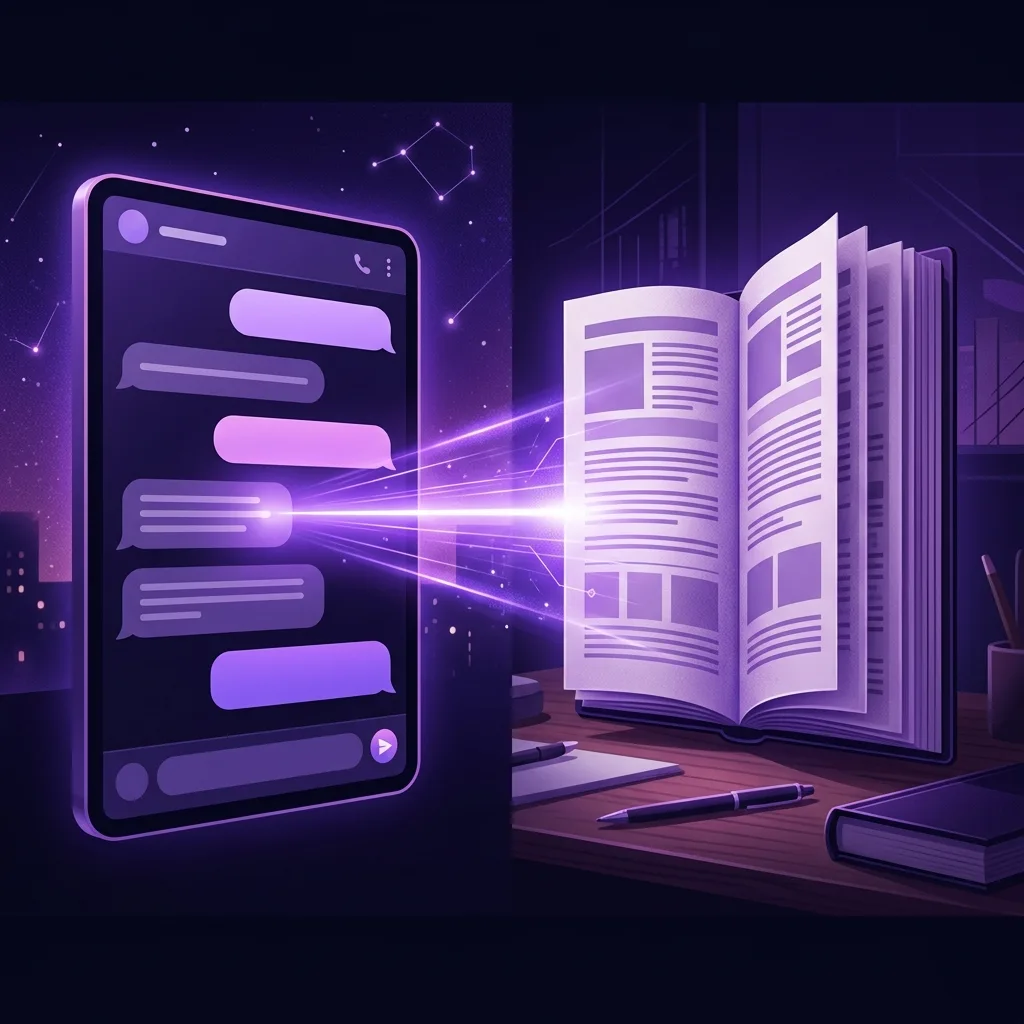
ChatGPT only "remembers" a limited slice of the conversation: its context window. When your novel grows beyond that limit, the early chapters drop out of its memory. The result is the classic disaster: in chapter 14 it changes the protagonist's eye color, resurrects a character you killed off, or invents that the village is by the sea when you established it in the mountains. It isn't lying — it simply no longer has what you wrote earlier in front of it.
2. It doesn't know your World Bible
A serious novel rests on hundreds of details: the exact age of each character, the rules of your magic system, the geography of your world, who knows which secret and since when. That's your World Bible. ChatGPT doesn't have it. Every time you open a new conversation, it starts from zero, knowing nothing about your universe. You can paste it in — but then you spend more time reminding it of your own story than actually writing it.
3. Voice drift: your characters start sounding the same
What makes a character memorable is their voice: how they speak, what they keep to themselves, their rhythm. ChatGPT gravitates toward the center, toward the average of everything it has ever read. Without a fixed record of how each character sounds, their dialogue gradually homogenizes until the gruff mercenary and the cultured duchess speak in exactly the same way. The voice — your most valuable asset — gets diluted into the "ChatGPT flavor."

4. Plot holes and contradictions
Without a holistic memory, ChatGPT can't police your plot's consistency. It won't catch the fact that the weapon appearing at the climax was never mentioned earlier, or that the "three-day" deadline has somehow stretched across two weeks of chapters. In a 100,000-word novel, those holes multiply — and you're the one who has to hunt them all down by hand.
5. Average prose: correctness without risk
The text ChatGPT returns is usually grammatically flawless and emotionally flat. It predicts the next most probable word, and "most probable" is almost never "memorable." Memorable prose breaks rules, surprises, takes risks. By design, a generalist model leans toward the safe and the expected — which is exactly the opposite of what makes a reader unable to put your book down.
6. It's not a writing environment
A novel isn't written in a chat window. You need chapters, scenes, notes, an outline, version control, the ability to search "where did I mention the medallion?" ChatGPT is none of that: it's a conversation box where your manuscript disappears upward into the scroll. Copy-pasting between the chat and your document becomes a job in itself — and every paste is a chance to lose something.
7. Your unpublished work, as someone else's data
On a standard account, what you write may be used to improve the model unless you disable that option. For an unpublished manuscript, that's something you should at minimum decide consciously. Your novel is yours; the tools you use should be just as clear about that as you are.
ChatGPT doesn't write badly. It writes without knowing anything about your novel. And a novel is, above all, everything only you know about it.
Why this happens: generalist, not a novel tool
None of these limitations are "defects" in ChatGPT. They're the logical consequence of what it is: a generalist tool, designed to answer anything for anyone. It can help you with an email, a recipe, or a snippet of code with equal ease. That versatility is precisely what prevents it from specializing in the very specific problem of sustaining a long novel: persistent memory of your story, coherence across hundreds of pages, and a space built for writing.
It's like asking a Swiss Army knife to fell a forest. It cuts, sure — but for that job you want a chainsaw. Not because the knife is bad, but because the work calls for something else.
What a long novel really needs
If the limitations stem from a lack of context, the solution is obvious: an AI that knows your story before it writes a single word. Specifically, a long novel calls for:
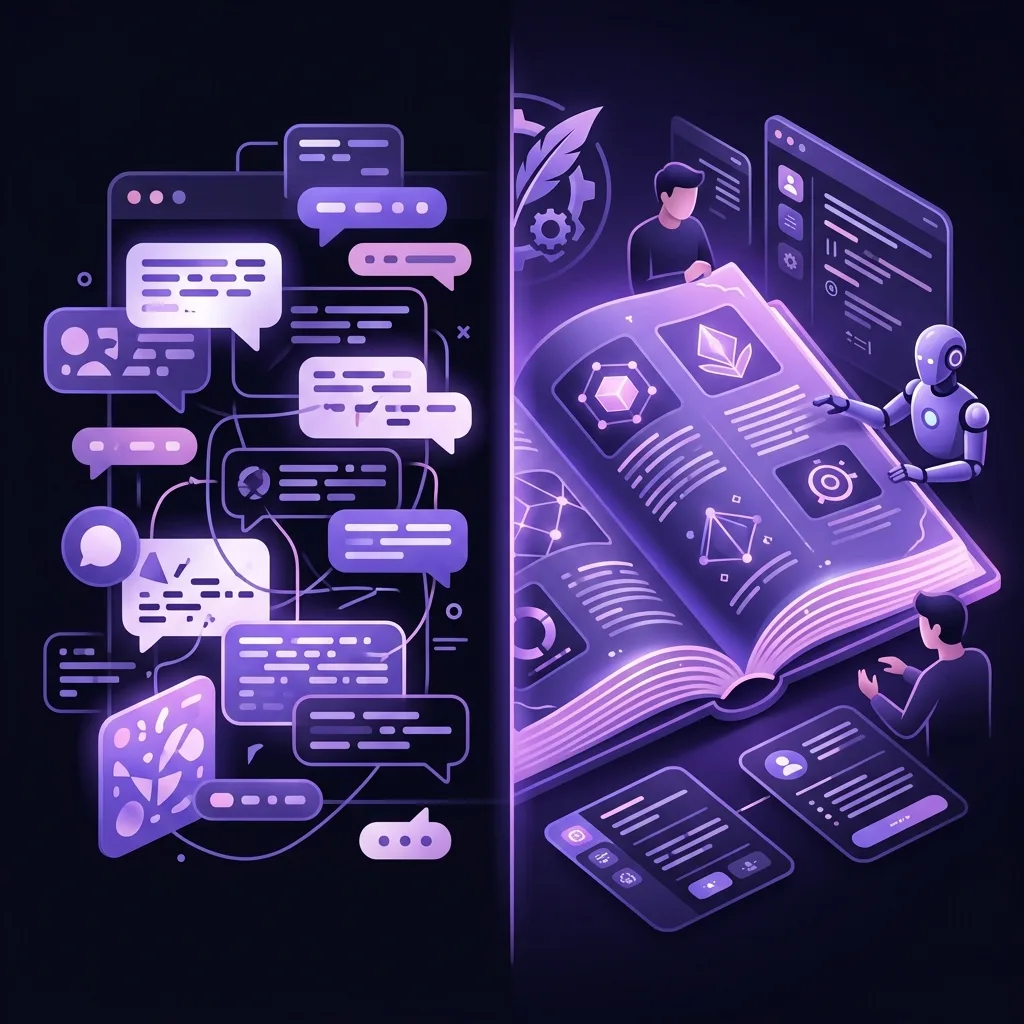
- Scriptum Memory. The AI should read your World Bible, your outline, and your previous chapters, keeping them in view with every suggestion. That way it doesn't continue just any scene — it continues yours.
- Coherence memory. It should remember who's who, what happened, and what rules govern your world, so it doesn't contradict itself at 50,000 words.
- Respect for voice. It should maintain each character's register and your own, rather than flattening everything toward the average.
- A real writing environment. Editor, chapters, outline, notes, and search all in one place — not copy-paste marathons.
- Professional output. Export to EPUB or Amazon KDP when you're done, without wrestling with formatting.
This is exactly what separates a generic chat from a writing studio. And it's the difference that Scriptum is built around: its assistant, Aura AI, doesn't start from a blank page — it starts from your novel. It reads your context and helps you write better what only you could have imagined. If you want a detailed side-by-side of the specialized tools, we break it all down in Scriptum vs Sudowrite vs NovelCrafter.
ChatGPT vs. an AI with your novel's context
Laid out in a table, so you can see it at a glance:
| What a novel needs | ChatGPT (generic chat) | Context-aware AI (e.g. Scriptum) |
|---|---|---|
| Remember the whole story | Only what fits in the conversation | Reads your World Bible, outline & chapters |
| Coherence at 100,000 words | Contradicts itself as it grows | Maintains your world's data and rules |
| Character voice | Tends to homogenize | Respects each character's register |
| Working environment | Chat window + copy-paste | Editor, scenes, outline, and notes |
| Export your book | No | EPUB and Amazon KDP |
| Your unpublished work | May be used for training (depends on settings) | Your novel stays yours |
How to use ChatGPT well (and when to move on)
None of this means deleting ChatGPT. It means using it for what it's actually good at, and making the switch when your project demands it. A simple rule:
- Use ChatGPT for isolated sparks: ideating, quick lookups, getting unstuck, polishing a paragraph. If you want to get the most out of it, learn to give it better instructions with our AI prompts for writing fiction.
- Switch to a specialized tool the moment you start writing in earnest — when you have characters to keep track of, a plot that can't contradict itself, and a growing manuscript. At that point the copy-paste stops being worth it, and you need an environment that remembers for you.
The deeper debate isn't "human versus machine" — we covered that in will AI replace writers? — but choosing the right machine. ChatGPT walks with you through the first steps. A tool with your novel's context walks with you all the way to the last page.
Frequently asked questions
Can ChatGPT write a complete novel?
It can generate coherent text chapter by chapter, but it can't sustain an entire novel on its own. As the story grows, ChatGPT loses track of what happened earlier: it forgets names, changes details, contradicts its own plot. It works for getting started, generating ideas, and unblocking yourself — not for steering an 80,000- or 100,000-word manuscript with coherence.
Why does ChatGPT lose the thread in long stories?
Because of its context window: it only "remembers" a limited slice of the conversation. Once your novel exceeds that limit, the early chapters fall out of its memory and it starts inventing things or contradicting what you've already written. It has no database of your story; each response is a prediction based on whatever fits in its context at that moment.
Is ChatGPT better or worse than a dedicated AI writing tool?
It depends on the task. For a quick question or a brainstorm, ChatGPT is fine. For writing a long novel, you need a tool that actually knows your story: your World Bible, your characters, your outline, your chapters. An AI with Scriptum Memory — which reads all of that before suggesting anything — continues your novel instead of inventing a generic one, and lives inside an editor built for writing, not a chat window.
Does ChatGPT use my novel to train itself?
It depends on your settings and your plan. On standard accounts, what you write may be used to improve the model unless you opt out. If your manuscript is unpublished, it's worth reading the data policy and choosing tools that guarantee your work is yours and doesn't feed third-party model training.
Can I write a bestseller with ChatGPT alone?
Very unlikely. ChatGPT tends toward average text: correct, predictable, and risk-free. A bestseller needs a recognizable voice, imperfect decisions, and an intention the AI simply doesn't have. ChatGPT can help you execute faster, but the story worth telling and the voice that tells it still come from you.
How do I move from ChatGPT to a specialized tool?
Bring what you already have: your notes, your outline, the chapters you've written. In a tool like Scriptum you turn them into a World Bible and a story plan that the AI reads before suggesting anything. From there you write inside an immersive editor, with the AI assisting on your own material, and export directly to EPUB or KDP when you're done.
Conclusion: the right tool for the right job
ChatGPT isn't a writer's enemy; it's a great tool that's sometimes used for the wrong job. For isolated ideas and unblocking, open it without hesitation. But when you sit down to write a real novel — long, coherent, in your voice — you need something that remembers your world, respects your characters, and lives where writing actually happens, not in a chat window that forgets.
Don't ask whether ChatGPT can write your novel. Ask which tool lets you write it better — without losing the thread or your voice. Try it with your own story in Scriptum.