The best AI tools for writing novels in 2026 are Scriptum (AI built into the editor, multilingual and with your story's World Bible), Sudowrite (the reference for English fiction), NovelCrafter (ideal for long sagas with your own API), NovelAI (generation with privacy) and general AIs like ChatGPT or Claude (versatile, but with no memory of your novel). The best one for you depends on your language, your genre, and whether you want the AI inside your editor or in a separate tab.
In just two years, artificial intelligence has gone from curiosity to a working tool on the desk of thousands of novelists. But that explosion brought noise: dozens of apps promising to "write your book in one click," most designed to generate marketing copy in English, not to support the long, demanding craft of writing fiction. In this guide we separate the wheat from the chaff. You'll see an honest comparison of the tools that genuinely help you write a novel, what each one does well, and — most importantly — which one fits the way you work. If you're still in the early stages, you'll want to read our guide on how to write a novel first, from idea to publication.
What a good AI tool for novelists must have
Before looking at names, it's worth knowing what sets a serious tool apart from a simple text generator. These are the five criteria that truly matter when you write long-form fiction:
- That it knows your story. An AI that forgets who your protagonist is between sessions forces you to repeat context endlessly. The good ones keep a "bible" of characters, places, and world rules.
- That it respects your voice. The goal isn't for the AI to write like itself, but like you. Tools that learn your style or work on your text are worth far more than those that impose their tone.
- That it lives where you write. Jumping between your manuscript and a chat tab breaks the flow. AI built into the editor itself is another league.
- That it works in your language. Many tools are designed for English only. If you write in another language, it shows in the results and the support.
- That it's sustainable for your wallet. You'll use it for months. The price and the model (subscription, credits, your own API) matter in the long run.
Quick comparison of the best AI tools for writing novels
This table sums up at a glance what each tool excels at, whether it remembers your novel's context, its real multilingual support, and its rough price as of June 2026.
| Tool | Best for | Knows your story? | Native multilingual | Rough price |
|---|---|---|---|---|
| Scriptum | Novelists who want AI + worldbuilding integrated | Yes: World Bible | Yes | €7.99 / month |
| Sudowrite | English fiction, expanding prose and scenes | Partial: Story Bible | Limited | ~$10–22 / month |
| NovelCrafter | Long sagas, manuscript management | Yes: with your own API | Interface yes; AI by model | ~$4–14 / month |
| NovelAI | Generation with privacy and control | Partial | Limited | ~$10–25 / month |
| ChatGPT / Claude | Brainstorming and one-off queries | No: forgets between sessions | Yes | Free–$20 / month |
| Scrivener (+ AI) | Organizing the manuscript (doesn't generate) | Not an AI | Yes | ~$60 one-time |
Analysis: the tools one by one
1. Scriptum: the AI that knows your novel, in your language
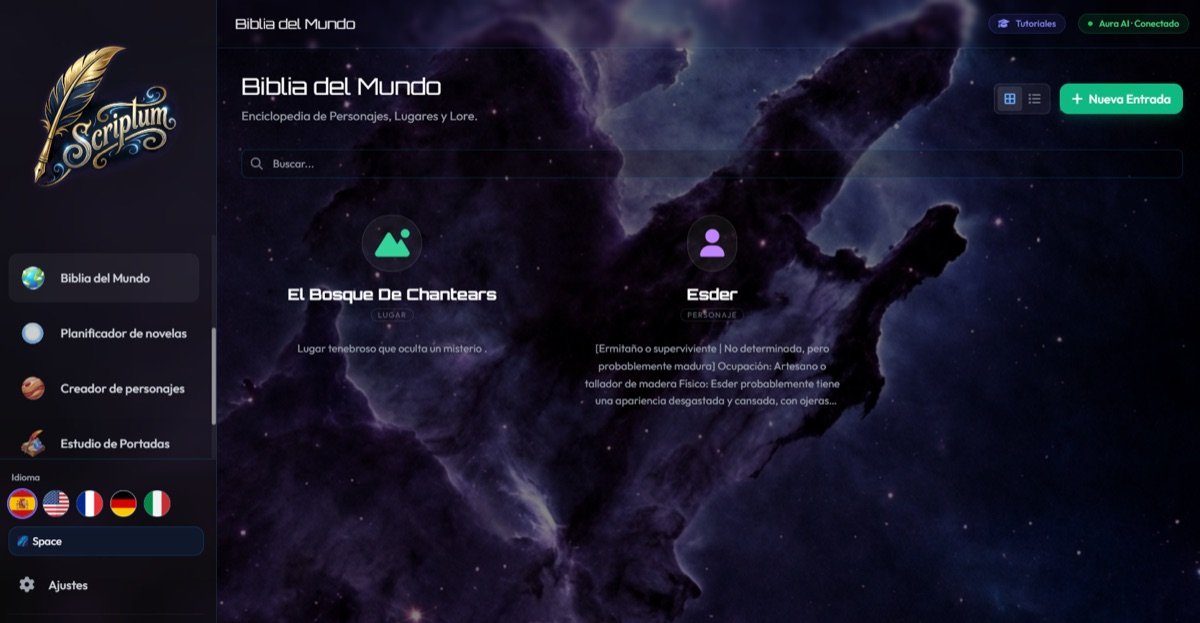
Scriptum is a complete writing studio built from scratch for novelists, not a repurposed text generator. Its difference is Aura AI, an assistant that lives inside the editor and knows your story's context thanks to the World Bible: your characters, your places, and the rules of your universe. That means when you ask it to continue a scene or suggest a twist, it doesn't improvise blindly: it respects what you've already built.
It's also the strongest option if you write in a language other than English, because the interface, support, and assistant are natively multilingual. Everything (immersive editor, World Bible, planner, and Aura AI) is included for €7.99 a month, which places it in the accessible range against its rivals. Its limit? It's focused on the novel and the fiction writer; if you're after mass-producing marketing copy, that's not its turf.
2. Sudowrite: the reference for English fiction
Sudowrite has earned its reputation among English-language authors of fantasy, horror, and science fiction. It shines at expanding scenes, deepening emotions, and proposing continuations that respect the tone. Its Story Bible feature provides context, and tools like "Describe" or "Brainstorm" are very useful. The catch for non-English writers: it's optimized for English and its price climbs quickly with usage. If you write in another language, you'll notice the difference.
3. NovelCrafter: full control for long sagas
NovelCrafter isn't just an AI: it's a manuscript-organization system with a codex (its narrative bible) and a modular approach. Its big strength is that you bring your own API key (OpenAI, Anthropic, open models…), which gives flexibility and lowers the cost of heavy use. In exchange, it demands more technical setup: it's not the friendliest option if you want to just open it and write without thinking about models or keys.
4. NovelAI: generation with privacy
NovelAI bets on unfiltered creativity and author privacy, with models built for narrative and encrypted storage. It appeals to those who want to experiment with long-form generation and keep control of their data. Its interface and approach, however, are less oriented toward "finish your novel in an orderly way" and more toward free exploration.
5. ChatGPT and Claude: versatile, but with no memory of your novel
General AIs are excellent companions for brainstorming and getting unstuck, and they write well. Their big limitation for the novel is structural: they don't remember your story between sessions. Each time, you have to re-explain who's who, which breaks consistency on long projects. They're a great Swiss army knife, but not a writing studio.
6. Scrivener (and other editors): organization, not generation
Scrivener remains a classic for structuring long manuscripts, and many authors combine it with an external AI. It's important to be clear: it's not an AI tool. If you already use it and it works for organizing, great; but for the assisted creative part you'll need to add another piece.
No AI writes your novel for you. The good news is that the best one doesn't even try: it removes the friction so you write more, and better.
Which one to choose for your case?
There's no "best" in the abstract; there's the best one for you. Here's our honest recommendation depending on your situation:
- You write in a non-English language and want everything in one place: Scriptum. The integrated AI, the World Bible, and the native language save you friction and money.
- You write English fiction and live off the prose: Sudowrite, for its quality expanding scenes.
- You're technical and manage a huge saga: NovelCrafter with your own API.
- You only need loose ideas now and then: ChatGPT or Claude on their free or $20 plan.
- You want to organize, not generate: Scrivener, adding an external AI when you need it.

How to get the most out of AI without losing your voice
Whatever tool you choose, the method matters more than the brand. Four rules that separate those who use AI well from those who end up with a soulless novel:
- Write first, ask for help after. Let the AI react to your text, not the other way around.
- Treat its responses as raw material. Never as the final text that goes into your manuscript.
- Rewrite in your own words. What's copied and pasted shows; what's rewritten is yours.
- Declare AI use when publishing. Platforms like Amazon KDP ask for it, and it's the right thing to do.
Frequently asked questions
What is the best AI tool for writing a novel?
There's no single answer: it depends on your language, your genre, and whether you want the AI built into your editor or separate. For an AI that knows your story's context inside the editor itself, Scriptum is the most complete option. For English fiction with a focus on prose, Sudowrite stands out. For very long sagas with your own API key, NovelCrafter is a good choice.
Can AI write an entire novel for me?
It can generate text, but a novel written by AI alone sounds flat and voiceless, and raises quality and rights issues. Serious tools are used as a copilot: they generate drafts, ideas, and alternatives that you direct, edit, and make your own. The creative judgment stays with the author.
Are there AI tools for writing novels in multiple languages?
Yes. Most current models write well in several languages, but few tools are designed for non-English speakers from the ground up. Scriptum works natively in Spanish, English, and more, with interface, support, and AI assistant in your language.
Is it legal and ethical to publish a novel written with AI help?
Using AI as a support tool is legal and increasingly common, just like using a proofreader or an editor. Platforms like Amazon KDP ask you to declare AI use when publishing. What matters is that the result is yours: that you direct, edit, and rewrite, rather than pasting generated text with no intervention.
How much do AI tools for writers cost?
They vary a lot. General AIs like ChatGPT are around $20 a month. Fiction-focused tools range from about $10 to over $25 a month depending on usage. Scriptum sits in the accessible range, with everything included (editor, World Bible, and Aura AI) for €7.99 a month.
Conclusion: the right tool is the one that makes you write more
In 2026 it's no longer about whether to use AI to write your novel, but which and, above all, how. Generic tools give you raw power; specialized ones give you context and craft. If you write fiction and want an AI that knows your story, respects your voice, and lives inside your editor — without jumping between tabs or repeating who's who — that's exactly what we've built with Aura AI in Scriptum. Whatever you choose, remember: the best tool is the one that, by the end of the month, has made you write more of your own pages.
The next step after writing? Learning to take your novel all the way to publication. And if you want to better understand the technology behind these tools, you can check the entry on generative artificial intelligence on Wikipedia.