Yes, you can publish a book written with the help of artificial intelligence on Amazon KDP, and it is perfectly legal in 2026. The only condition is that you declare AI-generated content when you upload the book. Amazon distinguishes between "AI-generated" content (the AI created it) and "AI-assisted" content (you created it with its help): assisted content doesn't even need to be declared. There is no penalty for using AI as a tool; the penalty is for publishing low-quality or duplicate books, or for failing to declare.
It's the question that paralyzes thousands of authors who have discovered what AI can do for their writing: am I risking Amazon shutting down my account if I publish a book written with artificial intelligence? The fear is understandable — too many rumors are floating around — but most of them are exactly that: rumors. In this guide we'll separate what Amazon KDP's real rules say from what the forums claim, so you can publish with peace of mind, and well. And if you're still deciding how to bring AI into your process, start with our guide to the best AI tools for writing novels.
Can you publish a book made with AI on Amazon KDP? The short answer
Yes. Amazon KDP allows you to publish books created with the help of artificial intelligence. There is no rule against it. What the platform requires is transparency: that you declare when content has been AI-generated, and that the result meets its quality and originality standards like any other book.
Put another way: Amazon doesn't have a problem with the tool, it has a problem with abusing the tool. An author who uses AI to write better and faster is welcome. Someone who uses it to flood the store with empty books is not. That difference is everything, and you'll understand it as soon as you see how Amazon classifies content.
AI-generated vs. AI-assisted: the distinction that changes everything
Since 2023, Amazon KDP splits content created with artificial intelligence into two categories. Understanding them is the key to this whole matter, because they determine what you have to declare and what you don't:
- AI-generated content. Text, images, or translations produced by the AI, even if you made changes afterward. If you ask an AI to "write me a chapter" and you paste it with minor tweaks, that's generated content. It must be declared.
- AI-assisted content. Content you created and for which you used AI as support: brainstorming ideas, outlining, proofreading, rewriting your own sentences, or polishing the style. The work is yours; the AI merely helped. It does not need to be declared.
The line that separates them is who makes the creative decisions. If the AI leads and you copy, it's generated. If you lead and the AI executes what you ask of it on your material, it's assisted. The table sums it up:
| Aspect | AI-generated | AI-assisted |
|---|---|---|
| Who creates | The AI produces the content | You create it; the AI supports you |
| Examples | Chapters, covers, or translations the AI generates | Brainstorming, proofreading, rewriting your sentences |
| Must it be declared? | Yes, when publishing | No |
| Is it allowed on KDP? | Yes, by declaring it | Yes, with no paperwork |
The good news for the serious novelist: if you treat AI as a copilot — you decide the plot, the characters, and every scene, and use it to get unstuck or polish — almost all of your work falls into the "assisted" category. And that isn't even declared.

What Amazon KDP asks you to declare (and what it doesn't)
When you upload a book, in the content details stage, KDP asks whether your work includes AI-generated content. Here's what's worth knowing:
- You declare generated content, not assisted. You only have to flag it if the AI produced text, images, or translations that you barely modified.
- It's not public. That declaration is internal information for Amazon; it doesn't appear as a label on your book's listing for readers to see.
- They don't ask for technical details. You don't have to state which tool you used or what percentage of the book was made with AI.
- Images count too. If your cover or interior illustrations were AI-generated, declare them just like the text.
So why do some authors run into trouble using AI on KDP?
Here's where the fear comes from. Yes, there are authors whose books or accounts Amazon has blocked in connection with AI, but almost never for using AI itself. The real causes are usually these:
- Mass publishing. Generating dozens of empty books to flood the store. In September 2023, Amazon limited publishing to three new titles per day precisely to curb this practice.
- Low quality. Unedited, incoherent, or clearly "filler" text. Misused AI produces books that disappoint, and bad reviews sink an account.
- Duplicate content or plagiarism. Books that are nearly identical to one another, or that reproduce existing works. Amazon penalizes non-original content, wherever it comes from.
- Failing to declare generated content. Skipping the declaration when it was due.
See the pattern? None of those problems has anything to do with writing one good novel with the help of AI. They're about spam and laziness. If you publish with quality and honesty, you're not in that group.
How to publish an AI book on KDP without trouble (step by step)
This is the way to do it right, the way that keeps you on the correct side of the rules and, above all, produces a book you'll be proud of:
1. Use AI as a copilot, not as the author
You decide the story. The AI helps you explore paths, break blocks, or describe a scene you have in your head but can't quite put into words. The more you lead, the more your work counts as "assisted" and the more the work is yours.
2. Edit and rewrite thoroughly
Don't publish anything exactly as it came out of the AI. Rewrite it in your voice, cut the generic, add your own details. This is the stage that turns a correct text into your text, and the one that gives the most weight to your authorship.
3. Verify facts and consistency
AI can invent ("hallucinate") facts, names, or events. Check every claim and make sure the characters, the timeline, and the world fit together from start to finish. A well-kept world bible saves you from inconsistencies.
4. Ensure originality
Your book must be unique. Don't publish variations of the same template or text that might match other works. Originality is an Amazon requirement, and it's what makes a reader remember you.
5. Declare honestly when you upload
If there's AI-generated content, flag it on KDP. It takes ten seconds and it lifts the risk off your shoulders. Walk through the full process in our guide on how to publish your novel on Amazon KDP step by step.
6. Take care of the cover and metadata
A good cover, a description that hooks, and seven well-chosen keywords make the difference between being found or not. The quality of the presentation also tells Amazon you mean business.
An AI that genuinely assists you (without writing for you)
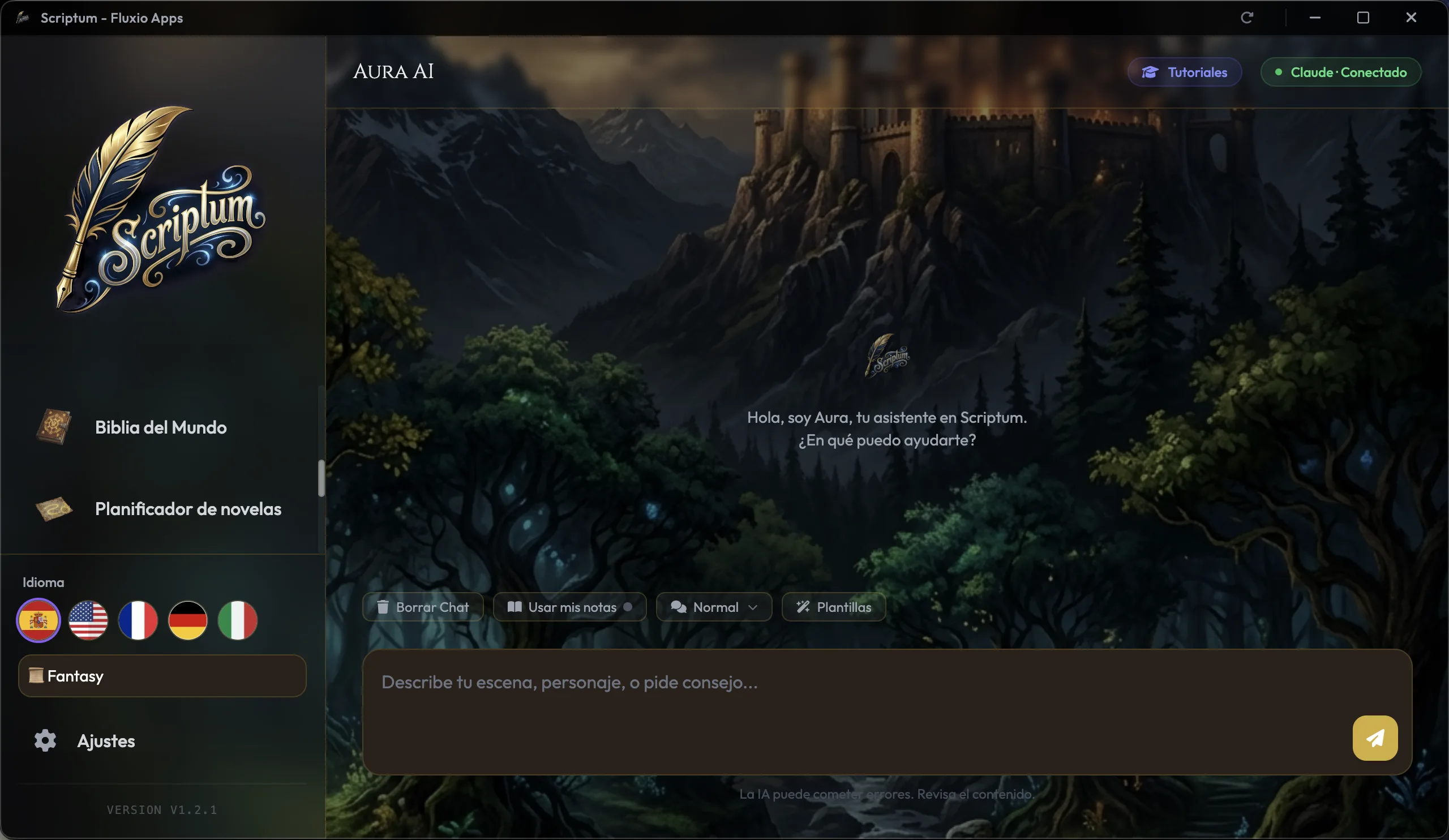
Not all AIs are equal in the eyes of your authorship. A generic chatbot doesn't know your novel and hands you flat text you'll have to redo entirely. A tool built for novelists works on your story, and that keeps the wheel in your hands.
In Scriptum, its assistant Aura AI uses Scriptum Memory, which reads your World Bible, your planning, and your chapter summaries before suggesting anything. It doesn't invent a generic scene: it continues your scene, with your characters and your tone. Its genre templates also let you fill in the details of your own plot, and an internal instruction forces the AI to slow down and respect each language's editorial style. The result: it assists you, but the novel is still yours, decision by decision.
Is it legal? Copyright for an AI-written book
The copyright question worries authors as much as the Amazon one. Here's an honest summary of where things stand in 2026:
- In the United States, the Copyright Office has clarified (guidance from 2023 and its report on the matter in 2025) that purely AI-generated content, without human creative input, cannot be registered. But a work of human authorship assisted by AI is protectable in its human part: your structure, your decisions, your writing.
- In the European Union and beyond, the framework is evolving with the AI Act, focused above all on transparency. Authorship remains tied to the human contribution.
The underlying idea is reassuring: your authorship doesn't live in who types each word, but in the creative decisions only you make. The more you lead and edit, the more solid your ownership of the work.
AI doesn't take your authorship away: it frees you from the mechanical work so you can spend your talent on deciding what truly matters in your story.
Frequently asked questions
Does Amazon KDP ban AI-written books?
No. Amazon KDP allows you to publish books created with the help of artificial intelligence. The only requirement is that you declare AI-generated content when you upload the book and that you meet its quality and originality standards. There's no penalty for using AI as a tool; there is one for publishing low-quality, duplicate, or infringing content.
Do I have to say I used AI when publishing on KDP?
You must declare AI-generated content (text, images, or translations that the AI produced and you barely modified). AI-assisted content (created by you and refined with AI help) does not have to be declared. Amazon does not ask for the name of the tool or the percentage used.
Does Amazon detect whether I used AI in my book?
Amazon does not publish any foolproof AI detector. Its system relies on your declaration during publishing, on quality standards, and on reader reports. That's why the winning strategy isn't hiding your use of AI, but declaring it and making sure the book has real quality and a voice of its own.
Can I use an AI-generated cover on KDP?
Yes. You can use AI-generated images on the cover or interior, but you must declare them as AI-generated content just like the text. Make sure you have the usage rights for the tool you created them with.
How many AI books can I publish on Amazon?
Since September 2023, Amazon limits publishing to a maximum of three new titles per day per account. It's a measure against mass publishing of low-quality content, not a ban on AI. Publishing few, good books is always a better strategy than flooding the store.
Does AI take away the copyright to my book?
The part of your book that results from your human authorship (the structure, the creative decisions, the editing and rewriting) belongs to you and is protectable. The U.S. Copyright Office has clarified that purely AI-generated material, without creative human input, is not registrable, but a work of human authorship assisted by AI can be registered. This is not legal advice: check the official sources in your country.
Conclusion: publish with AI, but publish with judgment
Publishing a book written with the help of AI on Amazon KDP isn't just possible: it's one of the great opportunities for the independent author of 2026. Artificial intelligence is neither the shortcut some fear nor the enemy others paint; it's a tool. And like any tool, the result depends on the hand that wields it.
Declare what you need to declare, take care of quality as if there were no AI involved, and always keep the wheel of your story. Do that and you'll have nothing to fear: you'll have a published book, legal and yours. Ready to write it with an AI that respects your voice? Get started in Scriptum.