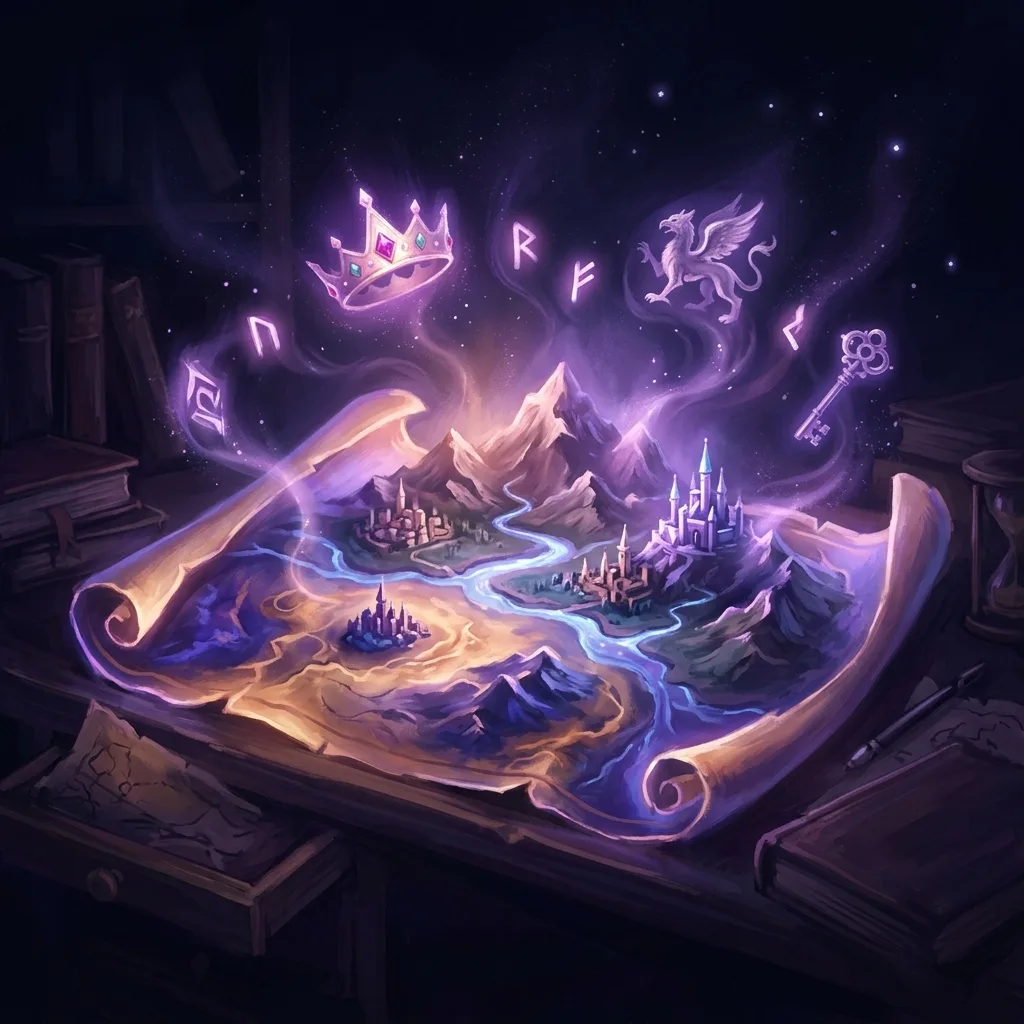
Worldbuilding is the process of building the world where your novel takes place: its rules, geography, history, and cultures. The key isn't to invent everything, but to create just enough for the story to breathe and to keep an iron consistency. Build from inside the plot, show only the tip of the iceberg, and keep the rest as foundation.
There's a magical moment when you read a good fantasy or science fiction novel: you stop feeling like you're reading and start to inhabit a place. The streets have a smell, the laws have logic, the past weighs on the characters. That's no accident: it's worldbuilding done well. And the good news is that it doesn't depend on having a superhuman imagination, but on a method. In this guide you'll see how to build a believable world, which pillars can't be missing and, just as importantly, how to avoid the mistake that sinks most first-time authors: building so much that they never start writing. And if you're taking your first steps, remember this is only one part of the journey: in our complete guide on how to write a novel you have the whole process, from idea to publication.
What is worldbuilding?
Worldbuilding is the process of designing the universe in which your story unfolds: its physical and magical rules, its geography, its history, its cultures, its creatures, and its everyday life. It's not decoration: it's the stage that makes everything that happens to your characters possible, and believable.
The ultimate goal has a name. In 1817, the poet Samuel Taylor Coleridge called it the "willing suspension of disbelief": that silent pact by which the reader accepts your rules (dragons, star travel, magic) as long as you're consistent with them. A well-built world protects that pact. A single inconsistency breaks it, and the reader snaps back to their armchair.
Why a coherent world hooks (and an improvised one repels)
Your reader forgives almost any fantastical premise, but they don't forgive inconsistency. If in chapter 3 magic has a terrible price and in chapter 20 the hero uses it for free to get out of a jam, the promise breaks. Internal consistency is what separates a world that feels real from a cardboard set.
That's why worldbuilding isn't about accumulating data, but about making decisions with consequences. If you decide that magic consumes years of life, that rule must shape the economy, the politics, and people's fear. A good world is a system where each piece fits with the others.
The 5 pillars of worldbuilding
You don't need to develop them all to the same level: go deeper where your story asks for it. But it's worth having thought about them, even if it's one line each.
1. The rules of the world
They're the foundation: how magic, technology, or the physics of your universe work. The novelist Brandon Sanderson formulated a very useful idea (his First Law): "an author's ability to solve conflict with magic is directly proportional to how well the reader understands said magic." Translated: if you want magic to save the hero in the climax, the reader has to know its rules beforehand. Define what can be done, what it costs, and what's impossible.
2. Geography and places
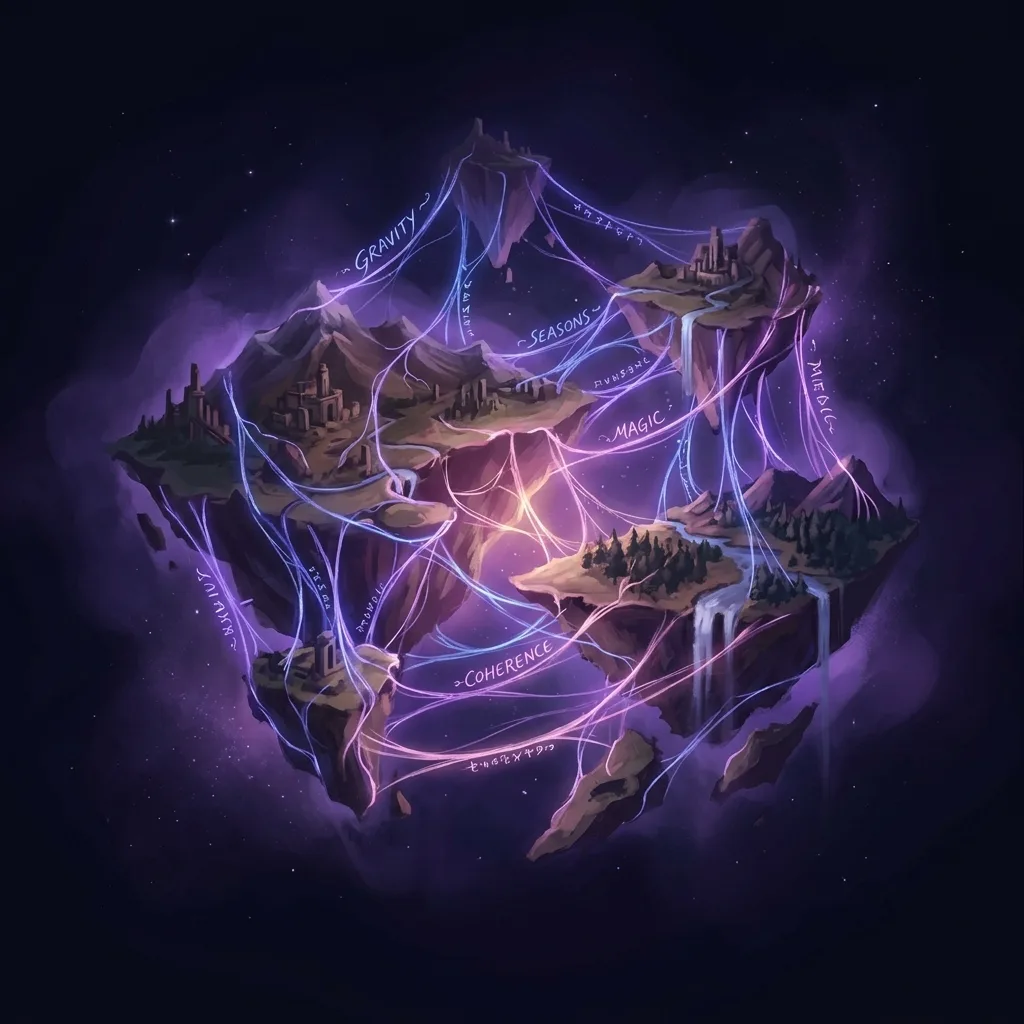
Where everything happens. You don't need a complete atlas: just the places your story steps in and how they relate. A mental map, or a real one, saves you inconsistencies of distance and climate, and gifts you conflict: borders, mountain passes, and ports are factories of narrative tension.
3. History and lore
The past that weighs on the present. A war that ended a hundred years ago, a fallen dynasty, a half-remembered cataclysm: lore gives depth to the world and a wound for the characters to carry. Don't dump it all on the page; let it peek out in legends, ruins, and inherited grudges.
4. Societies, cultures, and power
Who rules, who obeys, what people believe, and what they fear. Politics, religion, social classes, and customs turn an empty stage into an inhabited world. Always ask yourself: how do my world's rules change the way ordinary people live?
5. Everyday life
The small details are what make a world great: what people eat, how they greet one another, what currency they use, what they swear by when they're angry. These touches of texture are cheap to write and ruinously expensive to fake: they tell the reader the world exists beyond the margin of the page.

Mistake number one: over-building
This is where most people fall. They spend months drawing maps, inventing languages, and writing genealogies of kings the reader will never meet… and they don't write a single scene. Worldbuilding becomes a beautiful form of procrastination.
A practical shortcut: build only what your plot needs, when it needs it. Does your protagonist cross a kingdom? Develop that kingdom. Don't they set foot on the southern continent? One sentence is enough. The world grows as the story advances, not before.
How to keep consistency without losing your mind
A novel is written over months, sometimes years. Your memory won't recall a minor character's eye color, the name of a minor city, or the exact magic rule you set in chapter 2. And each lapse is a crack in the consistency you worked so hard to build.
The solution professional authors use is a world "bible": a single source of truth where the sheets for characters, places, rules, and lore live, and which you consult as you write. It's not bureaucracy; it's what lets you write fast and fearlessly, because you know the consistency is stored somewhere that isn't your head.
This is where a tool built for novelists makes the difference. Scriptum's World Bible centralizes all that knowledge (characters, places, organizations, magic systems, and lore) and, most importantly, makes it available to Aura AI, the writing assistant. That means the AI knows your world: you can ask it to explore the consequences of a rule or to warn you if something contradicts what you've already written, without leaving your editor. If you're coming from our guide on how to overcome writer's block with AI, this is the next level: the AI doesn't just unblock you, it also helps you hold the world together.
A 4-step method to start today
- 1. The mother rule. Define the one rule that makes your world unique (how magic works, what technology changes everything). The rest hangs from there.
- 2. The starting place. Develop only the spot where your story begins. The rest, later.
- 3. The wound of the past. Decide which historical event marks your characters' present.
- 4. The living bible. Open a sheet for each element and update it as you write. Let your world grow with your novel, not before it.
A world isn't measured by what the author knows, but by what the reader feels. Build it to breathe, not to impress.
Frequently asked questions
What is worldbuilding?
Worldbuilding is the process of designing the universe where a story takes place: its rules, geography, history, cultures, and creatures. Its goal is to create a coherent, believable setting that supports the plot and immerses the reader.
How much worldbuilding do I need before I start writing?
Just enough to start with confidence: the basic rules of the world, the place where the story begins, and the central conflict. The rest is built as the plot demands it. Building an entire world before writing is usually an elegant form of procrastination.
Is worldbuilding only for fantasy and science fiction?
No. Every novel has a world, even our own. A thriller in a real city, a historical novel, or a contemporary drama also need consistency of places, social norms, and atmosphere. Fantasy and science fiction just make it more visible because they invent the rules from scratch.
How do I avoid consistency holes in my world?
Centralize the information in a single source of truth (a world bible with sheets for places, rules, and characters) and consult it as you write. Most inconsistencies come from relying on memory across months of writing.
Can AI help me with worldbuilding?
Yes, as a copilot: to generate ideas, explore the consequences of your rules, or detect inconsistencies. It works best when the AI knows your world's context. The creative decisions stay yours; the AI speeds things up and reviews, it doesn't decide.
Conclusion: build a world, not an encyclopedia
The best worldbuilding is invisible: you don't notice the scaffolding, you only feel the building. You don't need to invent every river or every god before writing the first sentence. You need clear rules, iron consistency, and a place to keep all of it so you don't lose it along the way. Define the rule that makes your world unique, develop only what your story steps on, and let the rest grow with you. Your reader doesn't want your encyclopedia: they want to inhabit your world for a few hours and believe it completely.
If you want a tool that stores your entire world (characters, places, rules, and lore) and gives it to an AI that writes with you without losing the thread, that's exactly what Scriptum does with the World Bible and Aura AI. To dig deeper into the concept, you can also check the entry on worldbuilding on Wikipedia.