No, artificial intelligence will not replace writers, but it is changing the craft. AI generates text from patterns; it has no intention, no lived experience, and no voice of its own to risk. What is happening is subtler: the writers who learn to use AI as a tool will gain an edge over those who ignore it. The future of writing isn't "human versus machine," but "human with machine."
Every few months, a headline sets off the alarm again: "AI now writes novels," "The end of writers." And if you write, or dream of writing, the question stings: is there any point in carrying on if a machine can generate a book in an afternoon? Let's answer it without panic and without denial, looking at what AI actually does, what it can't do, and what the industry itself is saying. And if you also want to see how AI fits into the real process of writing, our guide to the best AI tools for writing novels will help.
Can AI write a whole novel by itself?
Technically, yes: a language model can generate thousands of coherent words with the appearance of a novel. But "generating text" and "writing a novel" are not the same thing. A novel is a chain of thousands of decisions with intention: what to tell, what to leave out, from which point of view, at what pace, and why. The AI decides none of that; it predicts the next most probable word based on the patterns it has seen.
The result is telling: correct text, grammatically flawless… and strangely empty. No risk, no surprise, no voice behind it. It works like a mirror of the average of everything ever written, and the average was never what made a book memorable.
What AI can't do (and why it matters)
Here's the heart of the matter. There are things that don't depend on the model's power, but on something the machine doesn't have:
- Intention. AI has nothing to say. You write because something burns inside you; it merely completes patterns.
- Lived experience. A loss, a first love, a betrayal. AI imitates emotions from the outside; you have felt them, and that shows on the page.
- A voice of your own. What makes you recognizable is your unique way of seeing and saying. AI tends toward the center; your voice is the opposite of the average.
- Creative risk. What's memorable almost always breaks the rules. AI, by design, leans toward the safe and the expected.
- Authorship and responsibility. Someone has to sign the work, defend it, and answer for it. That takes a person.
This last point isn't only philosophical, it's also legal. The U.S. Copyright Office has made clear that purely AI-generated content, with no human creative input, cannot be registered. Authorship, by definition, needs a human being behind it.
What AI does do well (and is worth using)
Denying AI's strengths is as naive as fearing it. Used well, it's an extraordinary ally for the parts of the craft that drain you without adding art:
- Beating the blank page. An imperfect first draft to react to always beats the void. For this, see how to overcome writer's block with the help of AI.
- Exploring variants. What if this scene were at night? What if this character lied? AI lets you test paths in seconds.
- Proofreading and polishing. It catches repetition, suggests synonyms, flags clumsy sentences. A tireless second pair of eyes.
- Speeding up the mechanical. Summaries, character sheets, brainstorming: tasks that used to steal hours and now take minutes.
The uncomfortable truth: AI won't replace you, the person who uses it better will
This is the line worth carving in stone. History has already taught us the pattern: photography didn't kill painting, it changed it. Machine translation didn't eliminate good translators, but it transformed their work. The calculator didn't end mathematicians.
The same goes for writing. AI won't replace the writer with judgment; it will hand an enormous advantage to the one who learns to direct it. The novelist who uses AI as a copilot writes faster, gets blocked less, and spends their energy on what truly matters: the creative decisions. Whoever ignores it entirely isn't "protecting their art"; they're simply competing with one hand tied behind their back.
What the industry says (and not the headlines)
Beyond the noise, the people who make their living writing have already drawn the line, and it's very clarifying:
- Hollywood screenwriters. In the 2023 Writers Guild of America (WGA) strike, one of the central agreements was that AI cannot be credited as an author or used to cut human creative work. They didn't ban the tool; they shielded authorship.
- Book authors. Organizations like the Authors Guild actively defend writers' rights against the unauthorized use of their works to train models. The debate isn't "will authors disappear?" but "how is their work protected?"
- Publishing platforms. Amazon KDP asks you to declare AI-generated content when publishing: the whole system assumes there's a human responsible behind every book. We cover it in detail in can you publish an AI-written book on Amazon KDP.
Let's be honest: AI is improving at a dizzying pace, and it would be foolish to downplay it. But the direction of the change doesn't point to the writer's disappearance, rather to the craft's evolution. The useful question isn't "will it replace me?" but "how do I work with this?"
How to use AI without losing your voice
The difference between AI empowering you or diluting you lies in how you use it. Three principles:
- Lead, don't delegate. You decide the story and every scene. The AI executes what you ask of it on your material, not the other way around.
- Always edit. Nothing gets published exactly as it came out of the AI. Rewriting in your voice is what turns a correct text into your text.
- Protect your judgment. The AI proposes; you decide. Taste, intention, and the "this yes, this no" remain yours.
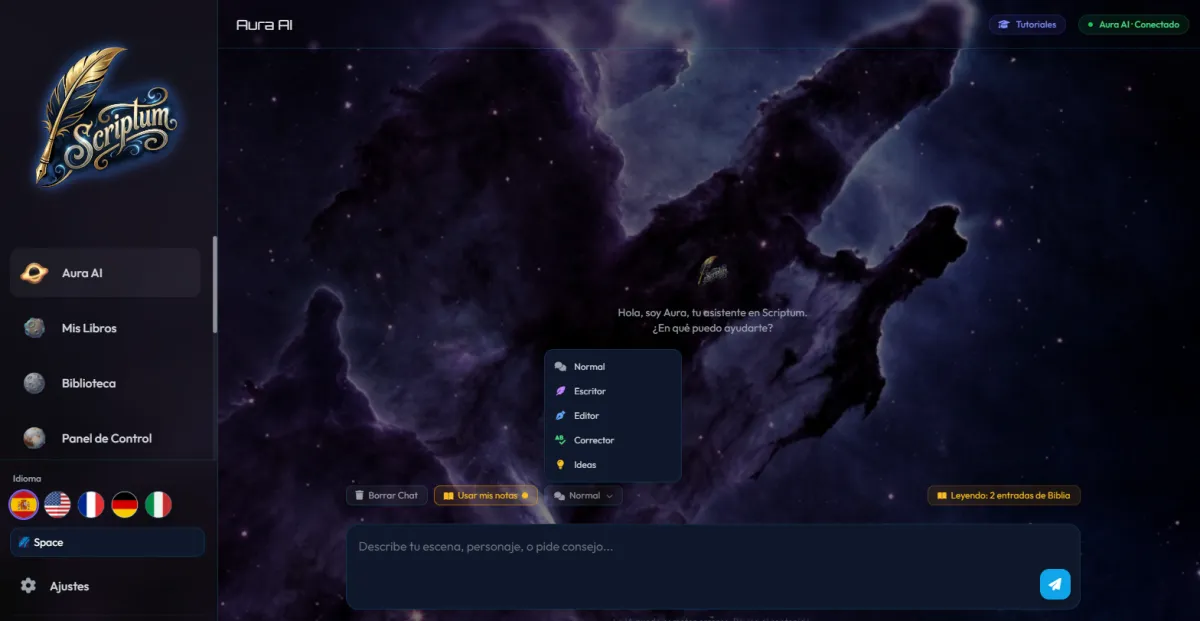
That's why the AI you work with matters. A generic chatbot doesn't know your novel and hands you flat text. In Scriptum, Aura AI uses Scriptum Memory, its memory system that reads your World Bible, your planning, and your chapters before suggesting anything: it doesn't invent just any scene, it continues yours, with your characters and your tone. AI doesn't write in your place; it helps you write better what only you could imagine.
AI can generate a thousand pages in a minute. What it can't generate is a reason to write them. That reason is, and will remain, yours.
Frequently asked questions
Will AI replace writers?
It won't replace writers, but it will change the craft. AI generates text from patterns, but it has no intention, lived experience, or a voice of its own to risk. What is happening is that writers who learn to use AI as a tool will have an edge over those who ignore it. The future isn't human versus machine, but human with machine.
Can AI write a bestseller on its own?
AI can generate correct, coherent text, but a bestseller needs a voice, an intention, and an emotional connection with the reader that AI, on its own, tends to flatten toward the generic. The books that work are born of human decisions: which story deserves telling and why. AI helps you execute them faster, not have them.
Can readers tell if a book was written by AI?
More and more. Purely AI-generated text tends to feel flat, predictable, and risk-free: it lacks the voice and the imperfect decisions that make a work human. Human editing and rewriting are what make the difference between a correct text and one that moves people.
Should I learn to use AI to write?
It's not mandatory, but it gives you an edge. AI used well speeds up the draft, breaks blocks, and frees up time for what matters. The key is to use it to assist you, not to replace you: you lead, decide, and edit. The writer who masters the tool produces more and better than one who ignores it.
Does AI have real creativity?
AI recombines what already exists with enormous skill, but it has no intention, experience, or anything of its own to say. The creative spark with purpose (choosing what to tell, why, and from which point of view) remains deeply human. AI is a brilliant instrument; the musician is still you.
Will I lose my style if I use AI to write?
Only if you let it write for you. If you use it to assist you (generate ideas, break blocks, polish) and always rewrite in your voice, your style stays and even sharpens. The risk isn't the tool, it's delegating to it the decisions that make you unique.
Conclusion: the craft changes, the writer remains
AI isn't the end of writers; it's the end of one way of writing. The mechanical tasks get automated, the first draft speeds up, the block loses its grip. But the essential part — having something to say, a way of seeing of your own, and the courage to put it into words — isn't something a machine can borrow, because it doesn't have it.
So don't ask whether AI will replace you. Ask how you're going to use it to write the book only you can write. Start doing it, with your voice in command, in Scriptum.