Serialized fiction — stories published in short installments, with a cliffhanger at the end of every chapter and micropayments built in — is one of the fastest-growing formats in the world, and apps like Pocket FM pay their writers millions of dollars a year. LitRPG (fiction with video-game mechanics: levels, stats, skills) is the genre that owns this model, because every level-up is a built-in hook for the next episode. In this guide you'll see how Pocket FM, Royal Road, Webnovel, and company actually work, how to write a serial (which isn't the same craft as writing a closed novel), how much you can really earn — no hype — why Spanish is a nearly untouched niche, and how to hold together a series of hundreds of chapters without contradicting yourself using Scriptum.
Matt Dinniman started publishing Dungeon Crawler Carl chapter by chapter, for free, on a site called Royal Road back in 2019. No publisher, no advance, nobody waiting for it. Five years later, the series has sold more than 14 million copies, spent 19 weeks on the New York Times bestseller list, racked up more than 140 million hours listened to in audio, and has a TV series in the works at Peacock. Its genre? LitRPG. Its format? Serialized fiction. This article is about that world: what it is, how it works, how much you can actually earn, and how to write for it without losing your mind — or your consistency — along the way.
- What it is: short serialized stories with a cliffhanger and micropayments. Pocket FM (audio), Royal Road and Webnovel (text), webtoons.
- The genre that rules: LitRPG — fiction with levels, stats, and skills on full display — fits the format perfectly because every chapter delivers a measurable reward.
- The money is real, but competitive: Pocket FM paid creators more than $36M in 2025; its top 1% clears $60,000+/year. Access is invite-only.
- It's written differently: chapters of 1,000-2,500 words, near-daily posting, arcs spanning hundreds of chapters, constant hooks.
- Spanish is nearly untouched: little competition, a genre riding a global wave. Blue ocean.
What serialized fiction is (and why it's exploding)
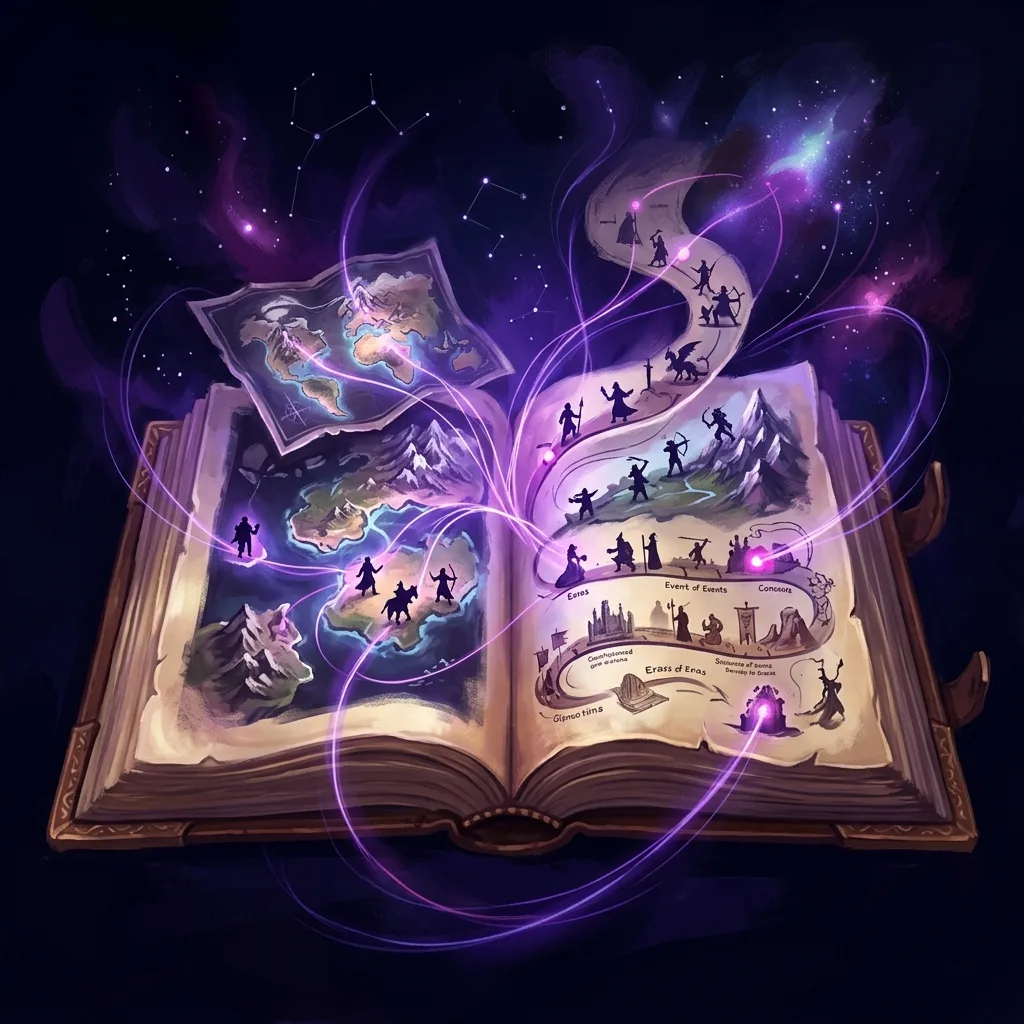
Serialized fiction is a story published in short installments — chapters or episodes — instead of landing all at once as a closed book. Every installment ends on a cliffhanger that pulls the reader into the next one, the series stretches across dozens or hundreds of chapters, and it's published on a frequent cadence, often daily. None of this is new: it's the 19th-century serial novel — Dickens, Dumas — resurrected on the phone and wired into a micropayment system.
What's new is the scale. The serialized-fiction platform sector already moves several billion dollars a year — estimates swing quite a bit between research firms, so treat them as an order of magnitude, not an exact figure — and it's growing at double digits. The solid numbers, the ones the industry itself reports, are dizzying: WEBTOON (which owns Wattpad) claims around 170 million monthly active users; Pocket FM, more than 130 million listeners. Behind all that consumption is an insatiable demand for stories, and that demand gets written by people like you.
A serial isn't competing for your Saturday-afternoon reading slot. It's competing for the dead time: the grocery line, the subway, walking the dog. That's why it wins.
How Pocket FM works: listening… and writing
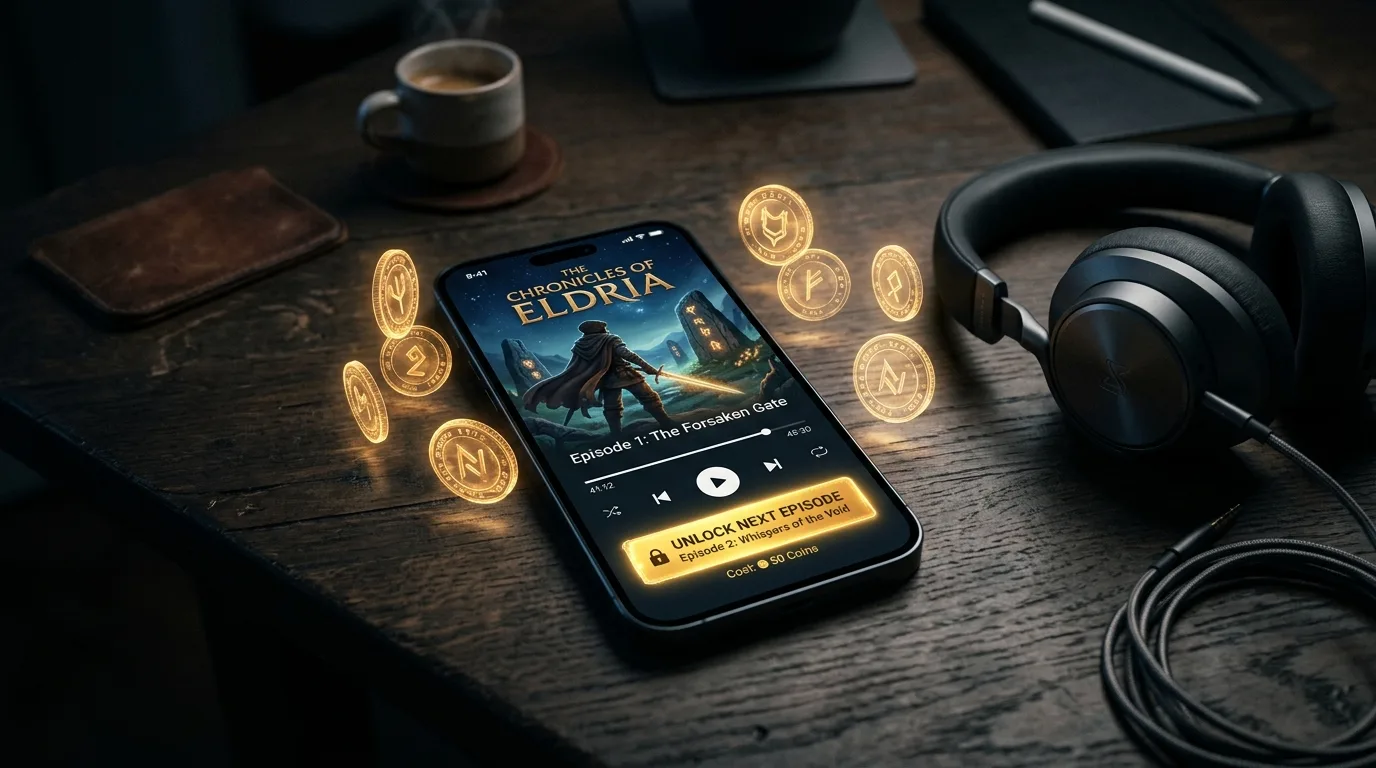
Pocket FM is an audio-series app: serialized fiction in audio form — full audio dramas with voice acting and sound effects, not a plain audiobook — in episodes of about 10 to 15 minutes, built to be binged one chapter after another. The average listener consumes around 110 minutes a day. The model is freemium: you listen with ads, or unlock premium episodes with coins you buy in packs; you can also wait for each episode to go free after a while. That drip of micropayments is the engine behind the whole business.
And here's the part that matters to a writer: on Pocket FM, people write too — and get paid. The platform recruits authors through its Writer Benefit Program, an invite-only program that — according to the company itself — accepts roughly the top 10% of best-performing stories. Payment is a revenue share on the coins listeners spend on your series, plus a layer of bonuses (for launching a new series, for monthly volume, for completing arcs). In 2025, payouts to creators topped $36 million, and the company has set its sights on more than tripling that for 2026.
Pocket FM isn't a "sign up and get rich" button. Three honest warnings: (1) access is invite-only and competitive; (2) the program currently prioritizes Hindi, Tamil, and English — there's no established door in Spanish yet; and (3) the contract includes a rights assignment over your work. None of this rules it out as an opportunity, but read it with a cool head before you sign. Serialized fiction pays real money; it doesn't give it away.
The platform map: where each author publishes
Pocket FM is the most recognizable hook, but it's just one square on a much bigger board. Every platform has its own audience, its dominant genre, and its own way of paying (or not paying). Here's the realistic map for 2026:
| Platform | What it is / format | How it pays |
|---|---|---|
| Pocket FM | Audio series (episodic audio dramas) | Revenue share + bonuses, invite-only (top ~10%) |
| Royal Road | Text · the epicenter of English-language LitRPG | Doesn't pay: it's for discovery. You monetize via Patreon + Amazon/KU |
| Webnovel (Qidian) | Text · Eastern fantasy, system stories, romance | Contract with a guaranteed minimum (~$200/month) + royalties. Has a Spanish section |
| GoodNovel / Dreame | Text · romance (werewolf, CEO) | Signing and volume bonuses; contracts criticized as opaque |
| Wattpad | Text · a massive community (89M users/month) | Paid Stories and Originals (advances of up to $5,000) |
| Amazon KU | Ebook · the destination for closing out arcs | Royalties per page read (Kindle Unlimited) + direct sales |
Two warnings so you don't waste your time: Kindle Vella, Amazon's bet on serialized fiction, shut down in February 2025; and Radish, which Kakao bought for $440 million, is closing its doors by the end of 2025. This sector is a gold rush, sure, but one where platforms appear and disappear. The sensible strategy is Dinniman's: build your audience on a free discovery site (Royal Road), and move ownership to an asset that's actually yours (Amazon, your email list, your Patreon). That way, if an app shuts down, your career doesn't shut down with it.
What LitRPG is (and its family): the star genre
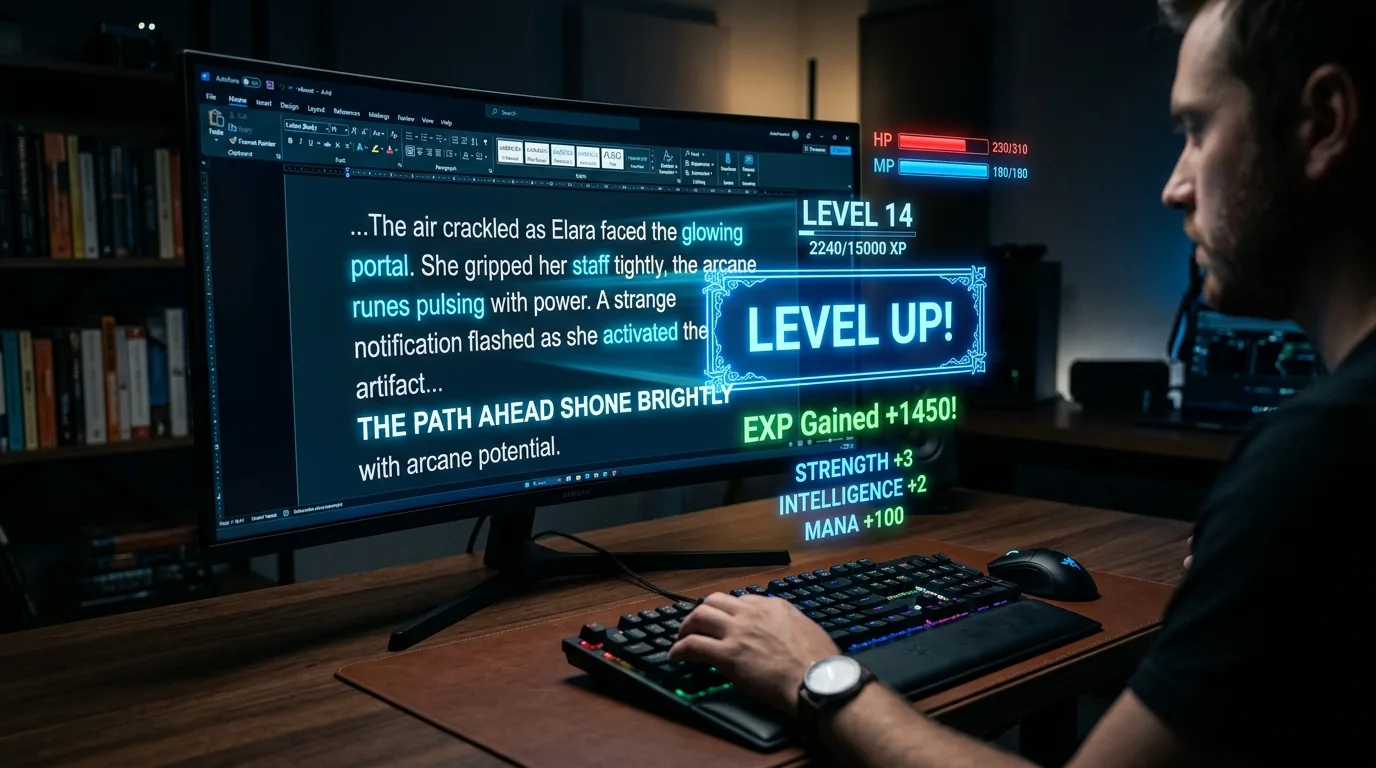
If serialized fiction is the stage, LitRPG is the headline act. LitRPG stands for literary RPG: it's fiction where video-game mechanics are an explicit part of the story. The character sees their stats, levels up, unlocks skills, gets notifications from a "system," and completes quests. The mental rule is simple: in a LitRPG, you see the interface. It emerged as a publishing label in Russia in the 2010s and exploded worldwide on the back of Korean web novels — Solo Leveling is its biggest ambassador.
It's worth not confusing three close cousins that get used as synonyms and aren't:
- LitRPG: the game system is visible. Stat sheets, experience bars, on-screen notifications. "I see the interface."
- GameLit: the story feels like a game — virtual reality, game-worlds, respawns — but without forcing you to show numbers.
- Progression fantasy: the focus is on the protagonist's climb in power (training, ranks, Eastern-style "cultivation"), often with no game mechanics visible at all.
Why does it fit the serialized format so well? Because the progression system hands you a hook every single chapter. Every level-up, every new skill, every number that goes up is a measurable reward for the reader and a promise for the next episode. You don't have to force the cliffhanger: it's built into the genre. That's why the communities are voracious — the r/litrpg subreddit has around 150,000 members — and why authors who master the pacing scale fast.
How to write a serial step by step
Writing in installments isn't slicing a novel into pieces. It's a different craft altogether, closer to writing for a TV series than to a closed book. Here are the mindset shifts that make the difference:
- Short, fast-paced chapters. Between 1,000 and 2,500 words per installment in text; 10-15 minutes in audio. Every chapter is a unit of consumption: it has to leave the reader satisfied and hungry at the same time.
- A cliffhanger at every ending. Not just at the end of the arc: at the end of every chapter. An open question, a threat, a half-revealed twist. It's the engine behind the micropayment.
- Hook them in the first lines. In serials, retention graphs are king: if chapter 1 doesn't grab the reader within a couple of paragraphs, there's no chapter 2. This is where it pays to nail how to open your story and its first line.
- Sustained cadence. The discovery algorithm rewards whoever publishes consistently. Several installments a week, ideally daily during launches. You need a daily production engine, not bursts of inspiration.
- Think in long arcs. The series that work stretch across hundreds of chapters and years. Design a progression system (or a plot) that can scale without breaking or growing stale.
That last point is what separates the writers who stick with it from the ones who quit around chapter 40. Holding a coherent story together across 300 installments published at a daily pace is a challenge of memory before it's one of imagination, and that's where almost everyone trips up. We'll get to that in a moment.
Planning to write hundreds of chapters?
A long-running serial sinks from contradictions, not from a lack of ideas. Lock down the rules of your world and your system in the Story Bible, and ask Aura about any character or thread to pick it back up without rereading 200 chapters.
Write in ScriptumHow much you can really earn
Now for the part everyone wants and almost nobody tells straight. Serialized fiction does generate real income, but the distribution has a long tail: a handful of authors earn a fortune and the vast majority earn little or nothing. These are verifiable numbers, not promises:
- Pocket FM: in 2025, the top-paid 1% of creators topped $60,000 a year, and more than 20% of monetized writers cleared $1,200 a month. Total payouts to creators: more than $36 million.
- Royal Road + Patreon: the platform itself doesn't pay, but LitRPG's biggest names monetize with early-access chapters on Patreon. Authors like Shirtaloon (He Who Fights with Monsters) or Zogarth (The Primal Hunter) pull in around $45,000-$60,000 a month. They're the exception, not the norm: only about 3% of readers pay.
- Webnovel: offers a guaranteed minimum (around $200/month for the first few months if you keep up your word-count pace) plus royalties.
- Wattpad: its Originals program hands out advances of up to $5,000 plus per-read income.
The sensible takeaway: don't quit your job on Monday. But as a path to making a living from writing, serialized fiction is today one of the most meritocratic paths that exist — you don't need an agent or a publisher, just good chapters and consistency — and the story of Dungeon Crawler Carl proves the ceiling is sky-high. The key is volume, and sticking with it.
The opportunity in Spanish: get there first
Here's the number that should snap you awake. The "LitRPG en español" group on Goodreads has barely a few dozen members. Its English equivalent, r/litrpg, is closing in on 150,000. That gap isn't a problem: it's the opportunity. The genre is riding a global wave — Spanish publisher Nova already publishes Dungeon Crawler Carl in Spanish as Carl el Mazmorrero — but content written directly in Spanish is almost nonexistent.
What does that mean for you? That the niche is nearly untouched. There's demand for serialized fiction in Spanish — Booknet claims around a million monthly readers on its Spanish-language version, Webnovel has a Spanish section tagged LitRPG — but almost nobody is serving it. It's a blue ocean: arriving early and doing it well buys you a positioning advantage that lasts for years. Plenty of authors play both sides: they publish in English to fish in the big market and in Spanish to plant a flag where there's almost no competition.
How to sustain a long-running serial with Scriptum
Let's be honest about what a tool does and doesn't do. Scriptum isn't going to write your series for you, and it doesn't guarantee you a Pocket FM contract. What it does — and this is exactly the serialized writer's bottleneck — is take the weight of maintaining consistency off your shoulders once you're 150 chapters in and can't remember what level you left your protagonist at or what rules you set for your magic system.
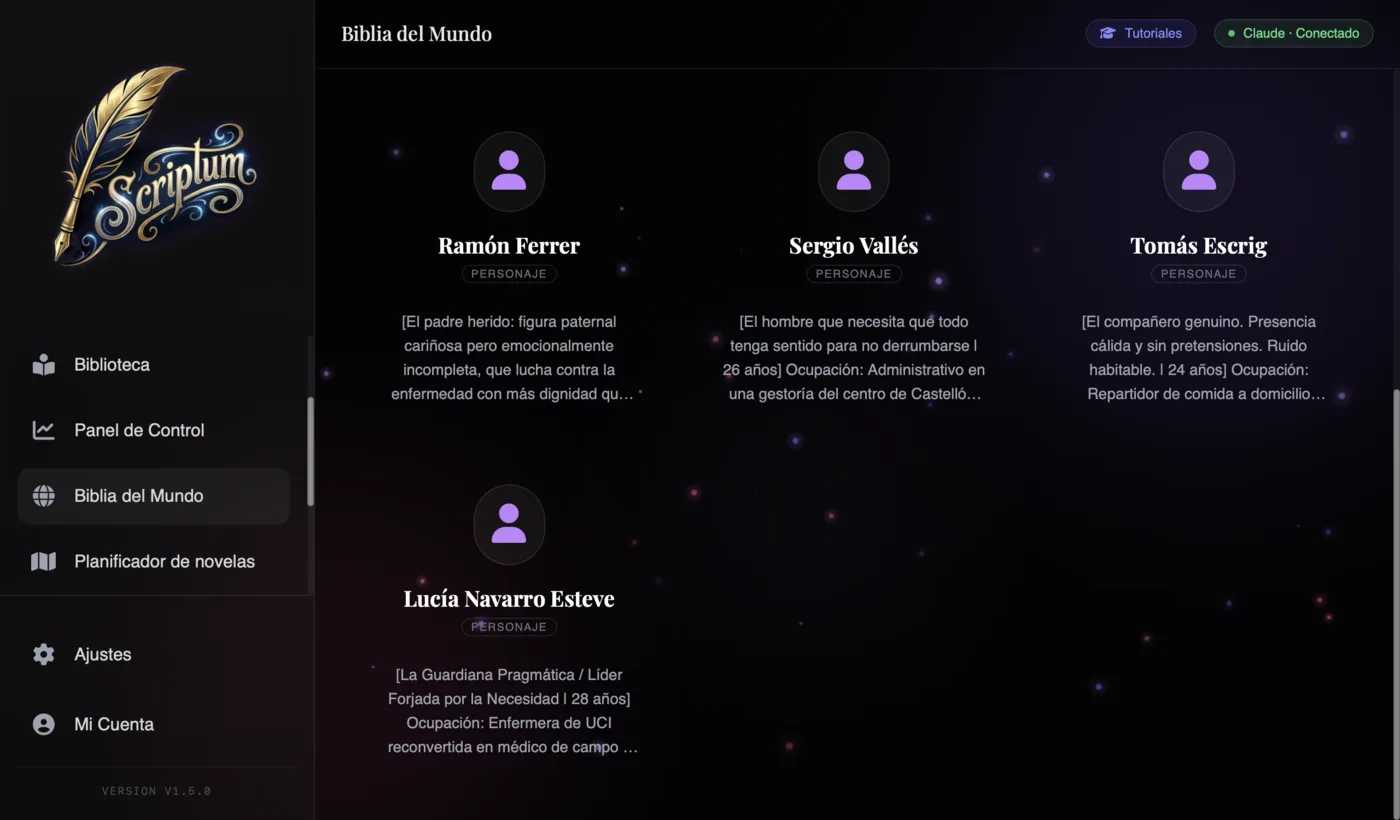
In a LitRPG this is especially brutal. A progression system is a numerical promise to the reader: if in chapter 12 you said a skill scales 5% per level, you can't contradict yourself in chapter 200 without the community — who build spreadsheets out of your stats — calling you out on it. This is where Scriptum's Story Bible works as your system sheet: it locks down your progression rules, every character's stats, and the limits of your world, and keeps them in front of you so you never contradict yourself. It's the same muscle that prevents plot holes in long stories, taken down to the detail of a game system.
And when you come back to a thread you abandoned forty chapters ago, Aura — Scriptum's AI — has a selective memory of your manuscript: you ask it about a character, an arc, or a rule, and it pulls the relevant passages from your own text so you can pick back up without rereading half the series. It doesn't do this on its own, and it doesn't "watch" your work for you — you're the one asking, you're the one in charge — but it hands you the context back in seconds. Combined with organized worldbuilding and a daily production rhythm, that's the difference between reaching chapter 300 and giving up at 40.
Common mistakes when starting a serial
- Writing a novel and slicing it up. A serial isn't a book cut into slices. If your chapters don't close on a hook, the reader doesn't come back. Think in episodes, not sections.
- Starting without a chapter buffer. Launching with three chapters written and promising a daily cadence is the road to burnout. Have a buffer of 15-20 installments before you publish the first one.
- A system that doesn't scale. In LitRPG, if your protagonist becomes invincible by chapter 30, the tension is over. Design your progression so there's always a higher ceiling.
- Neglecting numerical consistency. Contradicting your own rules or stats is the cardinal sin of the genre. Your community is keeping count even if you aren't.
- Signing without reading. Some platforms keep broad rights or pay out a small cut of what the reader actually spends. Before you sign away your work, understand exactly what you're giving up and in exchange for what.
- Going all-in on Pocket FM alone. It's invite-only and prioritizes other languages. Start where the door is actually open (Royal Road, Webnovel in Spanish, Amazon) and build your own audience.
Frequently asked questions
What is serialized fiction?
Serialized fiction is a story published in short installments — chapters or episodes — instead of as a closed book. Each installment usually ends on a cliffhanger so the reader or listener wants the next one, and the series stretches across dozens or hundreds of chapters published on a frequent cadence, often daily. It's the model behind apps like Pocket FM (audio), Royal Road or Webnovel (text), and webtoons. It isn't a new format: it's the 19th-century serial novel of Dickens or Dumas, adapted to the phone and to micropayments.
Can you make money writing for Pocket FM?
Yes, but with caveats. Pocket FM pays writers through its Writer Benefit Program, an invite-only program that accepts roughly the top 10% of applicants. The model is a revenue share on the coins listeners spend on your story, plus bonuses. According to the company itself, in 2025 the top-paid 1% of creators topped $60,000 a year, and more than 20% earned over $1,200 a month; total payouts to creators topped $36 million. But the program currently prioritizes Hindi, Tamil, and English, and the contract includes a rights assignment, so it pays to read the fine print. It's not a magic button: it's competitive.
What is LitRPG?
LitRPG (short for literary RPG) is a fantasy and science-fiction subgenre where video-game mechanics are an explicit part of the fiction: the character sees their stats, levels up, gains skills, gets notifications from a system, and completes quests, all within the story itself. It emerged as a publishing label in Russia in the 2010s and exploded globally thanks to Korean web novels like Solo Leveling. It fits serialized fiction beautifully because every level-up is a reward for that chapter and a natural hook for the next one.
What's the difference between LitRPG, GameLit, and progression fantasy?
All three share the idea of progression, but they differ in how much game mechanic they show on the page. In LitRPG the system is explicit: you see the stat sheets, the levels, and the notifications (the mental rule is "I see the interface"). GameLit is broader: the story feels like a game — game-worlds, virtual reality, respawns — but without needing to show numbers. Progression fantasy focuses on the protagonist's climb in power through training or rank (Eastern-style cultivation is the classic example) and often has no visible game mechanic at all. A LitRPG is almost always progression fantasy; the reverse isn't true.
Where can I publish serialized fiction in Spanish?
The most open doors today for a Spanish-language author are Royal Road (free, the epicenter of LitRPG, though mostly in English), Webnovel, which has a Spanish section tagged LitRPG, and serialized self-publishing platforms like Booknet, which claims around a million monthly readers on its Spanish version. Amazon Kindle Unlimited is still the natural destination for closing out arcs as an ebook. The Spanish-language LitRPG market is still in its infancy — the "LitRPG en español" group on Goodreads has barely a few dozen members against the 150,000 of the English-speaking community — which means little competition and a lot of ground still to claim.
How many chapters does a serial need, and how often should you publish?
There's no required number, but the model rewards volume and consistency. Web-serial chapters usually run 1,000 to 2,500 words, and Pocket FM's audio episodes last 10 to 15 minutes. The typical cadence for gaining traction on platforms like Royal Road is several chapters a week, if not daily, and successful series stretch across hundreds of chapters and several years. It's closer to feeding a TV series than to closing out a novel: sustained rhythm rules.
Do I have to write in English to succeed with LitRPG?
To reach the big market, today, yes: the bulk of the LitRPG and progression-serialized-fiction audience is English-speaking, and the strongest platforms and communities run in English. But that's also the opportunity: the Spanish-language niche is nearly untouched. Writing in Spanish gets you little competition and a budding community that's growing with the genre's global pull (publisher Nova has already translated Dungeon Crawler Carl into Spanish). Plenty of authors do both: they publish in English for volume and in Spanish to plant a flag in a market with almost no rivals.
Conclusion: publish chapter one
Serialized fiction has handed writers back something traditional publishing had taken away: a direct line to the reader, no gatekeepers. You don't need an agent or a publisher to start — you need a good chapter one, a cliffhanger, and the discipline to come back tomorrow with chapter two. LitRPG and its cousins are the spearhead of that model because the genre itself hands you the hook, and Spanish is nearly untilled ground where arriving early is worth its weight in gold.
Remember Matt Dinniman's story: he started for free, on a website, one chapter at a time. What separates his series from the thousands that get abandoned isn't raw talent at the start, it's holding hundreds of chapters together without breaking consistency. Design a system that scales, keep your buffer of installments ready, hook readers from the first line, and lean on the Story Bible and Aura so you never lose the thread of your own world. That's exactly what Scriptum does. Now go write chapter one.