
Yes, you can make a living writing. But not the way certain forums sell it: not overnight, not from a single book, and not without treating writing as a business. This guide gives you the honest answer — real income data, how many books you actually need, which income streams work, and how long it typically takes the people who get there.
Making a living as a writer is the dream of millions and the reality of a few thousand. The difference between the two groups isn't always talent. More often it comes down to information: the writers who pull it off know exactly how the publishing market works, what income sources are available to them, and what expectations are realistic. The ones who don't make it usually expect a good book to be enough.
Let's be straight about this. If you're thinking about writing novels as your main source of income, you need to read this first.
The honest answer: can you make a living writing?
Yes — with important caveats. Making a living as a writer is possible, but most people who do it aren't living solely off their novels: they're living off writing as a business, which means novels plus other related income. And the writers who do live exclusively from their books have usually been publishing for several years and carry a deep catalogue — not one or two titles.
The most dangerous myth is this one: "I write a book, I publish it, and the money starts coming in." It can happen, but it's the absolute exception. Statistically, most self-published authors earn less in their first year than they spent producing the book (cover design, editing, proofreading).
The opposite myth is equally damaging: "It's impossible — only a handful of people ever manage it." That's not true either. There are thousands of authors worldwide who make a living from writing, many of them without being household names outside their genre. What they have in common isn't literary genius — it's that they treat their career with the seriousness of a business venture.
The right question isn't "Can you?" It's "How do you build it?" And that's exactly what we're going to cover.
How much do writers actually earn?
Here you need to separate two worlds: traditional publishing and self-publishing. The numbers look very different.
Traditional publishing
A debut author signing with a mid-sized publisher can expect an advance somewhere between a few hundred and a few thousand dollars. Royalties only kick in once the book earns back that advance, and they typically run between 8% and 12% of the cover price. If your novel sells for $18 and you earn 10%, you get $1.80 per copy. To clear $20,000 a year purely from royalties, you'd need to sell more than 11,000 copies annually — a tough bar for most titles.
The big advances and bestseller deals you see in the news are news precisely because they're exceptional. Most authors with a traditional contract have a day job.
Self-publishing
On platforms like Amazon KDP, royalties can reach 70% of the sale price when the book is priced in the right range (between $2.99 and $12.99 in most categories). That changes the arithmetic completely: sell a novel at $4.99 with a 70% royalty and you pocket around $3.49 per copy. To hit $20,000 a year you need to sell roughly 5,700 copies — about 475 a month. Amazon reviews these bands from time to time, so check the current range on the official KDP help page before you set your price.
Is that a lot? It depends on your catalogue, your genre, and your marketing. With a single title, sustaining 475 sales a month is very hard. With ten titles, that same number spread across your catalogue is far more achievable.
What the real income bands look like
- Most self-published authors: under $500 a year. Zero marketing, a small catalogue, a saturated genre, or a niche too small.
- Active authors with 3–6 titles and basic marketing: $200–$1,000 a month. Supplementary income, not a living wage.
- Established authors with 7–15 titles, an active backlist, and an email list: $1,500–$5,000 a month. Here you can genuinely live from writing, though modestly.
- Consolidated authors with large catalogues, a personal brand, and multiple formats: $5,000–$20,000+ a month. The smallest group.
These aren't pulled from optimistic forums — they're broadly consistent with data published periodically by the Alliance of Independent Authors and similar industry surveys.
Income streams for writers
Making a living as a writer doesn't necessarily mean living only off your novels. There's an ecosystem of income sources that orbit the craft of writing, and the authors who make it work usually combine two or three of them. Here are the main ones:
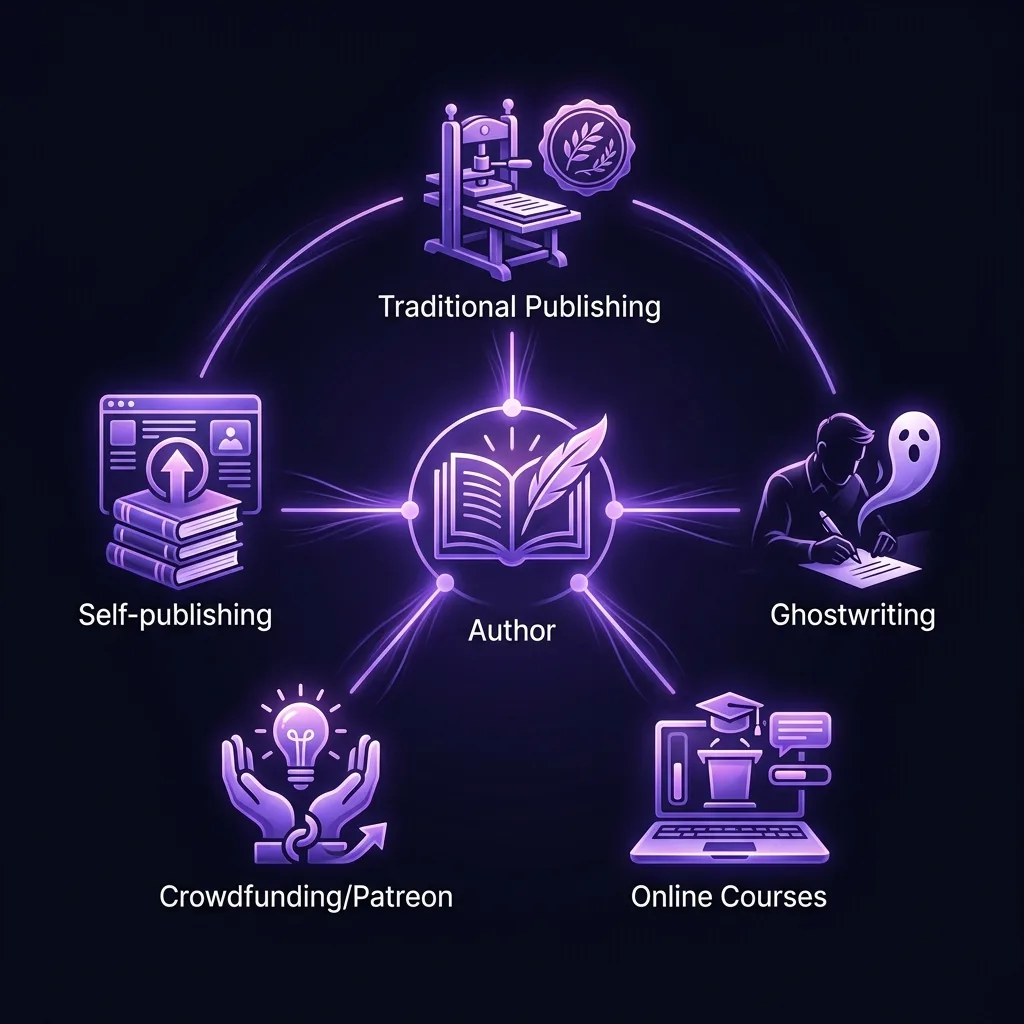
1. Direct self-publishing
Amazon KDP, Kobo Writing Life, Apple Books, Google Play Books, and distributors like Draft2Digital or IngramSpark. Royalties are high, control is total, and publishing is immediate. The challenge is visibility: there's no publisher putting your book in physical shops. You handle the marketing yourself, which costs time and money. Check out our guide on how to publish your novel on Amazon KDP if you're starting down this path.
2. Traditional publishing
Lower royalties, but access to physical distribution, credibility, and the possibility of an advance. It works particularly well for certain genres (literary fiction, children's and YA, non-fiction) and when you're prioritising visibility over immediate income. Before you decide, read our detailed comparison of self-publishing vs traditional publishing to weigh up both paths with real data.
3. The hybrid model
A growing number of authors use a mixed strategy: certain titles with a publisher (for visibility and awards) and the rest self-published (for income). It's the path that has grown fastest among professional authors in recent years because it combines the best of both worlds.
4. Ghostwriting
Writing books under someone else's name. It can be extremely lucrative — $5,000 to $50,000 per project, depending on length and client — but it means giving up public authorship. This is a real and serious income source, not a fringe activity: the ghostwriting market generates millions every year. Many professional novelists built their financial foundation here before their own catalogue took off.
5. Copywriting and content writing
Articles, corporate newsletters, video scripts, brand copy. It's not the same as writing fiction, but it's paid writing that can fund your literary project while you build your catalogue. Many professional novelists spent years writing content for businesses before they could quit that work.
6. Writing courses and workshops
If you have experience and can teach, you can monetise that knowledge. In-person workshops, online courses on platforms like Teachable or Udemy, or teaching at writing schools. Margins can be high with digital courses because you build them once and they scale.
7. Patreon and memberships
A community of readers who pay monthly in exchange for exclusive content: drafts, early chapters, podcasts about your creative process, direct access to you as an author. It's not for everyone, but for authors with a loyal following it can generate recurring, predictable income — which is exactly what's hardest to come by in a writing career.
The real maths: how many readers and books you need
Let's run the numbers concretely. Say you want to earn $2,000 net per month from your self-published novels. With an average royalty of $3.50 per book (at $4.99 with 70% royalty), you need to sell around 570 copies a month.
How do you get to 570 monthly sales?
- With 1 title: that one book needs to sell 570 copies every month, sustained. Hard to maintain without constant advertising or a viral moment.
- With 5 titles: you need 114 sales per title per month. Much more manageable if the genre has demand and the books cross-sell each other.
- With 10 titles: you need 57 sales per title per month. This is squarely in achievable territory with a sensible marketing strategy.
The backlist effect is real and powerful: when someone discovers the first book in a series and loves it, they buy the rest. That's why authors who make a living writing keep insisting on publishing in series within the same genre and maintaining a consistent publishing cadence. The backlist isn't a bonus — it's the primary revenue engine.
That's also why learning to actually finish your novel matters so much: the manuscript you never complete never enters your backlist, never sells, and never gets you anywhere.
Your backlist isn't what you wrote in the past. It's your most valuable asset right now: the books that send new readers straight into everything else you've ever written.
Building a sustainable writing career
The difference between an author with sporadic income and one who makes a living from writing isn't one successful book. It's the architecture of an entire career. These are the pillars that work:

Catalogue: write in series, write in genre
Authors who make a living writing publish in the same genre — often in the same series or universe. This isn't artistic compromise: it's how the reader market actually works. A historical romance reader who discovers you wants more historical romance from you, not a pivot to sci-fi thriller. Build your catalogue with coherence. If you know the story you want to tell, figure out first whether you should plan it or discover it as you go — that decision affects how long each title takes to produce.
Newsletter: the readership nobody can take from you
Amazon's algorithms change. Instagram could disappear. But your email list is yours. Authors who build an active newsletter have a massive advantage at every new book launch: an audience that already knows them, already trusts them, and is primed to buy on day one. Day-one sales matter enormously on Amazon because early velocity determines algorithmic placement.
Active marketing, not passive marketing
Publish and pray doesn't work. Authors who make a living writing spend 20–30% of their time on marketing: Amazon Ads or Facebook Ads, a presence on social platforms relevant to their genre, participation in BookTok or Bookstagram, NetGalley review campaigns, pricing strategies (permafree first-in-series, seasonal sales), and much more. Knowing how to promote your self-published novel is as important as writing it well.
Publishing cadence
The digital fiction market rewards authors who publish regularly. One book a year may be enough for certain genres and formats, but in fast-consumption genres like romance, thriller, or epic fantasy, publishing every three to four months keeps the algorithm active and the audience engaged. Sustaining that cadence requires a solid, non-negotiable daily writing routine.
Multiple formats and markets
The same book can sell as an ebook, in print (print-on-demand through KDP or IngramSpark), as an audiobook (ACX, Findaway Voices), and in other languages through translation rights. Each format is an additional income source without writing a new book. Audiobooks in particular have grown exponentially and represent a genuine opportunity for authors with catalogue.
Mistakes that keep you dreaming instead of earning
Certain behaviour patterns repeat themselves in authors who have spent years wanting to make a living from writing without getting there. Recognising them is the first step to not falling into them yourself.
Waiting for the perfect book before publishing
Perfectionism kills careers. The book that's on its twelfth revision isn't generating income. The one you published three months ago, even if it's not perfect, is. There's a real difference between reasonable quality standards — professional editing and proofreading, a cover that competes in the genre — and the paralysing perfectionism that delays publication indefinitely.
Publishing across too many different genres
Many authors publish a romance novel, then a thriller, then a non-fiction essay, then a fantasy. Every time you switch genre you start from zero with your audience. Readers are loyal to genre before they're loyal to author, especially early on. Pick one or two related genres and build there.
Ignoring marketing until launch day
Marketing doesn't start on publication day. It starts months earlier: building anticipation, securing beta readers who'll leave reviews on day one, warming up the newsletter, setting up ads. A launch with no marketing runway is throwing your book into a void.
Miscalculating production costs
A professional cover can cost $100 to $500. Proofreading an 80,000-word manuscript might run $300 to $800. Add developmental editing and you're looking at another $500 to $1,500. Before you publish, you need to earn that investment back. If you never calculate your break-even point, you can spend years publishing and losing money without realising it.
Confusing downloads with income
A book with 200 four-star reviews and 10,000 free downloads is not a business. The metrics that matter are paid sales, average royalty, and income per reader. Many authors optimise for visibility and not for revenue, and end up "being known" for years without any real income to show for it.
How to start building your writing career today
Whether you're just starting out or you've been stuck for a while, here's an honest action plan in order of priority.
Step 1: finish the manuscript
There is no career without published books. Everything else — marketing, strategy, formats — is secondary if you don't have a finished manuscript. If you have a half-written book that's been sitting for months, that's your number-one priority right now. A good starting point is learning how to actually finish your novel, with strategies that work when the initial excitement has worn off.
Step 2: pick your genre and stay there
Before you publish your first book, decide which genre you're going to build your catalogue in. Research the market: what's selling? Which subgenres have demand but aren't oversaturated? Where are the readers and how do you reach them? This one strategic decision is worth more than a thousand hours of writing in the wrong genre.
Step 3: produce to good-enough quality, not perfect quality
Invest in a cover (it's the first thing a buyer sees), in proofreading (typos destroy reviews), and in a blurb that actually sells the book. You don't need the best design in the world — you need one that competes credibly with the top titles in your category on Amazon.
Step 4: publish and start building your list
The day you publish your first book, launch your newsletter at the same time. Even if you only have ten subscribers, start. Every book you publish will add readers to that list. By the time you release your fifth book, you'll have an audience waiting for it.
Step 5: learn marketing while you write the next one
Don't wait until you have five books to start learning marketing. Learn as you publish. Amazon Ads, pricing strategies, BookFunnel for growing your subscriber list, cross-promotions with other authors in your genre… Dedicate an hour a day to this while you keep writing. Writing and the business side run in parallel — not in sequence.
Tools like Scriptum are designed precisely to help you maintain that production cadence without sacrificing quality: you can plan, draft, and revise in a single environment with AI support, without switching tools every five minutes.
Step 6: diversify income from the start
While you build your catalogue, don't rely solely on book sales. If you write well, offer copywriting or ghostwriting services to clients. If you have experience, run a workshop. This income gives you financial stability while the catalogue grows — and the day book sales overtake your service income, you'll have won.
Frequently asked questions
Can you make a living writing novels?
Yes, but it's not the norm and it doesn't happen quickly. A small percentage of writers earn enough to live solely from their novels. Most combine writing with related income: ghostwriting, copywriting, courses, or Patreon. The key isn't talent — it's catalogue size and marketing. The more books you publish and the better you promote them, the greater your chances of generating recurring income.
How much does a self-published author earn?
The range is enormous. Most earn under $500 a year. Authors with five or more titles who actively market their work can reach $500–$2,000 a month. Established authors with ten or more titles and a loyal readership can earn $2,000–$8,000 a month. Royalties on Amazon KDP range from 35% to 70% of the sale price depending on the price tier you choose.
How many books do you need to make a living writing?
There's no magic number, but as a benchmark: with 5–7 books in the same genre you can generate meaningful supplementary income if you work your marketing. To live exclusively from your novels, most authors who manage it have between 10 and 20 titles published. A deep catalogue in the same genre creates the backlist effect: every new reader who finds you can buy everything you've ever written.
Is it better to self-publish or go with a traditional publisher to make a living writing?
For making a living, self-publishing usually offers better royalties (up to 70% versus 8–15% from a traditional publisher). Traditional publishing brings physical bookshop visibility and distribution. Many authors who live from writing use the hybrid model: some titles with a publisher and the rest independently. The right call depends on your genre, your marketing capacity, and whether you value visibility or direct income more.
How long does it take to make a living as a writer?
In most cases, between 3 and 7 years of consistent work. The first years go into building catalogue, learning marketing, and growing a readership. Income grows non-linearly: it can be nearly zero for years and then take off once the catalogue passes a critical size. Consistency and publishing cadence are more decisive than individual talent.
What other income sources does a writer have?
Beyond book sales: ghostwriting (writing under a client's name), copywriting and content writing, writing workshops and courses, Patreon memberships, speaking engagements, translation rights, and licensing for adaptations. Most writers who make a living from their craft combine two or three of these streams — they don't rely solely on novel sales.
Honest conclusion
Can you make a living writing? Yes. Is it easy? No. Is it within reach for someone who works at it seriously? Also yes.
The key is to stop thinking of writing as an artistic activity that will magically start generating money someday, and to start treating it for what it is when done professionally: a creative business that requires strategy, catalogue, marketing, and patience.
The writers who make a living from their work aren't more talented than the ones who don't. They're more disciplined, more strategic, and more consistent. They publish even when they don't feel like it, they learn marketing even when they hate it, they build their audience book by book, and they don't quit when the first or second title fails to take off.
If you're willing to do that, making a living writing is not an impossible dream. It's a project with a plan and a timeline. Start by finishing the manuscript you have half-done, publish it at a quality level that competes in your genre, learn to promote it, and write the next one. That's how it's built — no shortcuts, no smoke and mirrors.
And if you need help maintaining your production cadence without losing your voice, Scriptum is built exactly for that: so you write more, write better, and stop wasting time on tools that don't understand what it actually takes to write a novel.