Romantasy is a hybrid genre in which the love story and the fantasy plot carry the same weight: take the romance out and the novel collapses. You write it by weaving the beats of the relationship into the beats of the fantasy conflict so that both resolve in the same climax, and it demands a happy or hopeful ending (HEA/HFN).
If you've landed here, odds are it's a dragon's fault. Rebecca Yarros's Fourth Wing ate TikTok alive, and suddenly half the world wanted to write "something like that". What happens next is always the same: you build a gorgeous world with its magic and its noble houses, you drop in a couple with tension… and a hundred pages later the romance has become decoration. That isn't romantasy: that's fantasy with romance, and the reader clocks it by chapter 4. This article sits at the crossroads of our guides to writing a romance novel and writing a fantasy novel, because romantasy is neither of them: it's the seam.
- Definition: fantasy and romance with equal narrative weight; neither one is a subplot.
- The test: if you delete the relationship and the novel still stands, it isn't romantasy.
- Structure: a double beat sheet; both threats resolve in the same scene.
- Genre contract: a happy ending (HEA) or a hopeful one (HFN).
- Market: in 2025 print romance rose in the US while pure fantasy fell 8.7% (Circana BookScan via Publishers Weekly).
- Spain: romance novels billed €53.64 million there in 2024, up 20.0% (FGEE/Conecta).
What romantasy actually is
Romantasy is a hybrid genre in which a love story and a fantasy plot share the same narrative weight. It isn't fantasy with a romantic subplot, and it isn't a romance set in a castle: they're two columns holding up the same roof. The word is a contraction of romance and fantasy.
It's worth being precise about the name. In Spanish, the FundéuRAE (2024) recommends the alternatives «fantasía romántica» or «la romantasía» — in the feminine. But almost nobody in Spain searches for it that way: on Google Trends, «fantasía romántica» sits at a relative interest of 0.2 against 58.9 for «romantasy» (Trends measures relative interest from 0 to 100, never searches per month). Which is the short version of a rule that holds in every market: the English term is the one people type.
There's no consensus on its origin either. Bloomsbury claims to have coined it, but as The Drift (2025) points out, an Urban Dictionary entry already existed in 2008. The name came from readers; marketing adopted it afterwards. Encyclopedia entry: romantic fantasy on Wikipedia.
The titles that define the genre today are Fourth Wing by Rebecca Yarros and Sarah J. Maas's ACOTAR series. Neither invented anything, but they set the expectations — high pace, recognizable tropes, explicit spice, an ending that pays you back — against which your manuscript will be read.
Why romantasy is exploding right now
A warning almost nobody gives you first: neither Circana nor Spain's Federation of Publishers Guilds (FGEE) tracks "romantasy" as a category. Its sales are split across romance, fantasy and science fiction, and young adult. Giving a clean figure for the genre is impossible, so be suspicious of anyone who hands you one. What you can read are the underlying currents, and they're enormous.
According to Circana BookScan (2025), print romance sales in the United States rose 24% year over year to 51 million copies, more than double the figure four years earlier, with romantasy among the fastest-growing subgenres — posting triple-digit growth.
But the key data point arrived when 2025 closed. According to Publishers Weekly, using Circana BookScan data, romance ended the year near 44 million copies (+3.9%) while fantasy fell to 24.1 million (−8.7%). The hybrid climbs while pure fantasy slips: readers haven't got tired of dragons, they've got used to dragons arriving with a love story attached.
Spain shows the same tailwind in a different market. According to the report Comercio Interior del Libro 2024 by the FGEE/Conecta (2025), the Spanish book sector billed €3,037.51 million (+6.3%) and adult fiction €709.34 million (+14.0%). Within it, romance novels reached €53.64 million (+20.0%) in Spain and science fiction and horror €24.13 million, up 26.3%, the fastest-growing subgenre. Spain is the European exception: print there grew 5.8%.
One note on the calendar: on Google Trends, interest in "romantasy" peaks between late December and early February in six of the seven markets we reviewed. If you control your publication date, factoring that in costs you nothing.
The test: are you writing romantasy or fantasy with romance?
Five questions. Answer them without defending what you've already written.
- If you delete the love story, does the novel still stand? If the answer is yes, it isn't romantasy: here, removing the relationship brings the plot down, because the relationship is plot.
- Does the couple have an arc of its own? "They like each other and end up together" is not an arc. An arc has internal obstacles, a change of belief and a cost.
- Does the climax resolve both things at once? If the battle is won in chapter 38 and the declaration turns up in the epilogue, you have two novels taped together.
- Is an HEA or HFN guaranteed? A happy ending, or at least a hopeful one — if not in this book, then by the close of the series.
- Is the point of view where the feeling is? If your narrator lives in war councils while the relationship happens off-page, the real weight isn't where you think it is.
Four or five yeses: you're writing romantasy. Two or three: you have fantasy with romance, a terrific genre that gets labelled differently; don't disguise it. Zero or one: it's fantasy, and your subplot is there to let the book breathe. The only bad move is promising one thing on the cover and delivering another in chapter 10.
The tropes readers expect
In romantasy, tropes aren't a vice: they're the menu. Readers search for them by name on TikTok and decide whether to buy you based on them. A trope is a promise of an emotional experience; your job is to deliver it without sounding like the twenty versions they've already read.
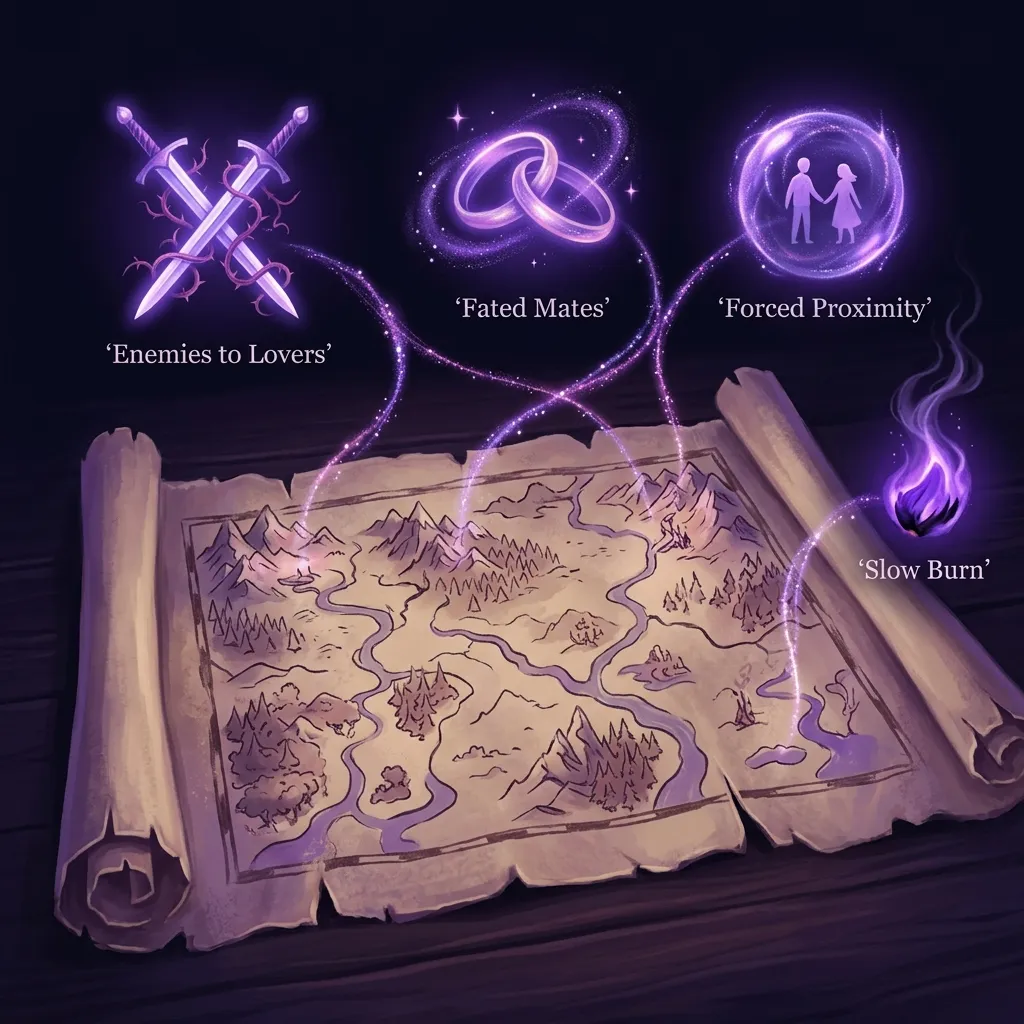
| Trope | What it promises the reader | The author's typical mistake |
|---|---|---|
| Enemies to lovers | Real antagonism turning into desire: watching a defence fall. | "Enemies" for two chapters of bad mood. With no real reason to hate each other, there's no journey. |
| Fated mates (a destined bond) | Inevitability and belonging: a force greater than them binds them together. | Using destiny instead of chemistry. The bond should complicate their lives. |
| Forced proximity | Compulsory intimacy: a journey, a cell, "there was only one bed". | Locking them up with nothing at stake. It only crackles if leaving is impossible and staying is dangerous. |
| The chosen one | Heroic destiny and its weight; love as shelter from the prophecy. | Powers without a price. If being the chosen one costs her nothing, there's no romantic conflict. |
| Morally grey / "shadow daddy" | A love interest who is dangerous, competent and devoted only to her. | Confusing morally grey with being a jerk. It means doing terrible things for understandable reasons. |
| Found family | A group that becomes home: humour, loyalty, side characters readers adore. | A decorative cast. Every member needs a relationship of their own, not one assigned joke. |
| Slow burn | Tension stretched across hundreds of pages that detonates once you can't take any more. | Confusing slow with empty. It isn't "nothing happens": something small happens in every scene. |
| Grumpy & sunshine | Contrasting temperaments, sparky dialogue, tenderness as the grump melts. | Making the grump cruel and the sunny one stupid. They're two ways of having survived something. |
The golden rule: tropes are the skeleton, not the flesh. Nobody remembers "enemies to lovers"; people remember those two. That said, naming your tropes in your blurb and on social media is literally the language your audience speaks — we unpack that in BookTok for authors.
The structure: how to weave the romantic beats into the fantasy ones
Here's the real gap: there are a hundred lists of tropes and no explanation of how a romantasy is built from the inside. You don't write one structure, you write two and stitch them together: every romantic beat lands on a beat of the fantasy conflict, so that the same event pushes both plots forward. Think of them as double stakes: if your protagonist has to destroy the magical bond to save the kingdom, and that bond is what ties her to him, you don't have two plots — you have one with two edges.
| Act | Romantic beat | Fantasy beat stitched to it | What the reader should feel |
|---|---|---|---|
| I (0–10%) | First meeting: they see each other, they clash, they leave a mark. | The world is introduced, and so is the threat straining it. | "They're going to end up together and it's going to hurt." |
| I (10–20%) | First contact: a brush of skin, a pulse, a wound healed. | Inciting incident: she's pulled into the conflict for good. | Physical awareness; there's no going back. |
| II (20–40%) | Spark and conflict: they need each other and get in each other's way. | The rules: magic, hierarchy, the price of power. | Wanting them to give in without letting them give in. |
| II (45–55%) | First confession: desire is admitted, out loud or in deeds. | Midpoint: something changes the nature of the conflict. | They've won something they can lose. |
| II (55–70%) | Point of no return: full intimacy, the bond sealed. | A partial victory that raises the price of what's coming. | Happiness with a knot in the stomach. |
| II–III (70–85%) | First separation: betrayal, a secret, duty over love. | All is lost: the enemy wins or the world breaks. | Legitimate pain, not a misunderstanding. |
| III (85–100%) | Climax and repair: choosing each other, consciously. | Final confrontation with the external threat. | Victory and love, one and the same decision. |
The percentages are indicative: they're there to help you spot dead zones. Two warnings. First: the first separation cannot be a misunderstanding; if they split because he saw something from across the room and didn't ask, the reader gets angry at you, not at him. Second: the climax has to resolve with a single decision that serves both fronts, or the novel splits down the middle.
Want a more granular frame? The Save the Cat beat sheet fits well: its fifteen beats for the external plot, with the seven from the table above laid on top. If this is your first long novel, start with how to write a novel.
Minimum viable worldbuilding for romantasy
The classic mistake made by writers coming from fantasy is building a thousand years of history and then shoehorning the relationship in. Here the world serves the tension, and four pieces are plenty for a first book:
- A clear political hierarchy. Who rules and what happens if you disobey: the reader needs to understand within two pages why those two cannot be together.
- A magical bond system. Magic in romantasy connects people: mating marks, mind links, blood oaths. Define it with rules and with a price.
- Two or three sensory locations. Not fifty: places you can smell. Readers remember the spots where something happened between them, not the ones on the map.
- A central taboo. Loving an enemy, sharing the bond with the wrong person. It turns every step closer into a risk.
And no infodumps: explain a rule of your world only when it's about to cost somebody something. For magic systems, see our guide to how to write a fantasy novel.
Spice level: how to choose it and hold it
Almost everything written about spice is aimed at readers. Let's flip it around. The uncomfortable truth: there is no single standard. Some sources use scales of 1 to 5 chilis, others 0 to 5, and every bookshop and BookTok community applies its own. What you do control is three decisions:
- Pick your level before chapter 1. It changes the vocabulary, the pace and even the length of your sentences; deciding halfway through reads like a change of voice.
- Hold the temperature. The most common sin is a chaste book with two explicit scenes in the third act: the reader who wanted them got bored before, and the one who didn't feels ambushed.
- Flag it in the blurb. One line is enough: "adult romantasy with explicit scenes". It doesn't scare readers off, it brings you the ones who'll rate you well.
And it works by contrast: the scene that matters matters because two hundred pages of badly disguised glances came first.
Romantasy vs dark romance: not the same thing
Worth clarifying, because the two get mixed up daily — and because, according to Google Trends, "dark romance" pulls even more relative interest than "romantasy". They share readers, but they promise different experiences.
| Aspect | Romantasy | Dark romance |
|---|---|---|
| Base genre | Fantasy + romance, with a secondary world or magic. | Contemporary or genre romance, usually without magic. |
| Source of conflict | An external threat (war, prophecy, power) pressing on the couple. | The relationship itself: power imbalance, obsession, coercion. |
| Consent | Present and explicit; the danger lives outside the bedroom. | A deliberate grey zone: part of the appeal. |
| Tone | Epic and aspirational, with humour and found family. | Oppressive, intimate, uncomfortable on purpose. |
| Promise to the reader | Adventure and a love that triumphs over the world. | Safe transgression inside the fiction. |
| Content warnings | Advisable if there's violence or high spice. | Practically mandatory, and detailed. |
The crossover exists, of course: dark romantasy. But if you write it, label it. Selling a book with dark romance dynamics as bright, sunlit romantasy is the fastest route to one-star reviews.
The HEA/HFN is a contract, not a whim
HEA stands for Happily Ever After: a happy ending, the couple together and stable. HFN is Happy For Now: they're together and all right even if the world is still on fire. In romance — and by inheritance in romantasy — this isn't a soft convention: it's the definition of the genre. Readers hand over hours to the tension because the payoff is guaranteed. Breaking it isn't brave: it's a breach of contract. You can write a tragic love story, but don't sell it as romantasy: that's a different audience.
In a series you have room to manoeuvre: HFN at the end of each book, HEA at the end of the last one. What you can't do is close book 2 with the relationship destroyed and no sign of hope: that's not a cliffhanger, it's a door in the face. And be careful about splitting them up at the start of every book to "get the tension back": by the third time, the reader stops believing you.
How not to get lost in book 3: keeping the series consistent
Romantasy is almost never a standalone: these are three- to five-book series. And that's where the problem nobody warns you about shows up: memory doesn't stretch that far. The failures that sink a series are rarely about style, they're about continuity, and here they hurt twice as much because these readers reread, highlight and compare.
- Who knows what, and since when. The secret he reveals in book 2 can't have been hinted at in book 1 in front of three other characters. Log every revelation with its chapter.
- The physical thermometer. It sounds prosaic and it's where most writers slip: when they touched, when they kissed, what happened and what didn't. If book 3 treats something as "the first time" and it already happened in book 2, they'll remind you on Goodreads.
- The state of the bond. If your magic ties characters together, that bond has phases: it appears, it strengthens, it frays, it breaks. Track it as a separate timeline.
- The magic rules you've fixed. Every limit is a debt to your future self. If nobody could teleport inside the walls in book 1, the rescue in book 3 can't skip that.
The classic tool is the story bible — full guide in how to build a consistent World Bible for your series — with one honest caveat: a document with a hundred entries works until it doesn't, because while you're writing chapter 52 you're not going to open a separate file. That's why we built Scriptum as a studio: the World Bible keeps characters and magic rules next to your manuscript, the Planner shows you the whole series as a board, and because the AI reads those entries you can ask it, in book 3, what a character knew back in chapter 9 of book 1. Plans over on pricing.
Conclusion: romantasy rewards the writer who structures
Romantasy looks like a genre of fashion and tropes, and on the surface it is. Underneath, it's the one that punishes a lack of architecture hardest: Fourth Wing and ACOTAR don't work because of the dragons or the faerie courts, but because every advance in the external plot moves the relationship, and vice versa. So the order goes like this: take the test, choose your tropes the way you'd sign a contract, build the double beat sheet, hold your spice level, honour the HEA and keep a record of everything you fix along the way. The hard part isn't the map: it's making sure that in book 3 the story is still the one you promised on page 1.
Frequently asked questions
What does romantasy mean?
Romantasy is a contraction of romance and fantasy: a hybrid genre in which the love story and the fantasy plot carry the same narrative weight. In Spanish, the FundéuRAE recommends «fantasía romántica» or «la romantasía», in the feminine, but readers and publishers everywhere use the English term, and that is what people actually search for on Google.
How do you write romantasy?
By weaving two structures into one. You define an external fantasy threat and a relationship with an arc of its own: first meeting, first contact, spark and conflict, first confession, point of no return, first separation and climax. What defines the genre is that both threads resolve in the same final sequence. And it demands a happy or hopeful ending (HEA/HFN).
What is the structure of a romance novel?
The couple meets, attraction runs into an obstacle that keeps them apart, intimacy escalates, a midpoint changes the nature of the relationship, a crisis hits at the end of act two, then repair and a happy ending. In romantasy that spine is built on top of a fantasy conflict: every romantic beat lands on a beat of the external plot.
What are the spice levels in books?
There is no single standard: every publisher, bookshop or BookTok community uses its own scale, some running from 1 to 5 chilis and others from 0 to 5. The low end usually means no explicit scenes (closed door) and the high end means frequent, detailed ones. As an author, what matters is picking a level, holding it, and flagging it in your blurb.
How do I start writing a fantasy romance novel?
With three decisions before chapter 1: what your relationship promises (the central trope), what external threat puts it in danger, and what spice level you are going to sustain. Then write the first meeting so it introduces the couple and the conflict on the same page, map out the double beat sheet, and only then build the world.
How many words is a romantasy novel?
There is no official figure, and you should be wary of anyone who gives you one as hard data. The range usually quoted runs from 90,000 to 120,000 words, sitting between romance and adult fantasy, but we have seen it in very few sources. What matters is pace: 95,000 well-tensioned words work better than 140,000 with a flat second act.