There is no single price for editing a novel, and anyone who quotes you one without seeing your manuscript is telling you a story. What does exist is public, verifiable data. The Editorial Freelancers Association (EFA) publishes median rate ranges for fiction: $0.030–0.035 per word for developmental editing, $0.027–0.035 for line editing, $0.020–0.027 for copyediting and $0.012–0.020 for proofreading. For an 80,000-word novel, that translates into anything from about $960 for a proofread to $2,800 for a developmental edit — and considerably more if you need several passes. In this guide you'll find the rates with their source and consultation date, a worked example in dollars, a brief look at Spain and Latin America, and an AI-assisted method to reach your editor with a clean manuscript and pay less.
You've finished the novel. You ask three editors for a quote and receive three numbers that look nothing alike: one charges by the word, another by the hour, a third by the manuscript page. Are they trying to trick you? Almost certainly not: they're measuring different things. This article brings order with a rule you're going to appreciate: not one figure appears here without an open source and a consultation date. And if you're still at the stage of revising the manuscript yourself, start with our guide to self-editing your novel step by step before you talk money.
The quick (and honest) answer: why "it depends" isn't a dodge
Let's start with the uncomfortable part: there is no "official price" for editing. No guild sets one, no law fixes one, and any website selling you "the industry standard rate" is selling you something nobody has ever measured. What the US market does have — and most other markets don't — is an association that surveys its members and publishes the results in the open: the EFA. Even those numbers are median ranges from a survey, not a price list anyone is bound by.
What you can do — and it's what this article does — is gather concrete rates that professionals and associations publish openly, with a link and a date, and learn to compare. The final price of your edit depends on four variables, all of them logical: the type of editing (checking for typos doesn't cost the same as rewriting sentences), the condition of the text (editors adjust the price after seeing a sample), the length (you're billed by volume, not by book) and the market (an editor in Boston, another in Madrid and another in Buenos Aires live in different economies).
Hold on to this idea before you look at any table: a quote doesn't just measure the editor's work; it measures how much work you leave them to do.
The four types of editing, explained once and for all
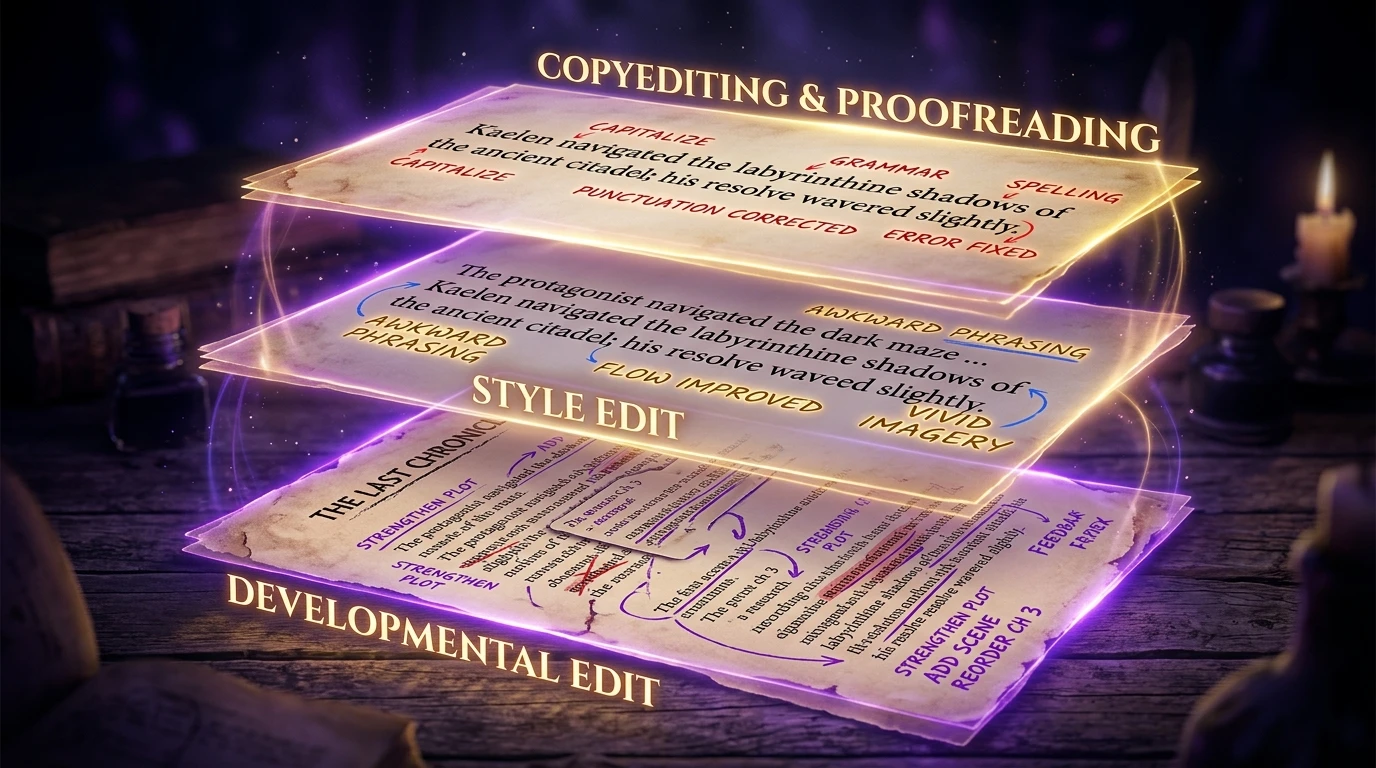
Half of all quote-shock comes from here: comparing a copyedit with a developmental edit is comparing an oil change with an engine rebuild. The publishing industry distinguishes four levels, and each one assumes the previous one is already done:
| Type | What it covers | When it happens |
|---|---|---|
| Developmental editing | Structure, plot, characters, overall pacing, plot holes | With the draft finished, before anything else |
| Line editing | Sentence by sentence: clarity, repetition, filler words, register, rhythm | Once the structure is locked |
| Copyediting | Grammar, spelling, punctuation, consistency of style and usage | On the text that has already been line edited |
| Proofreading | Typos and layout slips on the formatted book | Final pass before print or ebook |
The order matters as much as the type. Each level takes the previous one for granted: nobody polishes the punctuation of a chapter that might need to be cut. That's why publishing houses edit in cascade, and why paying for a copyedit before the style work is done is throwing money away: every later rewrite will plant fresh typos.
How editors charge: per word, per page or per hour
Second source of confusion: the billing unit. Several systems coexist, and comparing quotes without unifying them is like comparing fruit prices when one vendor sells by the pound and another by the piece.
- Per word. Dominant in the US and the easiest to check: multiply your word processor's count by the rate.
- Per manuscript page. The industry convention equates one manuscript page with about 250 words — a double-spaced typed page. Some editors still quote this way; divide the page rate by 250 to get the per-word figure.
- Per hour. Common in the US. It's the least comparable unit, because it depends on the professional's pace and on the state of your text.
- Flat project fee. Some editors quote a single figure for the whole manuscript after reading a sample. Fine — as long as you can divide it by your word count and see what you're actually paying per word.
The conversion is grade-school arithmetic: at roughly 250 words per manuscript page, an 80,000-word novel runs about 320 manuscript pages. With that, you can reduce any quote to dollars per word and compare for real. If a quote is hourly, ask one more question: how many words per hour does the editor average on a text like yours? Without that number, an hourly rate tells you nothing.
US rates: what the EFA publishes
The US market has something most others lack: an association that publishes median rate ranges by specialty. The Editorial Freelancers Association (EFA) surveys its members (latest survey: November 2025 to January 2026; consulted July 22, 2026) and publishes these ranges for fiction:
| Type (fiction) | $ per word | $ per hour |
|---|---|---|
| Developmental editing | $0.030–0.035 | $52.50–70 |
| Line editing | $0.027–0.035 | $50–60 |
| Copyediting | $0.020–0.027 | $40–50 |
| Proofreading | $0.012–0.020 | $35–45 |
Two warnings before you quote this table at anyone. First: these are median ranges declared by surveyed professionals, not guaranteed prices; plenty of editors charge above and below them. Second: the rates apply to your word count, so a 120,000-word epic costs half again as much to edit as an 80,000-word debut — if you're not sure where your manuscript should land, here's how many words a novel usually runs, genre by genre.
Rates beyond the US: Spain and Latin America
If you write in Spanish, work with a Spanish-language editor or are just curious how the US compares, here's the short version of the global picture. In Spain there is no official rate card — competition law even bars professional associations from publishing recommended prices — but individual editors publish theirs openly: public rate cards such as Estilográficas Corrección and Núria Masdeu (both consulted July 22, 2026) run roughly €0.010–0.015 per word for a copyedit and €0.015–0.018 for combined line-and-copy work, plus 21% VAT. In Argentina, two professional bodies — PLECA and Más para más — publish suggested minimum schedules in pesos, updated for inflation through 2026. Elsewhere in Latin America the usual model is an individual quote after a sample, often priced per cuartilla (a page unit of about 1,800 characters with spaces).
One practical warning if you hire across borders in either direction: ask which currency the invoice is issued in and who absorbs the conversion and transfer fees. An excellent quote can stop being excellent with 6% of fees stacked on top.
Worked example: editing an 80,000-word novel
Let's land all of the above on the most typical case: an 80,000-word novel — the classic debut length. These figures come exclusively from the EFA per-word ranges cited above, with their source and date; they are not market averages and don't pretend to be:
| Type of editing | EFA range ($/word) | Cost for 80,000 words |
|---|---|---|
| Developmental editing | $0.030–0.035 | $2,400–2,800 |
| Line editing | $0.027–0.035 | $2,160–2,800 |
| Copyediting | $0.020–0.027 | $1,600–2,160 |
| Proofreading | $0.012–0.020 | $960–1,600 |
How to read it: multiply the per-word rate by 80,000 and you get each cell — no magic, just arithmetic you can redo for your own word count. For European context, the same novel in Spain would run roughly €440–1,200 for a copyedit and €660–1,440 for line-and-copy work by the published rate cards cited in the previous section, plus VAT.
And if you need more than one pass? That's the normal case: line editing first, copyediting after. Adding the EFA ranges, the combined package for 80,000 words lands between $3,760 and $4,960 — before any proofread of the formatted book. It's not cheap. Which is exactly why the smart move is to make the part you can do yourself as cheap as possible.
What you can do with AI before you pay
Editors set their final price after evaluating a sample of your text. That's the variable you control. A manuscript that arrives clean gets edited faster, qualifies for the low end of per-word ranges and, if you're billed hourly, burns fewer hours. Every typo you catch yourself is professional time you don't pay for.
This is where an AI that knows your novel changes the game. In Scriptum, the Aura assistant works inside the editor and with the context of your story, so you can run a systematic self-edit in passes, each with a single goal (you can see how Aura works inside Scriptum):
- Pass 1 — Repetition and filler words. Ask Aura to flag words repeated within the same paragraph, your personal crutch words ("just", "suddenly", "then") and catch-all verbs. It's exactly the kind of grime a line editor charges to scrub.
- Pass 2 — Agreement and tenses. Subject-verb agreement slips, unjustified tense jumps, pronouns without a clear antecedent. Mechanical errors AI detects reliably, chapter by chapter.
- Pass 3 — Rhythm. Sentences longer than three lines, chains of -ly adverbs, monolithic paragraphs. Ask for a diagnosis and decide what to rewrite yourself: the judgment stays yours.
- Pass 4 — Internal consistency. Names that change spelling, eyes that change color, impossible timelines. With Scriptum's World Bible, Aura checks the text against your character and location sheets instead of trusting memory.
How much does this cut the bill? Let's be honest: there is no universal percentage to promise, and anyone who promises one is lying. What is verifiable is the mechanism: professional rates are set after a sample is assessed, and the spread between the low and high end of a single source can top 50%. Arriving clean is the most direct way to fight for the low end. There's also a bonus that doesn't show up in any table: a clean text lets the professional concentrate on what genuinely elevates the novel, instead of spending their hours on commas.
What AI does not replace (and it's worth saying clearly)
We're an AI software company and we'll still say it straight: AI does not replace professional human editing; it prepares for it. There are three things it can't give you today:
- Editorial judgment. Deciding that a subplot is dead weight, that chapter 12 should come before chapter 9 or that your narrator loses steam in the second act requires reading the way an editor reads: with craft, with distance and with responsibility for the whole. An AI can point at symptoms; the developmental diagnosis is still human.
- The last typographic mile. Professional copyediting applies fine points of style and usage — em dashes and quotation marks, consistency across 400 pages, the edge cases of The Chicago Manual of Style — with a hit rate that is precisely what you're paying for. AI cuts the noise dramatically, but it doesn't sign off on that final pass with professional guarantees.
- The accountability of a contract. A professional editor gives you a written quote, deadlines, an invoice and someone who answers if something goes wrong. That's a service with legal guarantees, not a software feature, and no tool — Aura in Scriptum included — pretends to take its place.
The sensible division of labor in 2026 is this: AI sweeps the mechanical layer with you in charge, and the professional brings the judgment and the guarantee. Anyone selling you AI-does-it-all is selling smoke; anyone telling you AI is useless is selling it too.
How to choose an editor and what to ask for in the quote
You now know what it can cost and how to arrive with a clean text. The most important part remains: choosing well. This is the checklist we'd use on our own novel:
- Sample edit. Two or three pages of your manuscript (many professionals offer one). It's the only way to see their judgment applied to your voice, not to somebody else's text.
- Type of editing in writing. The quote should say "line editing" or "copyediting", spell out exactly what it includes and how many rounds (a serious edit usually includes a review of the changes).
- Unit, rate and count. The editor's trick from above: dollars per word or per page, applied to which count, produced by which tool.
- Deadline and payment terms. A delivery date in writing and a payment schedule (paying by milestones protects both sides).
- Taxes and fees. Is the price final? Who absorbs payment-platform or currency-conversion fees if you're hiring across borders?
- Experience in your genre. Whoever edits romantasy doesn't apply the same criteria as whoever edits academic nonfiction. Ask for comparable titles.
- Tracked changes. Delivery with changes marked and comments, so you accept or reject each decision. It's your novel; the final word is yours.
And two symmetrical red flags: the ridiculously low price with no sample and no contract (nobody edits 80,000 words well for $100), and the sky-high quote that never specifies the type of editing or the deliverables. A cheap edit you have to redo is the most expensive edit of all.
Frequently asked questions
How much does it cost to edit a 100,000-word novel?
Using the EFA ranges cited in this article (consulted July 2026): copyediting would run $2,000–2,700 and line editing $2,700–3,500; developmental editing would reach $3,000–3,500 and proofreading $1,200–2,000. In Spain, published rate cards put the equivalent copyedit at roughly €550–1,500 and line editing at €830–1,800, plus VAT. These are calculations made with specific public rates, not market averages: always request a quote on your own manuscript.
Which comes first: line editing or copyediting?
Line editing first, then copyediting and, if the book is being typeset, proofreading at the very end. The reason is simple: line editing rewrites sentences, and every rewrite can introduce new typos. If you pay for a copyedit before the style work is done, you will end up paying for it twice.
Can I publish on Amazon without hiring an editor?
You can: Amazon KDP does not require professional editing. Whether you should is another matter. Typos are one of the most repeated complaints in negative reviews. If the budget will not stretch to everything, prioritize thorough AI-assisted self-editing and, at minimum, a professional copyedit before you publish.
Can AI replace a human editor?
No. AI is very good at catching the mechanical layer: repetition, filler words, agreement slips, obvious typos. But it does not replace a professional's editorial judgment, the fine final typographic pass or the accountability of a contract with deliverables and an invoice. Use it to arrive with a cleaner text and pay for fewer hours of professional work, not to skip the professional.
How do I know if a quote is reasonable?
Reduce everything to the same unit (price per word) and compare it against public ranges like the EFA's cited in this article. Ask for a sample edit of two or three pages, confirm which type of editing it includes and how many rounds, and be equally suspicious of the unjustifiably expensive and the suspiciously cheap.
How long does it take to edit a novel?
There is no published standard timeline: it depends on the length, on the condition of the text and on the editor's calendar. What is certain is that a full novel is measured in weeks, not days, and that rush jobs usually carry a surcharge. Get the deadline in writing in the quote and plan your publication date with margin.
What is a manuscript page and why do some editors charge by it?
A manuscript page is an industry convention equal to about 250 words: one double-spaced typed page. Some editors quote by page or by hour instead of by word. To compare quotes, convert everything to the same unit: divide any page rate by 250 to get a per-word rate, and for hourly quotes ask how many words the editor averages per hour on a text like yours.
Conclusion: pay for judgment, not mystery
So, how much does it cost to edit a novel? You now have the grown-up answer: for a typical 80,000-word manuscript, from about $960 for a proofread to $2,800 for a developmental edit by the EFA's published ranges, with Spain and Argentina publishing their own reference rates and much of the market working by individual quote. But don't obsess over the figure: obsess over knowing what you're buying. Decide the type of editing, unify the units, ask for a sample and a contract, and arrive with a manuscript so clean the professional can spend their hours on what genuinely elevates your book. Editing isn't the final toll of writing; it's the last rewrite, only with expert help. If you're deciding what path your novel takes next, we'll leave you the comparison of self-publishing versus traditional publishing and the step-by-step guide to publishing on Amazon KDP. The best money you'll spend on your novel is the money that arrives after you've done your part.