Most published adult novels run between 70,000 and 100,000 words, but no official body signs off on that figure: it's a convention of the publishing market, and every genre stretches or shrinks it. Here are the ranges the industry's own guides publish, source by source, a calculator to convert words into pages, and the idea that puts everything else in order: a novel is as long as its story needs to be, not one scene more.
It's the question every novelist asks before starting and the one almost nobody answers honestly: how many words is a novel? The short answer exists, and you'll get it in the first section. The full answer is more interesting, because behind that number sit publishing economics, reader expectations and half a century of conventions nobody ever voted on. In this guide you'll see where the numbers come from, what range your genre expects, how to translate words into pages and what to do if your manuscript runs over or falls short. If you're building your book from scratch, keep the guide on how to write a novel from start to finish within reach too.
The short (and honest) answer
A typical adult novel runs between 70,000 and 100,000 words. That's the range the industry's most consulted guides repeat: the publishing platform Reedsy gives it as the standard, and Writer's Digest, the reference magazine for working writers, narrows it further: between 80,000 and 89,999 words sits what it calls the safe zone for adult commercial and literary fiction.
Now the honest part, the one almost no article tells you: there is no official figure. No international bureau of the novel certifies lengths, and no rule exists for a manuscript to break. What exists is a market convention, built by the publishing industry, that rests on three very earthly legs: production cost (more pages, more paper, more expensive to print and distribute), reader expectation (whoever buys a thriller expects a thriller-sized book) and commercial risk (betting on a 200,000-word debut costs twice as much as betting on a 90,000-word one). Reedsy sums it up quoting an editor: long books are, simply, more expensive to produce.
That's why this article won't present any figure as law. It will tell you, range by range, who publishes it and where, so you can judge with the cards face up. Where two sources contradict each other — and they do — you'll see it flagged.
What counts as a word and why the industry doesn't count pages
Everything counts: the dialogue, the articles, every "and", every "the". The count your word processor shows — tokens separated by spaces — is the one the whole industry uses. No connectors are discounted and no long words are weighted: 80,000 words are 80,000 words, whatever letters they carry.
And why words instead of pages? Because the page is a treacherous unit. It depends on the font, the size, the leading, the margins and the trim: the same text can fill 250 pages in a cramped mass-market paperback and 400 in a large-print edition. The word, on the other hand, is identical on your laptop, in the agent's copy of the manuscript and at the printer. That's also where the old convention of the typed manuscript page comes from — double-spaced, typewriter font — which ran about 250–300 words and still survives in people's heads whenever someone says "my novel is 300 pages long".
The practical consequence: when the industry asks about your novel, answer in words. And one point of professional etiquette: the custom when querying is to round the count to the nearest thousand (you say "87,000 words", not "87,214"). The exact figure is for you and your desk; the rounded one is for the query letter. When you want to picture how much physical book all that is, use a conversion with declared assumptions — like the calculator coming up next.
Calculator: from words to pages (and back)
Type your figure, pick a format and watch the result live. The conversion assumptions are in plain sight, because an estimate without assumptions is a guessing game.
Words ⇄ pages calculator
≈ 291 pages
Assumption applied: standard manuscript, ≈275 words per printed page; real layouts vary.
Real layouts vary with font, size and leading: this is an editorial estimate, not a promise from the printer.
With this you can translate any range in the table below. And if you write in Scriptum, this math is done for you without asking: the live counter per chapter and per book updates as you type.
The table: how many words by genre
Every genre has its own contract with the reader, and length is part of that contract: fantasy needs room to build a world, a thriller punishes every page that doesn't tighten, middle grade respects the reading stamina of a ten-year-old. These are the ranges published by three open industry guides — Reedsy, Writer's Digest and The Write Life — plus the Nebula Awards rules for the shorter forms. Read them as guidance for a traditionally published debut: in self-publishing the margin is wider.
| Genre | Usual range (words) | Who publishes that range |
|---|---|---|
| Literary fiction | 80,000–100,000 (can drop to 60,000) | Reedsy; Writer's Digest puts the ideal at 80,000–89,999 |
| Crime / thriller | 70,000–90,000 per one source; 80,000–100,000 per another | The Write Life (70,000–90,000); Reedsy (80,000–100,000) |
| Romance | 70,000–100,000; short subgenres from 40,000 | The Write Life; Reedsy (80,000–100,000) |
| Fantasy | 90,000–120,000, with epics reaching 150,000 | The Write Life; Writer's Digest recommends 100,000–115,000 |
| Science fiction | 100,000–115,000 | Reedsy and Writer's Digest agree |
| Historical fiction | 80,000–100,000 | The Write Life |
| Young adult (YA) | 50,000–80,000 | The Write Life; Writer's Digest narrows it to 55,000–79,999 |
| Middle grade (ages 8–12) | 20,000–55,000 per one source; 25,000–40,000 per another | Writer's Digest (20,000–55,000); The Write Life (25,000–40,000) |
| Novella | 17,500–40,000 for the Nebulas; 30,000–50,000 per The Write Life | Nebula Awards rules (SFWA); The Write Life |
| Short story | Under 7,500 for the Nebulas; up to 30,000 in looser usage | Nebula Awards rules (SFWA); The Write Life (1,500–30,000) |
Notice that the sources don't always agree, and that isn't an error in this table: it's the demonstration that we're talking about conventions, not rules. Reedsy puts the thriller at 80,000–100,000 and The Write Life at 70,000–90,000; on the novella, the Nebulas close the border at 40,000 words and The Write Life stretches it to 50,000. Each guide describes the slice of the market it knows best. When you have to pick one reference, stay in the zone where the ranges overlap: it's hard to go wrong there.
Novel, novella and short story: where the borders are
At which exact word does a long story become a novella, and a novella a novel? The most honest answer: at whichever word the people running the award you're entering say it does. The most cited borders in publishing are those of the SFWA, the Science Fiction and Fantasy Writers Association, because its Nebula Awards need exact limits to classify works. They are these:
| Form | Length (Nebula Awards) |
|---|---|
| Short story | Under 7,500 words |
| Novelette | 7,500 to 17,499 words |
| Novella | 17,500 to 39,999 words |
| Novel | 40,000 words or more |
Source: official Nebula Awards rules. Now the important nuance: these are the rules of an award, not a law of literature. Other prizes draw their own lines and common usage is fuzzier still. The novella tradition — that in-between jewel where classics like The Old Man and the Sea, Of Mice and Men and A Christmas Carol live — proves the short shelf isn't a novel that fell short, but a form with its own way of breathing. And one data point that unsettles a lot of people: according to the count popularized by the NaNoWriMo challenge, The Great Gatsby has 47,094 words. One of the most celebrated American novels of the twentieth century wouldn't clear the minimum many agencies now expect from a debut. The borders are drawn by humans with specific interests; it's worth knowing that before treating them as dogma.
Is your manuscript too short? Signs and fixes
You've finished the draft, the counter reads 52,000 words and your genre asks for 90,000. Before you panic, diagnose. A short manuscript is almost never a quantity problem: it's a symptom of story left untold. The typical signs:
- The plot moves in a straight line. The protagonist wants something, tries and succeeds. Missing are the "no" before the "yes", the setbacks along the way, the price of every victory.
- The key scenes are summarized. "They argued all night and in the morning she was gone" is an entire scene compressed into one sentence. If your moments of highest emotional charge fit in a paragraph, you're telling instead of showing.
- The supporting cast is furniture. They enter, serve their function and vanish without desires or arcs of their own.
- The world doesn't breathe. No sensory texture, no life around the central conflict.
The fixes follow the same order and none of them is "add padding": dramatize the summarized scenes (turn that "they argued all night" into the argument, with its silences and its slammed doors), add a subplot that pressures the main one (not a decorative parallel: one that crosses it), give a supporting character a goal that gets in the protagonist's way and make every victory pay a toll. Check the interiority of your point of view too: in short drafts, the first thing missing is usually what the protagonist thinks and doesn't say. Lengthening isn't fattening: it's finishing the telling you left halfway. If you can't see where those gaps are, an outside read helps; and if you write in Scriptum, you can ask Aura to flag which scenes are told in summary and deserve to be dramatized.
Too long? What to cut first
The opposite problem is more common than it looks, especially in fantasy. If your debut sits at 160,000 words and your genre expects 110,000, trimming adverbs won't save you: you prune the structure first and the sentence after. This is the order of return:
- Scenes that repeat a function. If two scenes teach the same thing (the villain is cruel, the couple has chemistry), keep the better one. It's the most painful cut and the one that frees the most words.
- The late start. Many manuscripts begin two or three chapters before their story does. Find the first scene where the conflict is already moving and consider opening there; the guide on how to start a novel gives you the criteria.
- Subplots that never touch the main plot. If you can remove it and the central story doesn't notice, you already know the answer.
- Social dialogue. Greetings, goodbyes and courtesies without subtext. Enter every conversation late and leave early.
- The sentence-level pass. Only at the end: adverbs, redundancies, crutch words. This is where you win the last 5,000 words, not the first 30,000.
A yardstick for every scene: does anything change between its first line and its last? The power, the information, the relationship? If nothing moves, the scene is expendable no matter how prettily it's written. Killing your darlings hurts less when you remember that a cuts file deletes nothing: what leaves the novel can live in another. And there's a bonus nobody mentions: professional editing is billed by length — here's what it costs to edit a novel — so every scene you cut also trims that bill.
How many words per chapter?
Here honesty is even more necessary: there is no canonical chapter length, and whoever sells you one is selling smoke. What there are, are observable customs. Run the numbers yourself with public data: the first Harry Potter has 76,944 words spread across 17 chapters — about 4,500 words per chapter on average. At the other extreme, thriller writers like James Patterson have made two-page chapters a house trademark. Both work, because the chapter isn't a unit of measurement: it's a unit of tension.
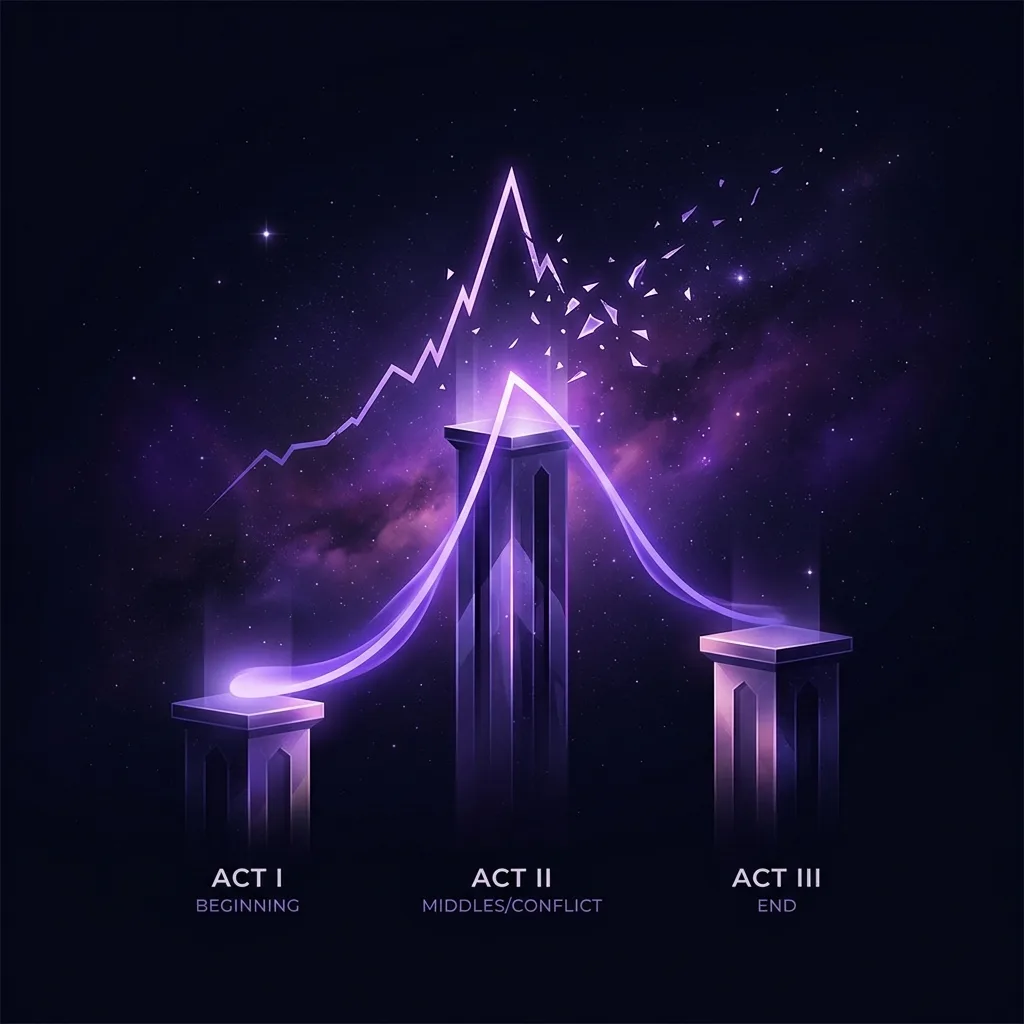
The practical rule: a chapter ends where the reader has a reason to turn the page, not where the counter hits a round number. That said, regularity helps: chapters of similar length create a reading rhythm the reader appreciates without knowing it, especially if they read in stolen minutes. And chapter length talks to the architecture of the whole book: if yours isn't clear yet, start with the three-act structure.
The mistake of writing for the number
Knowing the ranges has a dangerous side effect: starting to write for the number. It shows immediately. Manuscripts bloated with descriptions nobody asked for to scratch out 90,000, or amputated of necessary scenes to stay under 110,000. In both cases the author stopped serving the story to serve the statistic, and the reader — who doesn't know the ranges but can smell the padding and the holes — pays for it.
The NaNoWriMo case illustrates it well. For a quarter of a century, the November challenge proposed writing 50,000 words in 30 days; its founder picked the figure because it hovered near the length of a short novel like The Great Gatsby. As a habit engine it was a marvel: 1,667 words a day for a month changes your relationship with the blank page. But 50,000 was the goal of a challenge, not the industry's definition of a novel, and confusing the two left a lot of people convinced they had finished a novel when they had finished an excellent first sprint. The organization shut down in 2025; the figure survives in writing culture, and it's worth remembering it for what it always was: a training target.
Length is a consequence, not a goal. First you finish the story; then you measure it; and only then, if the distance to your genre's range is large, do you revise with the tools of the two sections above.
How to track your count without obsessing
Between counter obsession and total ignorance there's a healthy spot: measure little, but measure well. Three habits are enough:
- A session goal, not a book goal. "Today, 500 words" is actionable; "I still need 40,000" is just a slab. Pick a daily figure you can hit on your worst day, and raise it when it gets small.
- A weekly trend, not a daily balance. Checking the total every ten minutes is the writer's version of watching the mirror while on a diet. Review once a week: the curve informs, the tic craves.
- Count in drafting, discount in revision. In a first draft, added words are progress. In revision, progress often means subtracting. Switch metrics with the phase and don't punish yourself for "going backwards" when you're polishing.
For this, tools matter. In Scriptum the counter runs live per chapter and per book: as you write you see the words of the scene, the chapter and the full manuscript, without leaving the editor or adding up documents by hand, and with writing goals to sustain the routine. Knowing at all times how much each chapter weighs turns the ranges in this guide into useful information instead of anxiety. And if your struggle isn't measuring but reaching the end, there's a dedicated guide to finishing a novel without abandoning it.
Frequently asked questions
How many words is a “normal” novel?
Most published adult novels run between 70,000 and 100,000 words, with the area around 80,000 as the most common landing zone. It is not an official rule: it is the convention that agents, publishers and industry platforms publish again and again, with significant variation by genre.
Is 50,000 words a novel?
Depends who you ask. For the Nebula Awards, anything over 40,000 words already counts as a novel; for the now-closed NaNoWriMo challenge, 50,000 was the goal of the event, not an industry standard. In the traditional adult market, 50,000 words is considered short for a debut in most genres, though it fits novellas, young adult and shorter romance well.
How many pages is 80,000 words?
In standard manuscript format, at about 275 words per page, 80,000 words come to roughly 291 pages. In a dense mass-market paperback, at about 300 words per page, around 267; and in a 6×9 trade paperback, at about 350, close to 229. Real layouts vary with font, size and leading: always treat it as an estimate.
What is the minimum length to publish on Amazon KDP?
Amazon KDP does not set a minimum word count for ebooks, though since 2013 it has removed titles under roughly 2,500 words as overly short content. For paperbacks the technical minimum is 24 pages. That you can publish short does not mean you should: readers expect to receive what the product page promises.
How many words should a chapter be?
There is no canonical figure. Run the numbers with public data and the 17 chapters of the first Harry Potter average out at about 4,500 words, while some thriller writers work with chapters under 1,000. The useful rule is about tension, not measurement: a chapter ends where the question stays open.
Will publishers reject a manuscript over its length?
A figure far outside the range does not usually trigger an automatic rejection, but it does set off an alarm: long books cost more to produce, and a 200,000-word debut multiplies the publisher's risk. That is why industry guides talk about “safe” ranges. An extraordinary story can break the convention; an average manuscript should not try.
How many words is the Harry Potter series?
According to published counts, the complete series adds up to around 1,084,170 words in its original edition. The first book has 76,944 and the fifth, the longest, 257,045. It is proof that the ranges are elastic: the same author can triple their length once readers are already inside the story.
How do I count the words in my manuscript?
Any word processor has a counter: Word and Google Docs show it in the bottom bar. The real upgrade is counting in units that mean something: in Scriptum you get a live count per chapter and per book as you write, with session goals, so you can see at a glance where your novel is growing and where it has fallen short.
Conclusion: the number serves the story
Keep the complete map: the adult novel lives between 70,000 and 100,000 words, every genre negotiates its own contract, the borders with the novella and the short story are drawn by awards and customs — not laws — and the serious sources don't even fully agree with each other. Far from being a problem, that's your freedom: the ranges tell you where the market plays, and your story decides where it plays. Write first, measure after, adjust at the end.
And when you measure, do it with the tool on your side: a live counter, session goals and a clear view of how much each chapter weighs. Because the number exists to serve the craft, never the other way around. A novel is as long as its story needs to be, not one scene more.