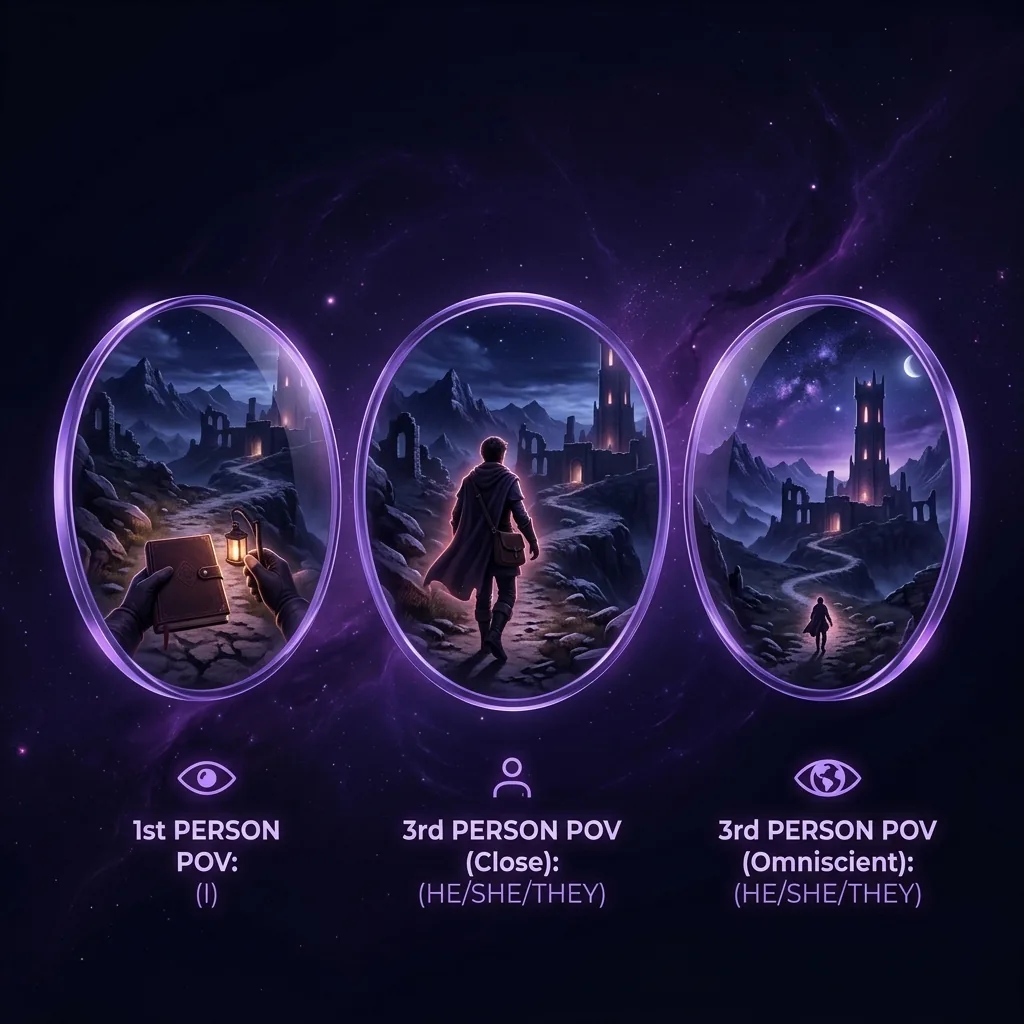
Point of view is whose eyes you tell your story through, and it's one of the first decisions that shapes how the whole novel will feel. You have three big options: first person ("I"), which gives maximum intimacy and voice; second ("you"), rare and experimental; and third ("he/she"), which can be limited (close to one character), omniscient (a narrator who knows everything), or objective (a camera with no access to minds). For most novels, third person limited is the most versatile choice. Whichever you pick, the golden rule is consistency: the reader will tolerate any point of view except an uncontrolled one.
Before you write the first sentence of your novel you make, almost without noticing, a decision that conditions everything: who is telling this? Point of view isn't a minor technical detail but the lens through which the reader will live hundreds of pages. It changes the intimacy, the information you hide or reveal, the voice, and even the tension. In this guide you'll see the three fundamental points of view, their variants, when each one fits, and the mistakes that make a manuscript look like a beginner's. If you're still shaping your project, you can start with our guide on how to write a novel and come back here to decide on your narrator.
What is point of view?
Point of view (or perspective) is the position from which a story is perceived and told: it defines who sees the events and who relates them. It determines which thoughts the reader has access to, what information is kept from them, and what tone and closeness the narration will have. It's not the same for the reader to know only what one character knows as it is to know everything: that difference is, to a large extent, what we call point of view.
1. First person: the voice of "I"
In first person, a character narrates their own story: "I opened the door and knew something was wrong." It's the most intimate point of view and the one that most easily creates a recognizable voice. The reader is glued to the narrator's consciousness, shares their emotions and their judgments, and that generates an immediate complicity.
Its great strength is also its limit: you can only tell what that character sees, knows, or deduces. You can't show what's happening in another room or get inside anyone else's head. That limitation, used well, is gold: it enables the unreliable narrator, the one who lies, deceives themselves, or hides information, and who turns the voice itself into a mystery. The most common risk is filtering: saturating the text with "I saw," "I felt," "I thought," which pushes the reader away instead of pulling them closer. Rather than "I saw her hands trembling," it's almost always stronger to write "her hands were trembling."

2. Second person: the uncommon "you"
In second person, the narrator addresses a "you" who is the protagonist: "You open the door and you know something is wrong." It's the rarest and riskiest point of view. Done well, it produces a hypnotic immersion and a unique sense of immediacy; done badly, it tires quickly and feels like a gimmick. It works in short stories, in specific passages, in experimental fiction, and in interactive fiction (the "choose your own adventure" gamebooks). For a long, conventional novel it's rarely the best choice, but it's worth knowing: being aware that it exists helps you understand the other two better.
3. Third person: the flexible narrator
In third person, someone external tells what happens to the characters: "She opened the door and knew something was wrong." It's the most widely used point of view in modern fiction because it offers a whole range of distances. Within third person there are three variants worth not confusing:
- Third person limited. The narrator stays close to a single character per scene and tells only what that character perceives and thinks. It combines the flexibility of third person with much of the intimacy of first. Today, it's the dominant choice.
- Third person omniscient. A narrator who knows everything: accesses any character's mind, knows the past and the future, comments and judges. It was the norm in the 19th-century novel (Tolstoy, Austen) and allows a panoramic view, at the cost of some emotional distance.
- Third person objective. The narrator is a camera: it shows actions and dialogue but enters no one's mind. It creates coldness and mystery; the reader infers the interior from the gestures. The classic example is Hemingway's "Hills Like White Elephants."
Comparison table: what each point of view chooses
| Point of view | Access to the mind | Intimacy | Best for |
|---|---|---|---|
| First person | The narrator only | Maximum | Strong voice, unreliable narrator, memoir, young adult |
| Second person | The "you" protagonist | High but strange | Experimental, short story, interactive fiction |
| 3rd limited | One character per scene | High | Most novels; thriller, fantasy, romance |
| 3rd omniscient | All characters | Medium | Ensemble sagas, epic, classic novel |
| 3rd objective | None | Low (deliberate) | Mystery, distance, minimalist style |
Head-hopping: the mistake that gives the beginner away
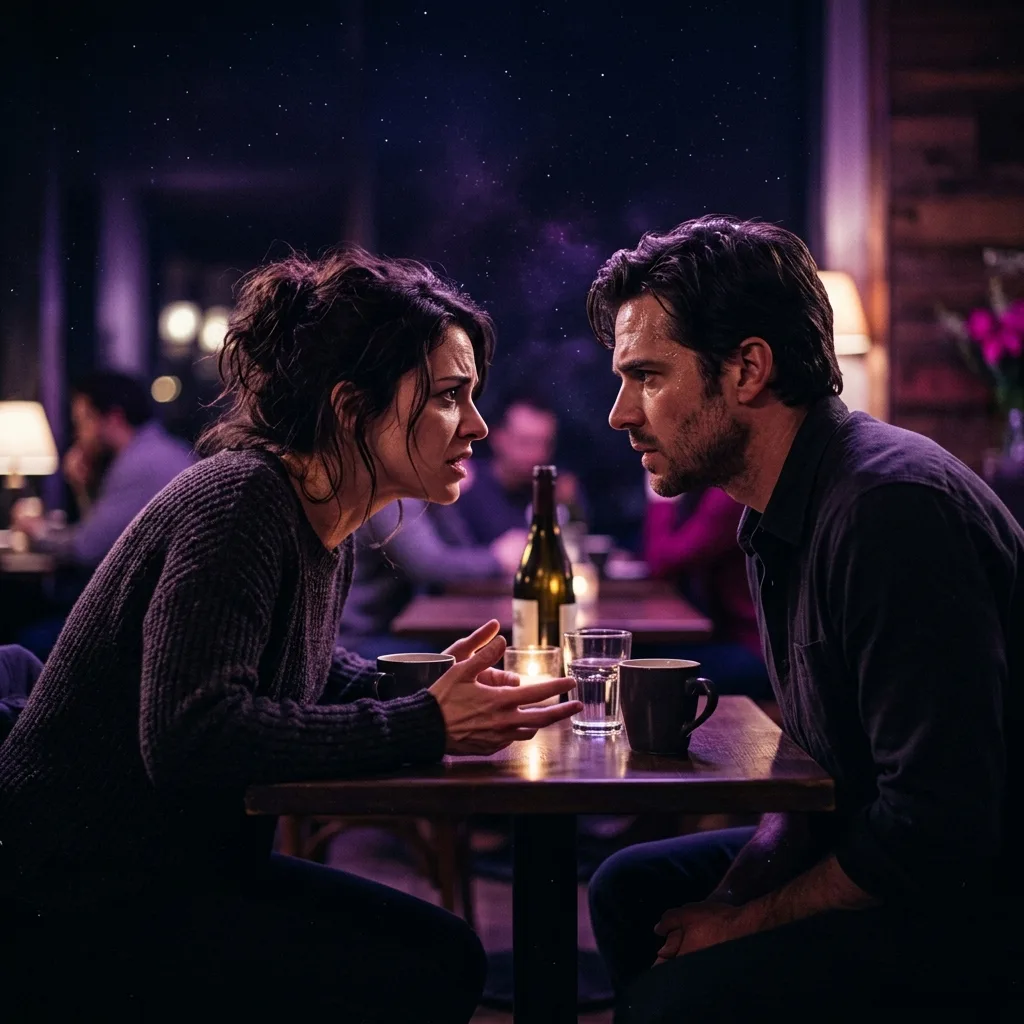
The most frequent slip with third person limited is head-hopping: jumping from one mind to another within the same scene with no transition. In one paragraph we know what Ana is thinking; in the next, suddenly, what Marcos feels; then we're back to Ana. The reader gets dizzy because they never know whose gaze it is. Careful: this is not the same as the omniscient narrator, who accesses several minds in a deliberate and controlled way. The difference between omniscience and head-hopping is control. If you want to switch point of view, do it at a scene or chapter break, never mid-paragraph.
The reader forgives almost any point of view. What they don't forgive is not knowing, at every moment, whose eyes they're looking through.
Narrative distance and voice
Within a single point of view you can move closer to or further from the character's mind. That graduation is called narrative distance, and it ranges from the wide shot ("She was a forty-year-old woman who lived alone") to free indirect discourse, where the narrator's voice merges with the character's thought without quotation marks ("Now what? She wasn't going to sit there waiting like an idiot"). Mastering that distance is what separates flat prose from living prose. Voice, moreover, is born from point of view: the character's way of speaking, their judgments, and their obsessions filter every sentence. That's why it's worth working on point of view alongside your characters and the way they speak, closely tied to how you write believable dialogue.
How to choose your novel's point of view
There's no best point of view in the abstract; there's a best one for your story. These questions help you decide:
- Is the strength in a voice? If your protagonist has a unique or unreliable way of seeing the world, first person squeezes the most out of it.
- Do you need several threads? If there are parallel plots and several characters with weight, third person limited alternating between chapters is ideal.
- Do you want a panoramic or ironic gaze? The omniscient lets you comment and span generations, at the cost of closeness.
- Are you after mystery and coldness? The objective hides the interior and forces the reader to deduce it.
A practical trick: write the same key scene in two different points of view and read them aloud. Almost always, one of the two "sounds" like your novel and the other doesn't. That decision, remember, conditions the structure and what you can show; it's worth making it early, though nothing stops you from changing it in a rewrite if you discover you got it wrong.
How to hold your point of view in Scriptum
The real challenge of point of view isn't choosing it but sustaining it across the whole novel. It's very easy for a thought to slip in at chapter 22, when you're tired, from a character whose head you shouldn't be inhabiting in that scene. Scriptum's immersive editor helps you focus on one scene at a time, and Aura AI, which knows your characters through the World Bible, can flag when a perspective shift or an unintentional head-hop has crept in. You decide the point of view; the tool helps you not betray it by accident.
Common point-of-view mistakes

- Head-hopping. Jumping from mind to mind in the same scene. Switch point of view only at clean breaks.
- Filtering in first person. Overusing "I saw," "I felt," "I thought." Showing what's perceived directly is usually enough.
- Breaking the limitation. Telling in third person limited something the focal character can't possibly know.
- Omniscience without intent. Believing you're writing omniscient when you're actually losing control of a third person limited.
- Changing tense by accident. Starting in the past and sliding into the present (or vice versa) through carelessness.
Frequently asked questions
Which point of view is best for a first novel?
For most first novels, third person limited is the safest and most versatile choice: it gives you the intimacy of getting inside a character's head without the rigidity of first person and without the runaway risk of the omniscient. Pick one character per scene, tell only what they perceive and think, and hold that discipline. If your story needs a very distinctive voice or an unreliable narrator, first person may work better.
What's the difference between narrator and point of view?
Point of view is whose eyes the story is seen through (who perceives); the narrator is who tells it (who speaks). They often coincide, but not always: in third person limited the narrator speaks in third person yet filters everything through one character's perception. Telling them apart lets you control narrative distance: how close the reader gets to the character's mind.
What is head-hopping and why is it a mistake?
Head-hopping is jumping from one character's mind to another's within the same scene with no transition, in a third person that's supposed to be limited. It disorients the reader and breaks immersion, because they never know whose gaze they're behind. It shouldn't be confused with the omniscient narrator, who accesses several minds deliberately and in a controlled way. If you want to switch point of view, do it at a scene or chapter break, not mid-paragraph.
Can I switch point of view throughout the novel?
Yes, and it's common: many novels alternate the point of view of several characters, usually switching with each chapter or scene, not within the same one. The key is consistency and clarity: make it clear from the first line of each section whose gaze it is, and keep the rule stable throughout the novel. What confuses the reader isn't the switch, but the uncontrolled switch.
Which tense should I write in, past or present?
The past is the dominant convention and the most invisible to the reader: it tells events as already happened. The present brings immediacy and tension, widely used in first person and young adult fiction, but it tires in long works and limits time jumps. Tense is independent of point of view: you can narrate in first person and past, or in third and present. Choose the one that holds your story's tone and be consistent.
Conclusion: the lens changes everything
Choosing point of view is choosing the lens through which the reader will live your novel. First person draws close and gives voice; third person limited combines intimacy and flexibility; the omniscient encompasses; the objective hides and suggests; the second experiments. None is superior: the best is the one that serves your story and that you're able to sustain without cracks all the way to the last page. Decide it early, test it in one scene, and above all be consistent: that's the difference between a novel that envelops and one that disorients.
If you want a tool that helps you focus on one scene at a time and watch that you're not betraying your point of view, that's exactly what Scriptum's editor with Aura AI does. And if you want to dig into the theory, you can check the entry on narration and point of view on Wikipedia.