Want to write a book but don't know where to start? Do this: decide what kind of book it will be (a novel, a memoir, or non-fiction), sum up your idea in a single sentence, sketch a six-line plan, and commit to writing 200 words a day without correcting yourself. You don't need innate talent or months of free time: you need a small plan and consistency. This guide gives you both, step by step.
If you got here by typing exactly that into Google — "I want to write a book but don't know where to start" — you should know two things. First: you're not alone; it's one of the fastest-growing searches this year. Second: your problem is almost never technical. You're not short on vocabulary or grammar. You have too much fear and no plan small enough to start today. This guide takes care of both, in that order.
Breathe: wanting to write a book is already the first step
Let's start by taking a weight off your shoulders: your impulse is universal. In 2002, the essayist Joseph Epstein estimated in The New York Times that 81 % of Americans believe they have a book in them. Eight out of ten people. And yet only a tiny fraction ever writes the first page, and an even smaller fraction finishes the draft.
The difference between the people who write a book and the people who only wish they had isn't talent: it's that some start and others don't. And you've already done something most people never do: search for how to start. Nobody searches for how to start something they don't truly care about.
So no, you're not too late. You don't need permission, or a master's degree in creative writing, or to have read all the classics. You need to dismantle three fears and follow five concrete steps. Fears first, because they're what's keeping you stuck.
The three fears keeping you stuck (and why they don't matter)
Almost nobody who wants to write a book is blocked by not knowing how to use commas. They're blocked by one of these three sentences playing on a loop. Let's defuse them.
- "I'm not a writer." Correct: not yet. Nobody is before they write. Writer isn't a title someone grants you; it's an activity you practise: whoever writes regularly is a writer, full stop. Every author you admire started exactly where you are now, with the same impostor feeling. The difference is that they wrote anyway.
- "I don't have time." This fear rests on a false premise: that writing a book demands whole free afternoons. It doesn't. As you'll see below, with 15 minutes a day — about 200 words — you'll have the first draft of a novel in roughly a year. The honest question isn't "do I have time?" but "will I trade 15 minutes of phone for 15 minutes of book?".
- "What if it's bad?" It will be bad. We guarantee it, and it's the best news in this guide. Hemingway said that all first drafts are garbage, and he was talking about his own. A first draft isn't written to be good: it's written to exist. Nobody is going to read it. Bad writing can be rewritten; a blank page cannot. The bar for starting isn't "write well" — it's "write something".
There's a fourth, silent fear: the fear of getting it wrong without realising. Once your draft is under way, take a look at the 15 mistakes beginner writers make: you'll see we all make the same ones, and that none of them is irreversible.
Decide what book you want to write (and why)
"I want to write a book" is a wish; "I want to write THIS book" is a project. The first practical step is choosing your lane, because each type of book is planned differently. For a beginner, the three main lanes are these:
- A novel. An invented story with characters and conflict. Merriam-Webster defines it as an invented prose narrative of considerable length, and that "considerable length" usually translates into 70,000-100,000 words. It's the lane with the most technique to learn, but also the one with the most guides waiting for you.
- A memoir or family history. Your life, or your family's, told with the tools of narrative. You don't need to invent the plot: you need to choose the thread (a period, a relationship, a wound) and leave everything else out. It's one of the most valuable books in existence: nobody else can write it.
- Practical non-fiction. Teaching something you know: your trade, your method, your experience overcoming something specific. It's the most structured lane — it's closer to designing a course than to telling a story — and it works at shorter lengths, from 40,000 to 60,000 words.
Once you've chosen your lane, write your why on a sticky note and stick it where you write: "so my grandchildren know where they come from", "to prove to myself I can finish something", "to tell the story I wish I could have read". That sticky note isn't decoration: it's what will hold you up in week 7, when the enthusiasm dips. And if the lane is clear but the idea isn't, here's where to get ideas for a novel.
Your idea in one sentence: the premise
Before you write pages, write ONE sentence. It's called the premise, and it's your book summed up in under 30 words. If your idea doesn't fit in one sentence, it isn't clear yet; and if it isn't clear, the blank page will remind you of that every single day.
For a novel, the classic formula works: [protagonist] wants [goal] but [obstacle]. For example: "A retired pharmacist wants to find out who left an unsigned letter on her husband's grave, but every answer unearths a secret from her own marriage". With that sentence you already know who, what, and against what.
For a memoir, the premise is the thread: "The story of childhood summers in the village with my grandmother, and how that kitchen taught me everything I know about caring for others". For non-fiction, it's a promise to the reader: "This book teaches freelancers with no financial background how to get their numbers in order in 30 days". In all three cases, the premise does the same job: it gives you a compass for deciding what belongs in the book and what doesn't.
Write it today. Rough, without making it sound good. A clumsy premise that exists is worth infinitely more than a perfect one still in your head.
A minimal plan: the napkin outline
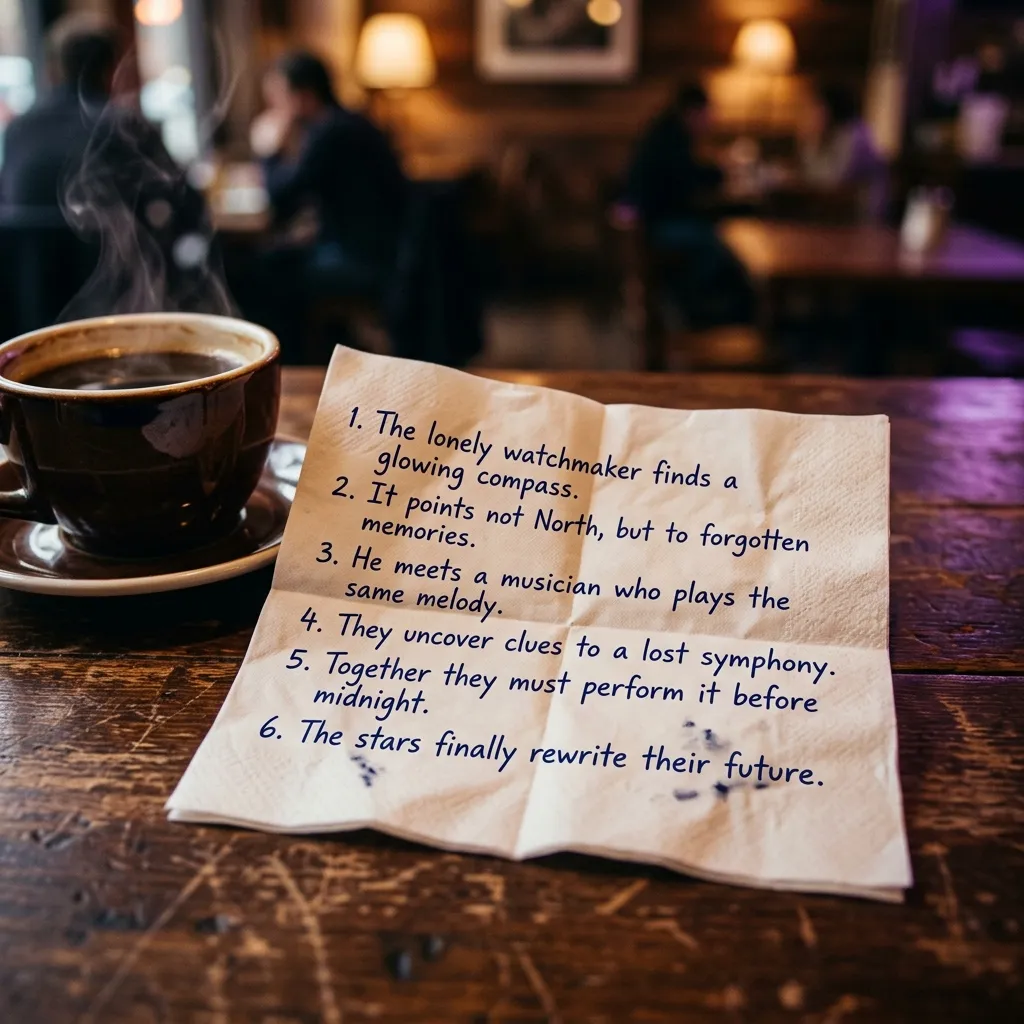
This is where many beginners sink: they believe that before writing they need a monumental outline. No. You need what we call the napkin outline: your story in six lines, a three-act structure stripped down to its essentials.
- 1. Who your protagonist is and what they want.
- 2. What event pulls them out of their normal life.
- 3. What first serious obstacle they run into.
- 4. What their worst moment is, when all seems lost.
- 5. What decision or discovery lets them try one last time.
- 6. How it ends and how they've changed.
Six lines. Ten minutes. If you're writing non-fiction or a memoir, the equivalent is a provisional table of contents: 8-12 chapters with one line each. In both cases the plan isn't a contract, it's a map: you can stray from it whenever the story asks you to.
What if improvising is more your thing? That works too. There are map writers and compass writers, and both finish books; in plotter vs pantser we help you find out which one you are. But even the purest improviser is grateful for those six lines on the day they get lost in the second act.
The minimum viable routine: 200 words a day
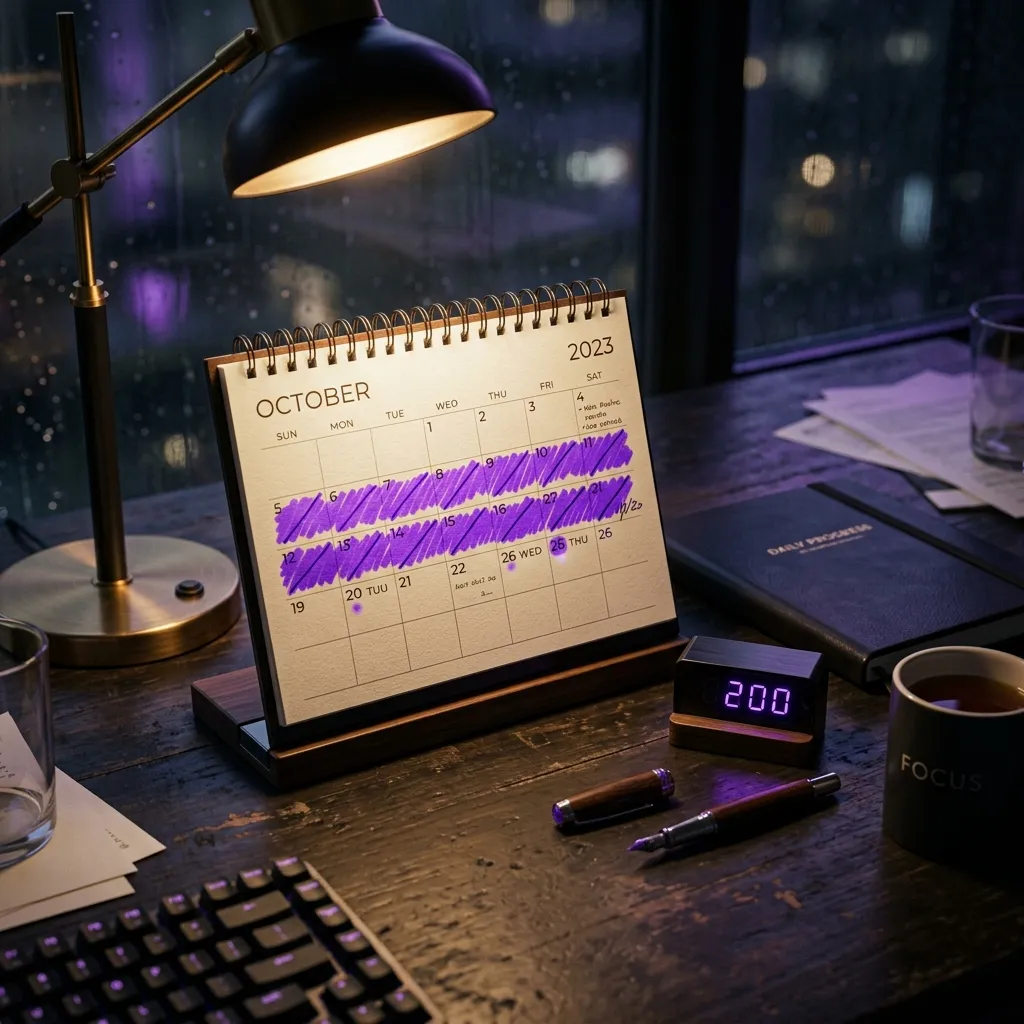
This is the step that separates the person who writes a book from the person who dreams about it, so let's do the maths slowly. 200 words a day is 73,000 words in a year. In other words: the complete draft of a novel, writing about 15 minutes a day. Half a page.
Why 200 and not 1,000? Because the goal of your first routine isn't to move fast: it's not to break. A tiny goal gets met even on the bad days, and meeting it daily builds the only thing that actually finishes books: the identity of someone who writes every day. Stephen King writes 2,000 words a day; you're not competing with him. You're competing with yesterday's you, who wrote zero.
Three rules to make the routine stick:
- Anchor your writing to a habit you already have. After your morning coffee, on the train, right after putting the kids to bed. Same time, same place, zero decisions.
- Make the streak visible. Mark every completed day on a calendar. Once you're twelve days in, you won't want to break the chain.
- On disaster days, one sentence counts. The streak measures consistency, not heroics.
Consistency beats inspiration hands down: it's the statistic behind the writers who finish. If you want to build the habit in detail, the complete guide is in daily writing routine: how to write every day.
Write the messy draft without correcting yourself
You now have a lane, a premise, an outline, and a routine. All that's left is the golden rule for each day's 200 words: write forward, never backward. No re-reading yesterday's pages to "improve them a little". No wrestling with one sentence for twenty minutes. If something grates, mark it "[FIX]" and move on. Revision exists, but it's another phase, done with another brain: writing and editing at the same time is driving with the handbrake on.
Nobody writes a book. You write a messy draft, and then you turn it into a book. Confusing those two phases is the number one reason first chapters get rewritten twenty times and books never get finished.
And the first page? Relax. It's normal for it to feel intimidating, but today you don't have to write it well: you have to write it badly on purpose, knowing you'll change it. When the time comes to work seriously on your first sentence and first chapter, that's another guide: how to start a novel. And if you want to see the full road waiting for you after the draft — revision, editing, publication — the whole map is in how to write a novel step by step. You don't need them today. Today you only need 200 messy words.
Where to write: the tools you need (and the ones you don't)
One last piece, and watch out for the trap: buying tools produces the same dopamine as making progress, without any of the progress. You don't need a new laptop, or a €500 course, or three writing manuals before you start. For the first few weeks, any word processor will do.
What you should demand from your tool, whichever one it is, are three things:
- One single place where the book lives. Chapters, notes, and characters together, not scattered across seven documents and three notebooks.
- Visible goals and streaks. Your 200-word routine needs a scoreboard. What gets measured gets maintained.
- Never losing anything, ever. Auto-save and backups. Losing a chapter kills more books than writer's block does.
When the project grows, you'll appreciate a writing studio designed for books rather than reports. Scriptum is exactly that: manuscript, characters, and notes in one place, daily goals and streaks so your consistency doesn't depend on willpower, and an AI that acts as a co-pilot — helping you unblock scenes and keep everything coherent — without writing the book for you. Because the book is yours; the tool just has to make it easy.
Conclusion: start today, even if it's just 200 words
Let's recap the full plan, which fits in five lines: choose what book you want to write and note down your why; sum up the idea in a one-sentence premise; do your six-line napkin outline; commit to 200 words a day anchored to a habit you already have; and write the messy draft without looking back. There's no secret requirement, no minimum talent, no right age.
"I don't know where to start" no longer works as a refuge: you've just read exactly how. The only question left is whether, before you go to bed tonight, you'll have written your premise and your first 200 words. That's 15 minutes. A year from now, it could be a book.
And if you want to start with everything in your favour — your manuscript, your notes, and your streaks in one place — try Scriptum: the AI writing studio where your first book stops being just an idea. All included for €7.99/month.
Frequently asked questions
How many words is a book?
It depends on the genre. An adult novel usually runs between 70,000 and 100,000 words; a young adult novel, between 50,000 and 80,000; a memoir, between 60,000 and 80,000; and a practical non-fiction book works well at 40,000-60,000. For your first book, don't obsess over the number: a 60,000-word draft is already a book. Write it first; adjusting the length is a job for revision.
How long does it take to write a book?
At a pace of 200 words a day, a 75,000-word draft takes around a year. At 500 words a day, about five months. Some people complete a first draft in 30 days with challenges like Novel November, but for a beginner, sustainable consistency matters more than speed: it's better to take a year and finish than to sprint for a month and quit.
Do I need a title before I start?
No. The title is one of the last things you decide: many authors change it several times while writing, and publishers change it again afterwards. Give it a provisional working title — “Project Grandma”, “The Lighthouse Novel” — and keep writing. What you do need before you start is the premise: your idea summed up in a single sentence.
Do I have to start writing at the beginning?
No. You can start with whichever scene or chapter you see most clearly — even the ending — and put everything in order later. In fact, many writers leave the first chapter for last, once they truly know their story. What matters is writing regularly, not writing in order. The order gets fixed in revision.
Is it better to write by hand or on a computer?
The best method is the one that gets you writing again tomorrow. By hand you think more slowly and disconnect from distractions; on a computer you write faster and it's easier to revise, count words, and never lose anything. Most authors combine both: notes and ideas by hand, and the draft on a computer, in a tool that saves your progress and your streaks.
What if I abandon the book halfway through?
It happens to almost everyone: enthusiasm dips around the middle of the draft, when the novelty wears off and the ending still feels far away. The antidotes are a small daily goal (200 words), a visible streak you won't want to break, and your why written on a sticky note in plain sight. And if you abandon it anyway, that's fine: pick it back up. A book parked for six months can be finished; one that was never started cannot.