Getting honest reviews for your book comes down to a simple, legitimate chain: you prepare an advance copy (ARC) of your finished novel, hand it out free to readers willing to read it, and ask them —without requiring it— for an honest review timed for launch day. You can do it on your own or through platforms like NetGalley, BookSirens or Booksprout, and add Goodreads in parallel. The only things off-limits are paying for reviews, making the gift conditional on a review, or swapping reviews between authors.
The real question isn't "how do I get reviews fast?" but "how do I get them without Amazon deleting them and without risking my account?" And the answer fits in one sentence: give away copies of your book and ask for an optional, honest review, without making the gift conditional and without touching the content of the opinion. That's exactly what Amazon allows. Its own KDP help says so: you may offer free or discounted copies "as long as you don't require a review in exchange or try to influence it." That's the one clean path, and also the one almost nobody explains properly.
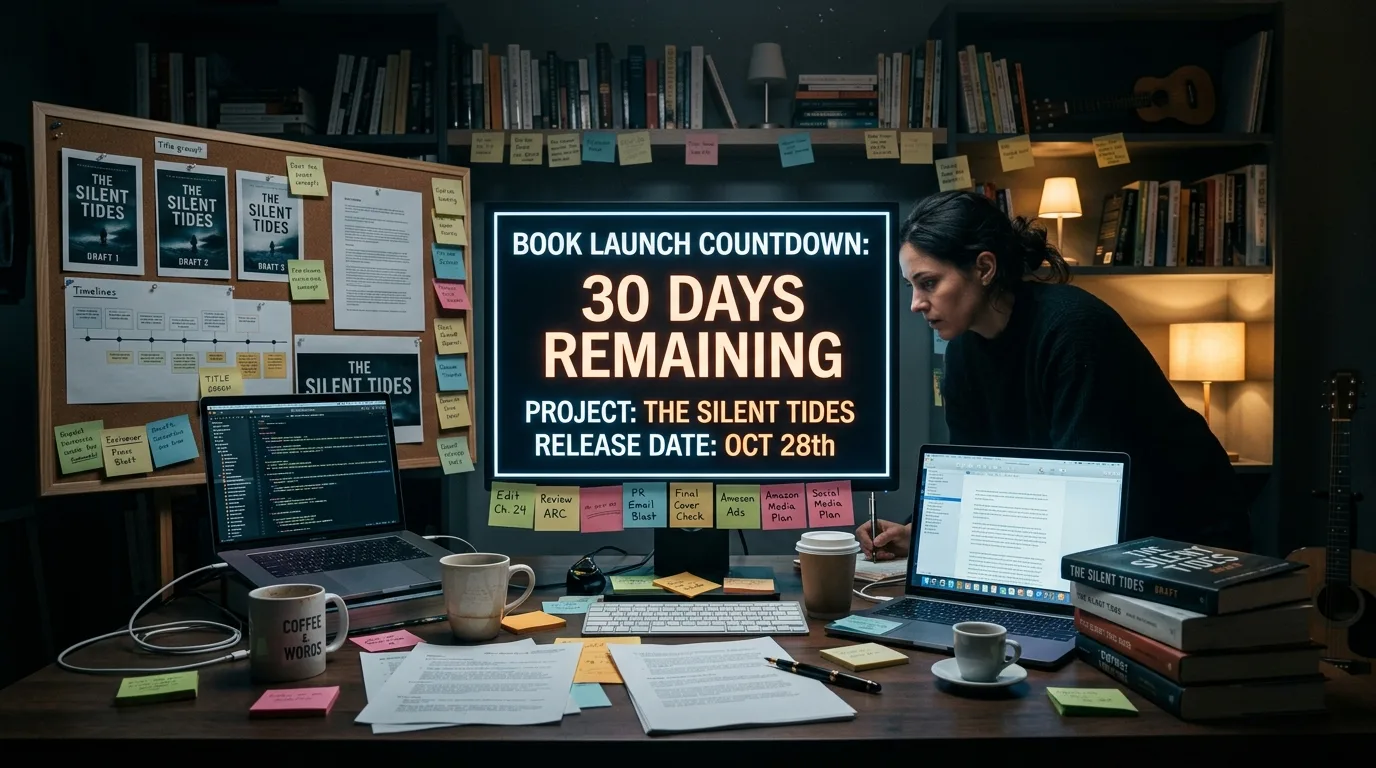
The second idea you need to internalize is one of timing: the review work starts 60-90 days before you publish, not after. The honest chain goes like this: first your beta readers (or first readers) improve the draft; then you build a list of ARC readers who'll receive the final version; and finally you orchestrate the launch so those reviews land on release day. If you haven't set a date yet, slot this into a 30-day launch plan and you'll see it all fall into place.
Why it's so hard (and the magic-number myth)
Let's start by dismantling the most widespread superstition. You'll read a thousand times that you "need 25 reviews to trigger the algorithm" or "50 to be able to run ads." It's folklore. Amazon publishes no threshold, and its advertising —Sponsored Products— is available for any KDP title on sale, including preorders, with no minimum number of reviews. Those "magic numbers" get repeated from blog to blog with no source. Forget them.
So why do reviews matter? For social proof, not the algorithm. A book with zero reviews looks untested: the undecided reader walks on by. That's the real problem, and it's a problem of human perception, not code. And here's the vicious circle: most buyers don't leave a review —industry estimates put it at just a handful per hundred readers, though it's not an official Amazon figure— so if you don't organize that first batch yourself, your novel can sit for weeks with the counter at zero. You're not chasing a magic number; you're trying to break the cold start with honest opinions.
Review, ARC, and beta reader: what each one is
Before you build the system, sort out the vocabulary, because there are three concepts people mix up that are actually distinct phases of the process:
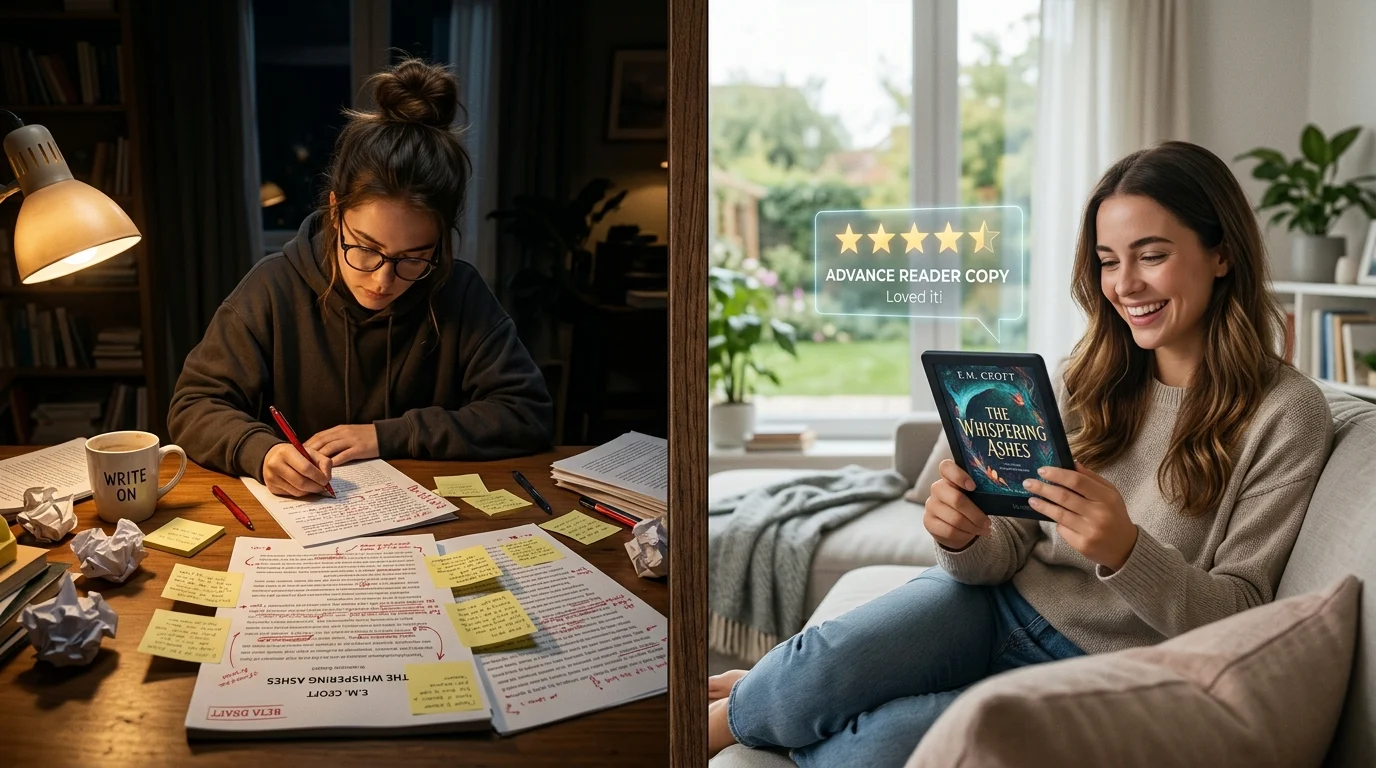
- Beta reader (or first reader). Reads a draft of your novel and gives you private feedback to improve the story before publishing: pacing, plot holes, characters. They don't leave public reviews; they help you write better.
- ARC (Advance Review Copy). A copy of the final version of the book that you send out before launch to readers willing to leave an honest public review on release day.
- Review. The public opinion on Amazon, Goodreads, or another platform. It's the outcome you're after, and it only arrives if you've taken care of the two earlier phases.
The key difference is the phase: the beta reader works on the draft; the ARC, on the finished version. Many authors recycle their best beta readers as their first ARC readers, and it's an excellent idea: they already know the story, they already care about you, and they're the ones who'll leave the most thoughtful reviews. If you want to dig deeper into the role of ARCs within the launch, I cover it in the guide on how to launch a book.
Legitimate ways to get reviews
There's no trick: there's a system. These are the methods that work and that break no rules. They all start from the same place: give access to the book and ask for the review without conditions.
- Your own ARC list. The most valuable asset, and the one you control. You build an email list of readers who want your book (from your socials, your website, your newsletter) and send them the free EPUB a few weeks before release. It's free, and it's the most honest and durable method.
- Your street team. A small group of loyal followers who not only read but spread the word about the launch. You don't pay them: you give them early access and a personal touch.
- Book bloggers and BookTok. Literary reviewers and creators who review on their blog, YouTube, or TikTok. You reach out one by one with a thoughtful pitch. If this channel interests you, there's a dedicated guide on BookTok for authors.
- ARC distribution platforms. Paid services that put your advance copy in front of registered reviewers. We'll look at them in detail in the next section.
- Amazon Vine. The only Amazon-backed program for "free product in exchange for a review." Amazon picks the reviewers and you can't ask for a positive review. Availability and the specific cost for KDP authors are best checked directly in KDP, since they change.
Notice the pattern: in every case you give the book and let go of control over the opinion. That "letting go of control" is exactly what separates a legitimate campaign from one that gets you deleted by Amazon.
Real platforms to distribute your ARC
If you want to reach reviewers you don't know, these are the go-to platforms. Treat every price as a rough guide: they change, so verify the current rate before you sign up. And remember a golden rule: you pay for distribution or access, never for guaranteed reviews. Nobody serious sells you reviews.
| Platform | What it charges (rough guide) | Worth keeping in mind |
|---|---|---|
| NetGalley | Direct listing ~$349-599 for 3-6 months; cheaper via a co-op or association (IBPA). | A big showcase for professional reviewers, booksellers, and librarians. Pricey direct; verify rates. |
| BookSirens | Charges per reader/download (a fee per reader plus a setup cost), not per review. | No guaranteed reviews; the company itself cites around 75% conversion as its own figure. |
| Booksprout | Annual plans: Growing ~$90, Pro ~$190, Bestselling ~$229. | Handles ARC delivery and reminds the reader to leave their review. Verify current plans. |
| Reedsy Discovery | ~$50 per submission. | No guarantee a review will be published or that it'll be positive; if the reviewer declines the book, there's no refund. |
| StoryGraph | Free as a review destination. | Not a paid ARC-distribution service: it's a platform where readers discover and review. Cultivate your listing. |
Which should you choose? If you have a budget and want professional reach, NetGalley (better via a co-op). If you want something cheaper and geared toward review readers, BookSirens or Booksprout. And in every case, your own ARC list remains the foundation: the platforms complement it, they don't replace it.
Amazon's rules, no tricks
This is the section almost no guide gets right, because they copy myths instead of reading the policy. Here's what Amazon allows and what it prohibits, with no half-truths.
What you CAN do
- Give away or discount copies of your book, including ARCs. It's Amazon's only exception to "free copy + review," as long as you don't require the review or try to influence its content.
- Ask for an honest, optional review. You can invite people to review; what you can't do is make the gift conditional on them doing it.
- Include a call for a review inside the book's content. At the end of the novel you can ask for an honest review. That said, never ask for "5 stars" or a positive review: only an honest opinion.
- Accept reviews without "Verified Purchase." They're valid too and get shown. The badge only certifies that a purchase happened on Amazon without a deep discount; it isn't required to review.
What you CAN'T do
- Pay for reviews. Not money, not gift cards, not discounts, not products. With books, the only thing you can give is the copy itself, free or discounted. Any other compensation invalidates the review and Amazon removes it.
- Swap reviews with other authors. The classic "I'll review yours if you review mine" is prohibited even without money: it counts as a review "in exchange for." Same goes for review circles and swap groups.
- Reviews from your inner circle. Amazon prohibits and removes reviews from people with a personal or financial relationship to you (family, partner, business associates, employees). It doesn't know your family, but it detects the relationship through shared signals —address, payment method, device, or Wi-Fi— and pulls those reviews, sometimes retroactively.
- Ask for reviews in the book description. KDP metadata can't ask for reviews. Inside the content, yes; on the sales page, no.
On Amazon Vine: it's the official program and the only Amazon-backed route for giving away product in exchange for a review. Amazon selects the reviewers, disclosure is automatic, and you can't ask for a positive rating. For books, it's worth checking availability and cost in KDP, since the terms for authors aren't always clear.
The red line is simple: you can give away your book and ask for an opinion, but never buy it, condition it, or swap it. Anything that crosses that line, Amazon deletes.
Goodreads: another ecosystem, other rules
Goodreads is owned by Amazon, but it runs on its own independent policies, looser than the store's. It's a second front you shouldn't neglect, because it plays by different timing rules:
- Free Author Program. Gives you a verified profile, bio, blog, events, and a Q&A section. It's the first thing to activate: it costs nothing.
- Reviews before launch. Unlike Amazon —which doesn't show customer reviews until the book is on sale—, Goodreads lets people rate before publication. Important nuance: since December 2025, Goodreads tightened pre-release ratings and asks you to confirm you've read the book and to state how you got your copy. It's no longer a free-for-all.
- It doesn't sync with Amazon. Goodreads reviews don't carry over to the Amazon listing: they're separate ecosystems. You have to cultivate both.
- Goodreads Giveaways. Copy giveaways have been paid since 2018 (Standard package ~$119 and Premium ~$599, aimed mainly at U.S. residents). Verify prices and availability before you dive in.
Email template to ask for a review
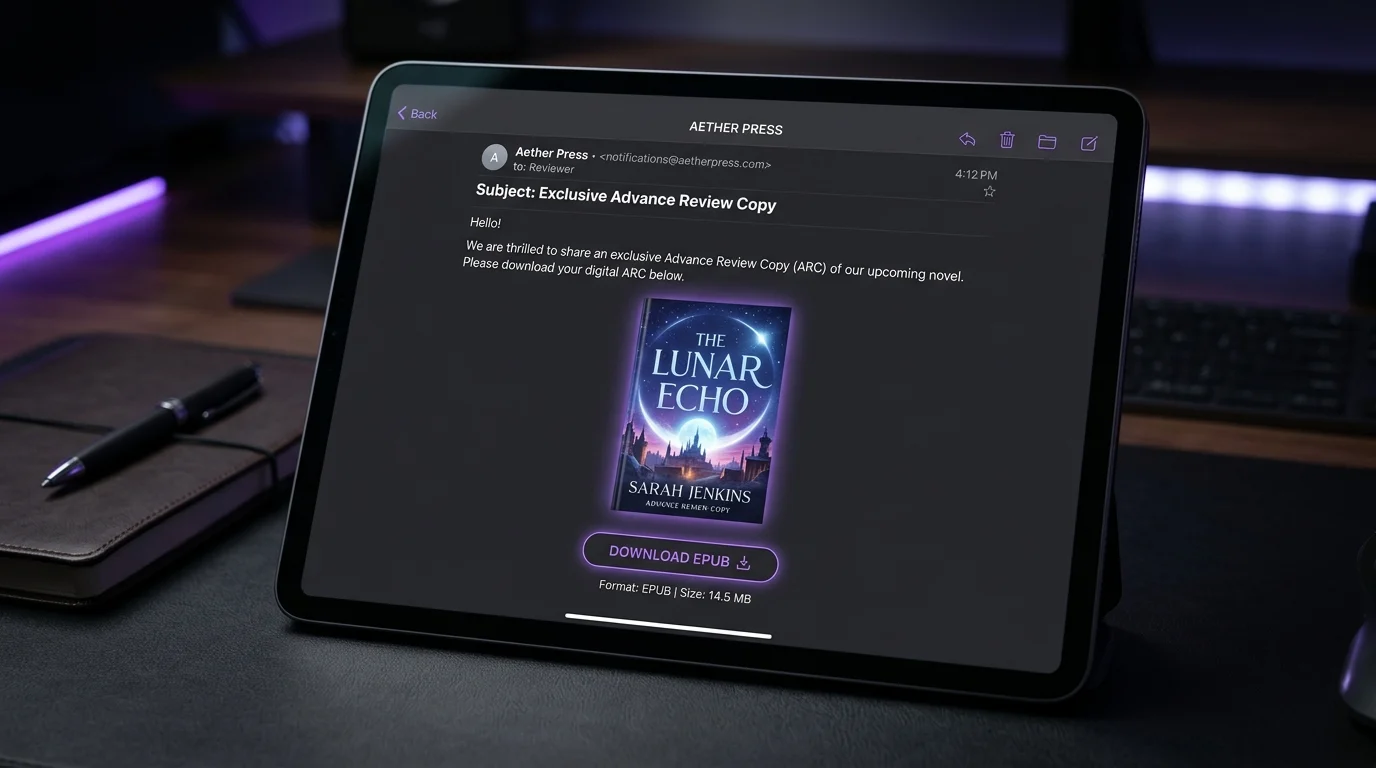
Here's an email ready to copy, adapt, and send to a potential ARC reader. It's written to comply with the rules: it offers the free copy, keeps the review optional, doesn't ask for stars, and mentions disclosure. Swap what's in brackets for your details.
Subject: Fancy reading my novel before it's out?

Hi [name],

I'm [your name], author of [novel title]. It goes on sale on
[date], and I'm putting together a small group of readers who
receive a free advance copy (an ARC) in EPUB.

There's no obligation: I'll send you the book at no cost and, if
you feel like it, you can leave an honest review on launch day.
Whatever your opinion, it's fine by me: all I ask is that it be
sincere. When you post the review, just mention that you received
a free copy.

If you're interested, reply to this email and I'll send the file.
Thanks for reading me.

All the best,
[your name]
[link to your website or socials]
One detail that makes the difference: never write "leave me a 5-star review" or "if you like it, review it." With "an honest review, whatever your opinion" you stay within the rules and, on top of that, you give your reviews more credibility. Not sure how to start yours? Ask Aura to draft the email from your book's synopsis and tune it to your voice.
How Scriptum helps you prepare your ARC
Let's be clear so we don't sell you smoke: Scriptum doesn't manage review campaigns, doesn't have a database of reviewers, and doesn't send ARCs for you. You do that with your list or with the platforms above. What Scriptum does do —and it saves you days— is get ready the material any review campaign needs:
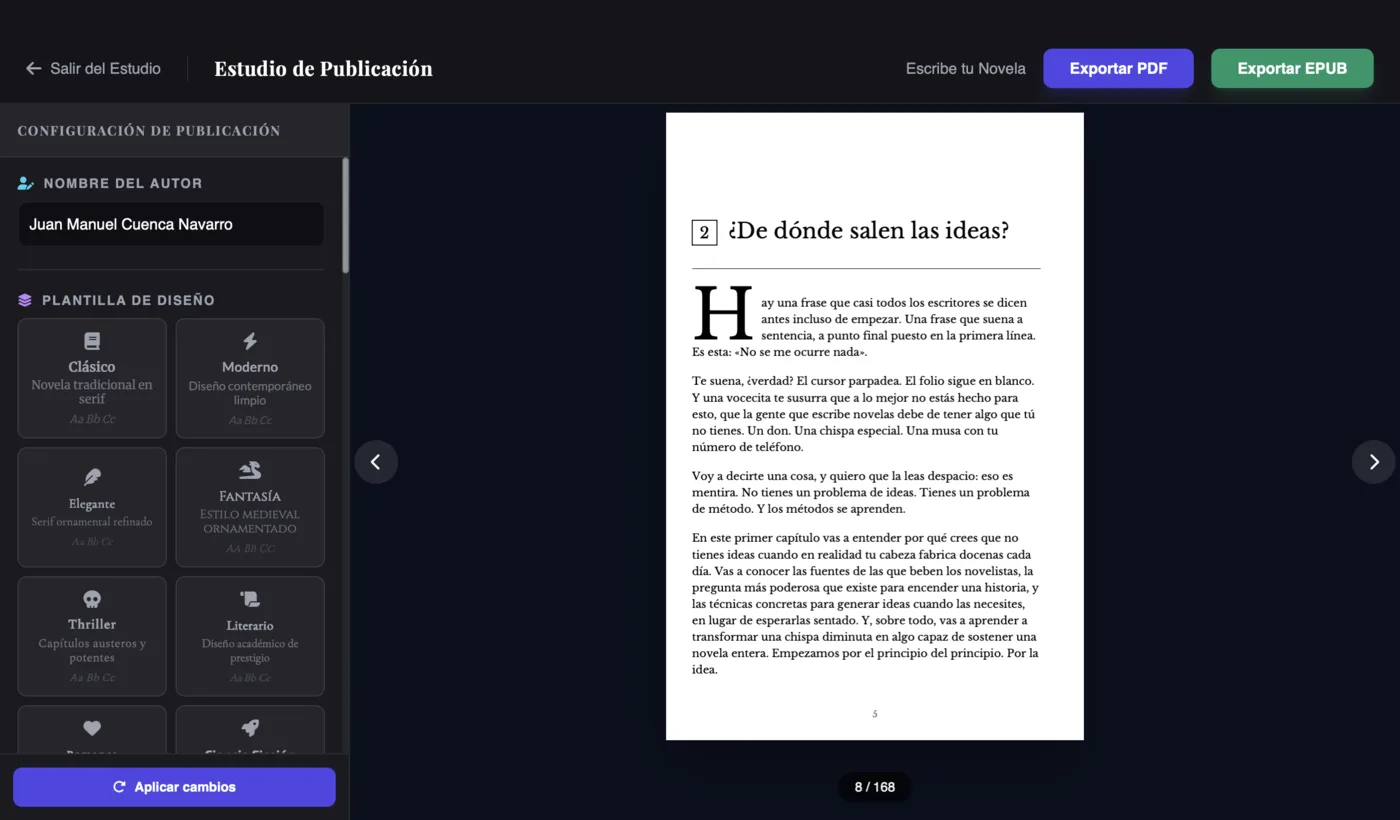
- The ARC file. From the Publishing Studio you export your novel to EPUB, PDF, and DOCX. The EPUB is exactly the format NetGalley, BookSirens, or your readers ask for to read on any device. A couple of clicks and you've got the file you'll hand out.
- The text that surrounds the ask. Aura, the AI that knows your story, can draft the outreach email to a reviewer, the letter that accompanies the ARC, or the blurb / synopsis you use to present it. You edit and add your voice.
In other words: Scriptum is the workshop where you write the novel and where the finished ARC comes out with its accompanying text. You run the campaign; we hand you the product ready to distribute. If you're comparing writing tools before you decide, it helps to see how they differ in the comparison Scriptum vs. Sudowrite and Novelcrafter.
Mistakes Amazon penalizes
Before you launch your campaign, memorize this blacklist. Each point is a real way to get Amazon to pull your reviews or suspend your account:
- Buying reviews. The costliest mistake. A single detected paid review can cost you your KDP account.
- Swapping reviews with other authors. Even without money, it's manipulation "in exchange for." Swap groups are a magnet for bans.
- Reviews from family and close friends. Amazon detects them through shared address, payment, device, or Wi-Fi, and removes them —sometimes months later.
- Making the gift conditional on the review. "I'll give you the book if you review it" invalidates the review. The gift comes first, with no strings.
- Asking for "5 stars" or a positive review. You can only ask for an honest opinion. Asking for a high rating crosses the line.
- Asking for reviews in the book description. KDP metadata can't request them; doing so can cause trouble with your listing.
- Reoffending after a warning. Amazon can act retroactively and, if you insist, suspend the account. No shortcut is worth that risk.
Frequently asked questions
How many reviews does a book need on Amazon to start selling?
There's no official figure from Amazon. The "25 or 50 reviews to trigger the algorithm" claim is folklore: Amazon publishes no threshold, and its advertising (Sponsored Products) is available to any KDP title on sale, with no minimum number of reviews. What does matter is not launching with zero: a handful of honest reviews provides the social proof that nudges an undecided reader to buy.
Can you give away a book in exchange for a review on Amazon?
You can give away or discount copies of your book, including ARCs: it's Amazon's only exception to the "free copy + review" rule. The condition is that you don't require the review or try to influence its content. The review must be voluntary and honest, and whoever leaves it must clearly disclose that they received a free copy. What you can't do is make the gift conditional on the review or pay with money, gift cards, or products.
Can my family or close friends review my book on Amazon?
Amazon prohibits and removes reviews from people who have a close personal or financial relationship with you (family, partner, business associates, employees). It's not that Amazon knows your family: it detects the relationship through shared signals —same address, payment method, device, or Wi-Fi— and pulls those reviews, sometimes retroactively. Repeat offenses can penalize your account.
Is review swapping between authors allowed?
No. Swapping reviews between authors ("I'll review yours if you review mine") is prohibited even when no money changes hands: Amazon treats it as a review given "in exchange for" something. Review circles and swap groups fall into the same manipulation category, and the reviews get removed.
What is a beta reader, and how is it different from an ARC?
A beta reader (or first reader) reads a draft of your novel and gives you private feedback to improve the text before you publish. An ARC is a copy of the final version that you send out to earn public reviews on launch day. It's a difference of phase: the beta reader helps you write better; the ARC helps you start out with reviews.
How do I get reviews on Goodreads as a self-published author?
Start with the Goodreads Author Program, which is free: it gives you a verified profile, bio, blog, and a Q&A section. Goodreads has its own review policies, looser than Amazon's store, and it lets people rate before release (since December 2025 it asks you to confirm you've read the book and to state how you got your copy). Remember that Goodreads reviews don't sync to Amazon: they're separate ecosystems, and it's worth cultivating both.
What happens if Amazon detects paid or fake reviews?
Amazon removes them, strips the "Verified Purchase" badge, and can even do so retroactively. If you reoffend, it can suspend your KDP account. It's not worth it: a single bought or manipulated review that gets caught can cost you your account and years of work.
Conclusion and key takeaways
Getting reviews isn't a matter of luck or shortcuts: it's an honest system that starts while you're still writing. You prepare the book, build your list, hand out the ARC, and ask for honest opinions without buying or conditioning them. Do it right and your novel enters the world with the social proof it needs so the next reader takes the plunge. These are the points you can't forget:
- Start 60-90 days ahead: beta readers → ARC list → launch.
- Giving away copies is legal; so is asking for an honest, optional review. Conditioning or paying for it isn't.
- Forget the "magic numbers": there's no official threshold; chase social proof, not the algorithm.
- No swaps and no reviews from your inner circle: Amazon detects them and deletes them.
- Cultivate Goodreads in parallel: it's free to start and plays by different rules.
- Arrive with the ARC ready: export your EPUB and prepare the text before you kick off the campaign.
You've got the novel and now you've got the method. The first honest reviews of your book are one ARC away.