To humanize AI text doesn't mean running a draft through a tool that fools a detector — that's just cosmetic. It means rewriting until the words carry your voice. AI prose reads like a machine because it writes toward the statistical average, avoiding what's strange, abrupt, or distinctly yours — and that's exactly where style lives. This guide covers why that happens, the twelve tells that give away AI-written text, and the method that makes AI writing sound human: like you, specifically, no matter where the draft came from.
Here's an uncomfortable test. Take a paragraph ChatGPT wrote for you, read it out loud, and ask whether you'd ever say that, in those exact words, with that exact rhythm. Almost never. It isn't badly written — the grammar holds up, the sentences flow — but it sounds like no one in particular. It has that same neutral, competent accent we've all learned to recognize by now. The issue was never using AI to write your novel; it's letting the AI talk in its default voice instead of yours. This guide is about the second part: stripping a text of the machine's voice and putting the author's back in. If you haven't found yours yet, start with our guide on how to find your writing voice and come back here.
- Why it sounds like a machine: AI predicts the most probable next word, so it drifts toward the statistical average. Ted Chiang called it “a blurry JPEG of the web” (The New Yorker, 2023).
- It homogenizes: stories written with AI assistance turned out 10.7% more similar to each other than stories written without it (Doshi and Hauser, Science Advances, 2024).
- It has measurable tells: the use of “delve” in scientific papers jumped roughly 14-fold after ChatGPT's release (Juzek and Ward, 2024). Not a vibe — a pattern.
- Detectors aren't the fix: they flag 61% of text by non-native English writers as AI-generated (Stanford, 2023), and OpenAI retired its own for being unreliable.
- The real fix isn't a synonym: humanizing for real means rewriting with an author's judgment, not dressing up text for a detector.
Why AI writing sounds like a machine
Fixing the problem starts with understanding it, and the problem is mathematical, not artistic. A language model writes by choosing, over and over, the most probable next word. That mechanic pushes it, inevitably, toward the center: the most expected sentence, the safest transition, the metaphor everyone has already reached for. Novelist Ted Chiang put it better than most in The New Yorker (2023): AI is “a blurry JPEG of the web,” a compressed copy that keeps the general shape but loses the fine detail. And the fine detail is exactly where your style lives.
This isn't just a feeling — it's measurable. An analysis from Florida State University (Juzek and Ward, 2024) documented how certain words AI loves — “delve” being the most famous example — multiplied their presence in scientific papers roughly 14-fold after ChatGPT arrived. Stanford researchers (Liang et al., 2024) found AI-flavored adjectives like “meticulous” and “commendable” spiking in academic peer reviews. The fingerprint is real, and it's traceable.
But the number that should actually worry a novelist is a different one. A study published in Science Advances (Doshi and Hauser, 2024) asked roughly three hundred writers to produce short stories with and without AI assistance. The result: AI did raise the floor for the weakest writers, but the stories written with it ended up 10.7% more similar to each other. In other words, AI raises your floor and lowers your ceiling. It homogenizes — turning many distinct voices into one average, correct, forgettable voice. Humanizing a text is, quite literally, undoing that homogenization.
AI doesn't write badly. It writes like everyone at once, which is the only way to sound like no one.
The 12 tells of AI-written text
Before you can fix your prose, you have to learn to hear the machine in it. Below are the twelve most common markers, compiled from what editors, linguists, and catalogs like Wikipedia's “Signs of AI writing” have documented. None of them proves anything by itself — it's the accumulation that gives a text away.
| The tell | How it sounds | The fix |
|---|---|---|
| 1. Inflated vocabulary | “delve,” “tapestry,” “commendable,” “in today's landscape” | The plain, exact word you'd actually say out loud |
| 2. “It's not just X, it's Y” | “It wasn't just a house, it was a sanctuary” | Say it once, and skip the automatic contrast |
| 3. The forced rule of three | Everything arrives in triads: “fast, clean, and effective” | Break the pattern — use two, or four, or one |
| 4. Em dashes, everywhere | Three dash-set asides crammed into one paragraph | A period will do; save the dash for when it earns it |
| 5. Filler adverbs | “truly,” “remarkably,” “incredibly” | Cut them — a strong verb doesn't need the crutch |
| 6. Stock metaphors | “a tapestry of emotions,” “a rollercoaster of feelings” | The specific, odd image only you would reach for |
| 7. Monotone rhythm | Sentence after sentence, all the same length | Alternate long and short. Like that. |
| 8. Glue transitions | “moreover,” “in conclusion,” “it's worth noting” | Cut the connector — it's almost always dead weight |
| 9. Dialogue that over-explains | Characters say exactly what they feel, out loud | Subtext: let them say one thing and want another |
| 10. Characters without wounds | Flat psychology, no contradiction, no shadow | Give each one a want and a crack underneath it |
| 11. All telling, no showing | The emotion gets named instead of provoked | Show it: gesture and detail, not a label |
| 12. Zero lived-in detail | Nothing really smells, tastes, or aches | Add the one concrete detail only you have lived |
Humanize for real: give it your voice, don't just dress it up
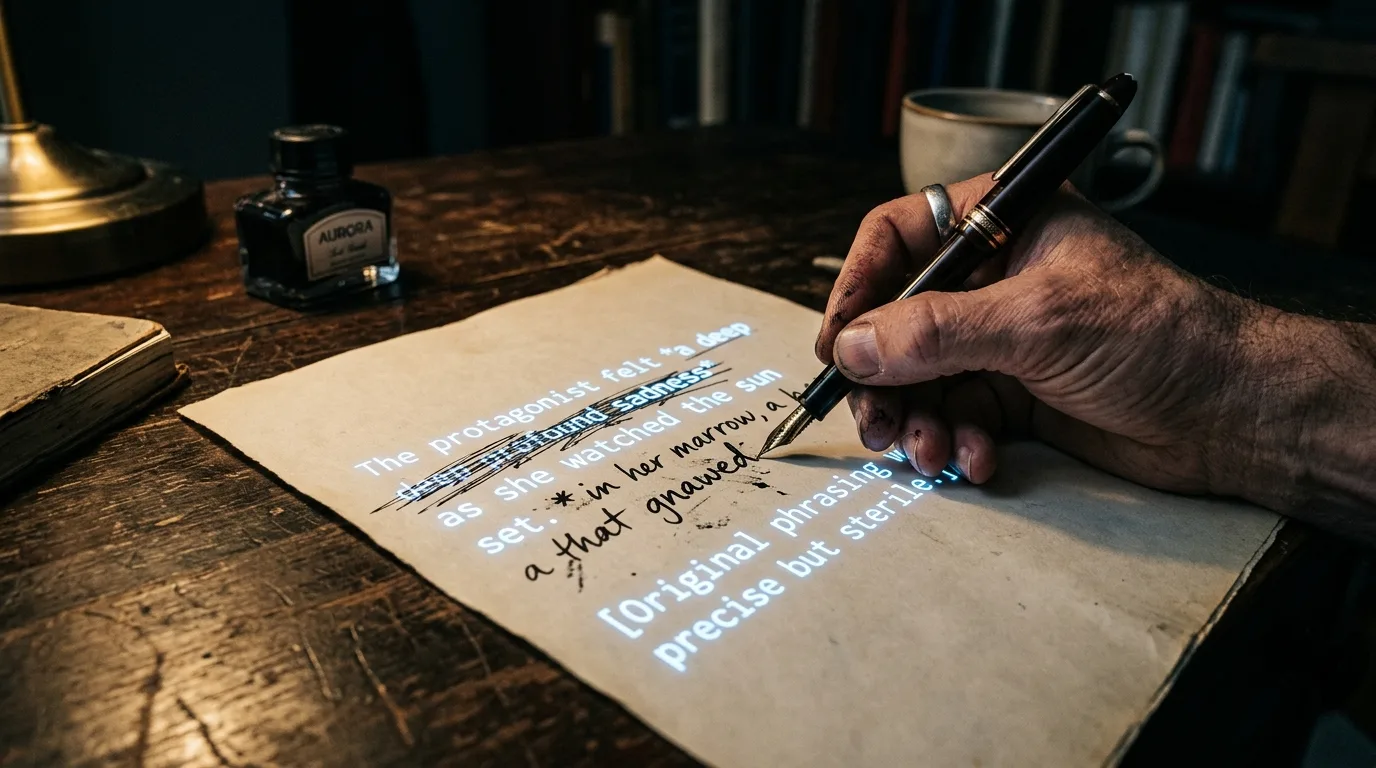
Crossing out all twelve tells leaves you with clean prose, but clean isn't the same as alive. A paragraph with no errors can still have no pulse. The second step — the one that actually humanizes a text — is imposing your voice on it. And voice doesn't get bolted on with a setting: it gets reintroduced by hand, giving the draft back the risk AI stripped out of it. Five moves that work:
- Read it out loud. It's the oldest test there is, and still the most reliable one. Your ear catches the machine before your brain does. Wherever you stumble, rewrite until it sounds like something you'd actually say. It's the advice that shows up everywhere from Ursula K. Le Guin to Stephen King, and it still holds up.
- Break the rhythm on purpose. AI breathes at the same pace the whole time. You don't. Drop a short sentence right after a long one. Cut somewhere the reader isn't expecting it. Rhythm is half of voice.
- Swap every generic image for one of your own. Where AI reaches for “a tapestry of emotions,” put in the concrete, slightly odd image that only you would think to use. A specific metaphor is your signature.
- Put the subtext back. AI tends to make characters say exactly what they feel. Real people almost never do. Let your character talk about dinner while what they actually mean is that they want to leave. That's where the scene comes alive.
- Add what only you have lived. The smell of your grandmother's kitchen, the specific mistake you made, the detail that isn't written down anywhere online. AI has read nearly everything, but it hasn't lived anything. Your biography is your edge.
Notice the pattern: humanizing a text isn't about putting distance between you and AI — it's doing the part of the work AI physically can't do. It builds the scaffolding; you supply the voice. Which is why the useful question was never “will people know I used AI?” but “does this sound like mine?” If the answer is yes, the rest stops mattering. And if you want to know exactly where AI genuinely helps and where it runs out of road, we cover that in ChatGPT for writing novels and in our guide to AI prompts for writing fiction.
The myth of the “humanizer” and AI detectors
Search “humanize AI text” and almost everything you'll find is tools promising something quite different from what we just described: rewriting a passage so an automated detector won't flag it as AI. It's worth being blunt about what these actually do. A “humanizer” swaps words for synonyms and twists the syntax until it throws off the detector. It doesn't hand you a voice — it disguises the absence of one. The text stays just as flat; the seams just show worse. For a novel, it does nothing useful at all.

And the detectors these tools are built to outsmart are far shakier than their marketing implies. A Stanford study (Liang et al., Patterns, 2023) found that detectors flagged 61% of essays written by non-native English students as AI-generated, while scoring native speakers with near-perfect accuracy — penalizing simpler vocabulary regardless of whether AI was ever involved. OpenAI itself retired its own classifier in 2023, citing its low accuracy. The takeaway for a writer is oddly freeing: writing to dodge a detector means writing for the wrong grader. Write for the reader, give the page your voice, and the detector stops being your problem.
How Scriptum protects your voice
Here's the actual difference between a generic “humanizer” and a tool built for novelists. A humanizer works blind on a stray paragraph with no idea who you are or what you're writing. Scriptum does the opposite: its assistant, Aura, works from the memory of your own manuscript — your characters, your world, your style — instead of an anonymous internet average.
In practice, that means Aura proposes without dragging you toward the average: it suggests based on what you've already written, keeps your characters consistent, and helps you unstick a scene without imposing its own neutral accent on it. It's still a co-pilot — you supply the voice, and the final rewrite is always yours — but a co-pilot that actually knows your novel doesn't pull you toward the mean; it helps you sound more like yourself. That's the exact opposite of a synonym-swapping humanizer. You can see everything it includes before you decide.
Reading list to sharpen your style
No shortcut replaces reading the people who thought seriously about voice before any of us did. Three books worth more than a thousand “humanizers”:
| Book | Author | What to learn |
|---|---|---|
| The Elements of Style (1959) | Strunk & White | Economy as style: cut everything that isn't earning its place — exactly what AI tends to add. |
| On Writing (2000) | Stephen King | Voice as honesty: write the way you'd talk, with the door shut and no fear. |
| Steering the Craft (1998) | Ursula K. Le Guin | The sound of prose: rhythm and syntax as music — the first thing AI loses. |
Common mistakes when humanizing a text
- Trusting an automatic “humanizer.” It swaps synonyms, not voice. You end up with prose that's just as flat, plus a few oddly phrased sentences.
- Writing for the detector instead of the reader. Detectors misfire constantly and punish the innocent. Optimizing for them means chasing a ghost.
- Stopping at AI's first draft. That text is raw material, not a finished product. Without your rewrite, it's the machine's voice signed with your name.
- Crossing out the tells but never adding voice. Error-free prose can still be soulless. Cleaning up is half the job; taking a risk is the other half.
- Asking AI to “write with more style.” Generic style doesn't exist. Feed it your own material — actual pages you wrote — if you want it anywhere near your voice.
- Homogenizing without noticing. Accept every suggestion as-is, and your novel starts to resemble everyone else's who's using the same AI. Push back on it often.
- Sanding down your quirks to “fix” them. That habit of starting sentences with “And,” that odd little turn of phrase — they're not everything, but they're often your voice. Don't let AI file them smooth.
Frequently asked questions
Why does AI writing sound generic?
Because a language model writes by choosing, word by word, the most statistically likely continuation. That mechanic pulls it toward the average of everything it has ever read: the most expected sentence, the safest transition, the most common metaphor. Novelist Ted Chiang put it best, calling AI “a blurry JPEG of the web” (The New Yorker, 2023) — a plausible compression that has lost the fine detail. It doesn't sound generic because it's badly written; it sounds generic because it's written toward the mean, and voice lives in exactly what departs from the mean.
What are the tells of AI-written text?
The most common ones: inflated, repeated vocabulary (the use of “delve” in scientific papers multiplied roughly 14-fold after ChatGPT's release, according to Juzek and Ward, 2024), the “it's not just X, it's Y” contrast structure, a forced rule of three, overused em dashes, filler adverbs like “truly” or “remarkably,” stock metaphors, glue transitions such as “moreover” or “in conclusion,” a monotone rhythm of similarly sized sentences, and — in fiction — dialogue that over-explains and characters without subtext or contradiction. No single tell proves anything on its own; it's the accumulation that gives it away.
How do I keep my author voice when writing fiction with AI?
Don't ask it to “write like a writer” — feed it your own material. Give it pages you've actually written so it can pick up your vocabulary, rhythm, and quirks, use it to unblock scenes or propose options, and always rewrite the output by hand: break the rhythm, swap the generic metaphor for a specific one only you would use, add a detail you actually lived through, and put back the subtext AI tends to leave out. Tools built for novels — like Scriptum with its assistant Aura — work from the memory of your own manuscript and style, not from an anonymous internet average.
Can readers tell a novel was written with AI?
It shows when the prose was never rewritten. A study in Science Advances (Doshi and Hauser, 2024) found that stories written with AI assistance ended up 10.7% more similar to each other than stories written without it: AI raises the average quality but homogenizes the result. What gives a novel away isn't that AI was used — it's that its default voice was left untouched. Once the author imposes their own rhythm, images, and point of view, it stops sounding like the machine and starts sounding like them.
Do “AI humanizer” tools actually work?
They do one very specific thing: rewrite text to dodge automated detectors, swapping words for synonyms and twisting the syntax. They don't give you voice; they disguise the absence of one. The result is usually just as flat, with worse seams. For a novel they're useless: your problem was never dodging a detector, it's making the prose sound like you, and no synonym swap does that — only rewriting with an author's judgment does.
Are AI detectors reliable?
Not very. They produce frequent false positives and penalize non-native English writers especially: a Stanford study (Liang et al., Patterns, 2023) found detectors flagged 61% of essays written by non-native English speakers as AI-generated, while scoring native speakers with near-perfect accuracy. OpenAI itself retired its own AI classifier in 2023, citing low accuracy. Writing to fool a detector means writing for the wrong grader; write for the reader instead, and the detector stops being your problem.
What is “regression to the mean” and why does it flatten AI prose?
It's a model's tendency to produce the most central, probable answer, which narrows the variety you'd naturally get from a human writer. Because AI predicts the most expected token, it avoids the strange, the abrupt, and the idiosyncratic — exactly where style lives. That's why its prose settles into a competent but anonymous middle ground: correct spelling, clean syntax, zero risk. Your job as the author is to reintroduce that risk: the unexpected word, the sentence that breaks its own pattern, the image only you would have thought of.
Where do I start to make my prose sound like me, not a machine?
Start by knowing your own voice before you touch AI: read your writing out loud and notice which words, rhythms, and images are distinctly yours. Then use AI as a co-pilot, never as the pilot — let it propose, unblock, and remember, but the final rewrite is always yours. Run every paragraph past the list of AI tells, swap the generic for the specific, and read it aloud again. If it sounds like something you'd actually say, you're on the right track.
Conclusion: voice is the last thing to get automated
AI has made writing correct sentences trivial. Which is exactly why “correct” stopped being worth much: what sets a writer apart today isn't the absence of errors, it's the presence of a voice. Humanizing AI text was never a trick for fooling a machine. It's the gesture that hands the craft back to you — taking a flat draft and filling it with yourself until it sounds like no one else.
So use AI without any embarrassment, but don't hand it the one thing it can't give you. Cross out its tells, break its rhythm, replace its metaphors, and pour your own life into the page. The machine writes toward the average. You write toward yourself. And if you want a tool that helps you write with AI without losing your voice along the way, that's exactly what Scriptum does.