A good ending isn't the one that resolves everything, but the one that feels both surprising and inevitable: it closes the protagonist's emotional arc, keeps the promise you made the reader at the start, and arrives because of what the characters have done, not through a last-minute coincidence. Choose the type of ending your story calls for — closed, open, bittersweet, twist, or circular — avoid the deus ex machina and the rushed finish, and leave the stage while the last note is still ringing. In this guide you'll find the method, the types of ending, and the mistakes that make a reader close the book let down.
A novel is remembered for two things: how it opens and how it ends. A reader will forgive a story a middle that drags a little, but they won't forgive a bad ending: that last chapter colours everything before it. They close the book feeling their time was stolen, they don't recommend it, and three hundred pages of work evaporate in the final five. The good news is that a good ending isn't a matter of luck or inspiration: it's craft, and it obeys rules you can learn. It's one of the pieces we cover in the complete guide to writing a novel; here we dig deep into the most feared one.
First, an important distinction: don't confuse finishing a novel with writing a good ending. Finishing is reaching the last page without abandoning halfway — we talk about that in how to finish your novel. A good ending is making that last page work: closing the story in a way the reader won't forget. You can finish your novel and still have a weak ending. What we cover here is how to avoid that.
What makes an ending good
An ending works when it delivers three things at once. These aren't theoretical flourishes: they're the yardstick you use to measure whether your last chapter is up to the standard of the rest.
- It's emotionally satisfying. That doesn't mean it's happy, it means it settles the emotional account you opened. The reader has invested hours waiting for something — justice, love, truth, redemption — and the ending has to answer that expectation, even if it denies it in a meaningful way.
- It's surprising yet inevitable. It's Aristotle's old formula: the best resolution surprises the reader and yet, when they look back, they understand it couldn't have gone any other way. If it's only surprising, it's a cheap trick; if it's only inevitable, it's boring. The magic is in having both at once.
- It closes the arc. The story was about something — a character who changes, a question to answer. The ending is where that change is tested and confirmed. If the protagonist ends up exactly as they began and nothing has meant anything, there's no ending: there's just a stop.
If your ending delivers all three, you're almost there. What comes next is how to build it: understanding the mechanics, choosing the right type, and dodging the traps.
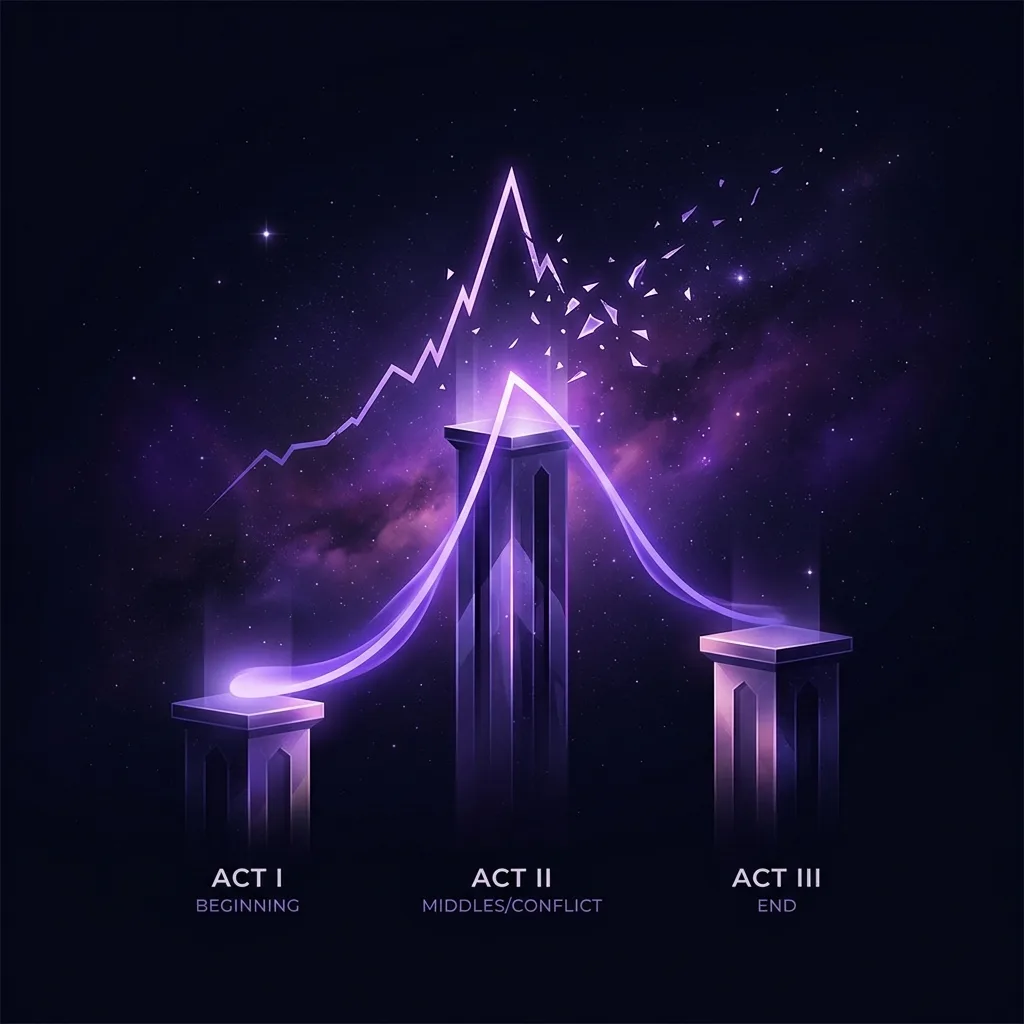
Climax and resolution aren't the same
This is where a lot of people trip up. The climax is the peak of tension, the final confrontation where the central conflict is resolved: the protagonist faces what they've spent the whole book avoiding. The resolution is what comes after: the calm after the storm, where loose ends are tied and the reader touches back down. They're two distinct moments with two distinct jobs.
Drafts fail in two opposite ways. Some skip the resolution: the climax hits and the book cuts off abruptly, leaving the reader without that moment of rest they need to absorb what just happened. Others stretch the resolution to infinity: after the big moment, twenty pages of characters saying goodbye and explaining how the rest of their lives turned out. The healthy proportion is simple: give the climax all the space it deserves — it's the scene the whole novel points toward — and give the resolution just enough to close. Leave the stage while the last note is still ringing in the air.
The types of ending (choose the one your story calls for)
There's no such thing as "the good ending" in the abstract: there's the right ending for this story and this genre. These are the types that work, and when to use each one.
- Closed or resolved. The conflict is answered, the loose ends are tied, the character reaches where the story was taking them. It's what genre fiction demands: romance calls for its happy ending, the thriller its justice, commercial fantasy its battle won. When the reader chose the book for its genre, that ending is a contract.
- Open. It closes the protagonist's emotional arc but leaves a question hanging for the reader to complete. Careful, though: an open ending isn't leaving everything dangling; it's a decision, not an oversight. If the reader finishes feeling like pages are missing, you haven't written an open ending, you've written an incomplete one.
- Bittersweet. Something is won and something is lost: the protagonist reaches their goal but pays a price, or fails at what they were after and finds something they didn't expect. It's the one that most resembles real life, and that's why it lands the deepest. It respects the reader's intelligence because it doesn't lie to them with a "happily ever after" the story hasn't earned.
- Twist. A final revelation reframes everything before it: the narrator wasn't to be trusted, the ally was the villain. It's the hardest of all, because it has to be surprising yet inevitable. If the reader rereads and can't find the clues that foretold it, you haven't written a twist: you've written a cheat.
- Circular. The story ends where it began — the same place, the same line, the same gesture — but now it means something else because the character (and the reader) have changed. Done well, it's one of the most elegant closes there is.
- Cliffhanger. It leaves the plot at its highest point to hook you into the next book. Valid in series, but with one condition: the arc of this book still has to close, even if the overall story continues. A cliffhanger isn't an excuse to give no closure at all.
How do you choose? Ask yourself what you promised the reader when they opened the book and what your protagonist has learned along the way. The right type of ending is the one that honours both.
Close the protagonist's arc
This is the heart of a good ending, and the one most often forgotten. If your protagonist has spent the whole novel learning something — to trust, to let go, to stand their ground — the ending has to put that change to the test. The decisive confrontation should be one that only the person they've become can overcome, not the one they were at the start. That's the point of the whole journey: the final challenge is the exam of the arc.
When the climax is resolved by what the character has learned, the ending feels earned. When it's resolved by coincidence, by an external rescue, or by a power that appears out of nowhere, it feels stolen — no matter how spectacular the scene. That's why the ending and the structural arc of the novel are inseparable: the resolution is the final test of the change you set up in the first act. And that's why it pays to be clear, from the moment you build your characters, about what they're going to transform into: that destination is your ending.
An ending isn't judged by how surprising it is, but by how inevitable it becomes when you look back. The surprise hooks you; the inevitability is what turns a trick into literature.
Keep the promise: plant and pay off
The number-one reason an ending fails isn't a lack of talent: it's broken promises. Every novel makes promises — sometimes explicit, almost always implicit — about what kind of story it is and how it's going to close. The ending has to pay them off. If you planted a mystery, solve it; if you hinted at a betrayal, deliver it or dispel it meaningfully; if you loaded a scene with tension, give it its release.
The classic tool for this is Chekhov's gun principle: if you hang a gun on the wall in the first act, it has to go off in the third. And in reverse, which is what matters most here: whatever resolves your ending must have been planted earlier. If something is going to save your protagonist at the climax, the reader has to have seen it pages before — without knowing it mattered. That planting is what makes the surprise feel inevitable instead of cheap. Most good endings aren't fixed by touching the ending: they're fixed by planting clues in the earlier chapters.
Mistakes that ruin an ending
Weak endings almost always fail through the same traps. If you recognise these, you'll know what to hunt for when you revise:
- The deus ex machina. The cardinal sin. It comes from Greek theatre, when a god was lowered by a crane to untangle the plot in one stroke. It's any magical, convenient solution with no setup: a character who appears out of nowhere, an impossible coincidence, a power that didn't exist. The reader feels cheated because the characters don't resolve the conflict. The cure is planting: nothing resolves the ending if it wasn't set up before.
- The rushed ending. Resolving in two paragraphs what had been simmering for three hundred pages. It usually comes from exhaustion: the writer wants to be done. But the climax is the most important scene in the book; give it its space.
- Underlining the moral. Closing with a speech where a character — or the narrator — explains what we've learned. Don't explain: evoke. The best endings close with an action, an image, or a silence, and let the reader supply the meaning.
- The endless epilogue. After the climax, twenty pages of farewells and "how it all turned out." Dragging things on past the peak dilutes its force. Learn to lower the curtain in time.
- The "it was all a dream." Or any variant that cancels out what was lived: the miraculous coincidence, the "it never really happened." It tells the reader their emotional investment counted for nothing.
- Loose ends. Different from the deliberate open ending: these are promises you simply forgot to pay off. If you opened an important subplot, close it. It's exactly the kind of slip that creeps into long novels.
How to know if your ending works
Almost no ending works on the first try, and that's fine: the ending is the scene that gets rewritten the most. When you edit you have an advantage you didn't have while writing — you already know how it ends — so you can go back and plant. When you revise yours, ask yourself these questions:
- Does it surprise and, at the same time, fit? If I reread, do I find the clues that foretold it?
- Does the protagonist resolve the climax because of what they've learned, or does a coincidence save them?
- Does it keep the promise of the genre? Does the reader get the kind of closure the book promised them?
- Have I separated the climax from the resolution? Do I give the peak its space and then close without dragging on?
- Do I close with an image or an action, rather than an explanation?
An infallible trick: read the last page aloud. The ending is pure rhythm, and the ear catches what the eye forgives. If it sounds like you're explaining instead of closing, rewrite it.
How Scriptum helps you with the ending
The judgement — what kind of ending your story calls for, what emotion you want to leave behind — is yours; that can't be automated. But there's a mechanical, exhausting part you can hand off. In Scriptum, Scriptum Memory keeps track of the elements you plant across the novel, so you can check at a glance which promises and which "Chekhov's guns" you've left unpaid before you write the resolution. And you can ask Aura AI to comb your ending for a deus ex machina, loose ends, or a rushed close, and to suggest ways to plant earlier what you resolve later, so you rewrite in your own voice. The AI doesn't decide your ending: it shows you where it holds up and where it cheats.
Frequently asked questions
How do you write a good ending for a novel?
A good ending is both surprising and inevitable: it closes the protagonist's emotional arc, keeps the promise you made the reader, and arrives because of what the characters have done, not through a coincidence. Choose the type of ending your story calls for (closed, open, bittersweet, twist, or circular), pay off the elements you planted earlier, avoid the deus ex machina and the rushed finish, and leave the stage while the last note is still ringing. The golden rule: don't spell out the moral, evoke it with an action, an image, or a silence.
What types of ending are there?
The main ones are: closed or resolved (loose ends tied up; typical of genre fiction), open (closes the emotional arc but leaves a question), bittersweet (something is won and something is lost, the closest to real life), twist (a revelation reframes everything, but it must be planted), circular (ends where it began, with a new meaning), and cliffhanger (leaves the plot hanging, typical of series). None is better: the art is choosing the one your story and your genre call for.
What is a deus ex machina and how do you avoid it?
It's a magical solution with no prior setup that appears out of nowhere to resolve the plot: a new character, an impossible coincidence, a power that didn't exist. The reader feels cheated because the conflict isn't resolved by the characters' own merit. You avoid it by planting: anything that resolves the ending must have been set up earlier (Chekhov's gun principle). If something is going to save your protagonist at the climax, the reader should have seen it — without knowing it mattered — pages before.
Is an open or a closed ending better?
It depends on the genre and the promise you made. Genre fiction (romance, thriller, commercial fantasy) usually calls for a closed ending: it's a contract with the reader. Literary fiction allows for more open endings. But an open ending isn't leaving everything up in the air, it's closing the emotional arc even if plot questions remain. If the reader finishes feeling like pages are missing, it's not an open ending: it's an incomplete one.
How do you avoid a rushed ending?
A rushed ending arrives too fast, giving the reader no time to absorb what's happening. It's usually down to the writer's fatigue. The fix is to give the climax the space it deserves — it's the scene the whole book has been heading toward — and to separate it from the resolution: first the confrontation, then a brief close. Write the ending in a separate draft, unhurried, and revise it as the most important scene in the novel, because it is.
Can you fix a bad ending in editing?
Yes, and that's the norm: almost no ending works on the first try. When you edit, you already know how the story ends, so you can go back and plant the elements that make the ending feel inevitable. Many endings aren't fixed by touching the ending, but by planting clues in the earlier chapters. Check that every promise has its payoff, that the protagonist resolves things because of what they've learned, and that no solution comes out of nowhere.
Conclusion: an ending is a promise kept
If you take just one idea from this, let it be this: a good ending doesn't arrive, it's prepared. The sense of inevitability that sets a great close apart isn't written on the last page: it's planted throughout the whole book and harvested at the end. Choose the type of ending your story calls for, close your protagonist's arc by putting it to the test, pay off everything you promised, and dodge the traps — the god on the crane, the rush, the sermon.
The next time you face the last chapter, don't ask yourself "how do I end this?", ask "what ending makes everything before it mean what it was meant to mean?" That question turns a correct resolution into an unforgettable one. Start preparing yours today in Scriptum.